Best Solutions for Securing OT and Supply Chain for Manufacturing IT Leaders
Discover 5 critical security solutions for manufacturing IT leaders: Intrusion Shield, SecurityScorecard, Red Canary, DataEndure, and enVista for OT and supply chain protection.

Manufacturing IT leaders face a unique challenge: securing environments where downtime costs tens of thousands per hour, production systems run on decades-old technology, and your security perimeter extends deep into your supplier network. You can't patch a PLC without voiding warranties, and you can't air-gap systems when suppliers need real-time access to production data.
This article focuses on what matters: the five critical security categories manufacturing IT leaders should prioritize, specific vendors worth evaluating, and how to manage these partnerships without getting locked into ecosystems that don't serve your operational realities.
Critical Security Categories to Consider for Manufacturing
1. OT/ICS Network Security
Your operational technology wasn't designed with security in mind. PLCs, SCADA systems, and industrial sensors run on protocols like Modbus and DNP3 with no native authentication. You can't install endpoint agents on these systems, and you can't afford the latency traditional security tools introduce.
What you need: Network-level threat detection that understands industrial protocols, virtual patching for unpatchable systems, and agentless monitoring that won't disrupt production.
2. Supply Chain Risk Management
Your security perimeter extends beyond your walls. Every supplier with EDI access, every logistics provider with shipment visibility—they're all part of your attack surface. When a supplier gets breached, you need to know immediately, not 60 days later.
What you need: Continuous monitoring of supplier security posture (not annual questionnaires), external security ratings, dark web monitoring for credential leaks, and automated alerts when supplier ratings drop.
3. 24/7 Threat Detection & Response
Ransomware attacks happen at 2 AM on Friday. By the time files are encrypted, you've lost. You need detection in the pre-encryption phase—when attackers are dumping credentials and moving laterally. Most manufacturing IT teams can't staff a 24/7 SOC.
What you need: Managed Detection and Response (MDR) with 24/7 monitoring, pre-ransomware detection analytics, human-led threat hunting, and response playbooks that understand manufacturing's uptime requirements.
4. Ransomware-Resilient Backup & Recovery
"We have backups" isn't a strategy when attackers dwell in networks for weeks before deploying ransomware. Manufacturing requires specific recovery sequencing—you can't just restore ERP and call it done. You need SCADA, historians, MES, and ERP restored in the correct order.
What you need: Immutable backups that ransomware cannot encrypt, air-gapped storage, OT-aware recovery orchestration, tested recovery procedures, and RTO/RPO alignment with production criticality.
5. Supply Chain Integration & Visibility
Modern manufacturing requires real-time data sharing with suppliers and logistics providers. These integrations (EDI, APIs, B2B portals) create security risks if not properly architected. As you implement automation and connect MES to ERP, you're expanding your attack surface.
Platforms such as Descartes help manufacturers coordinate logistics visibility, supplier collaboration, and secure data exchange across complex global supply chains.
What you need: Secure integration architecture, API security for B2B connections, real-time supply chain visibility without exposing sensitive data, and integration expertise that considers security implications.
Next, let’s evaluate some solutions that you should consider introducing for a more robust IT infrastructure.
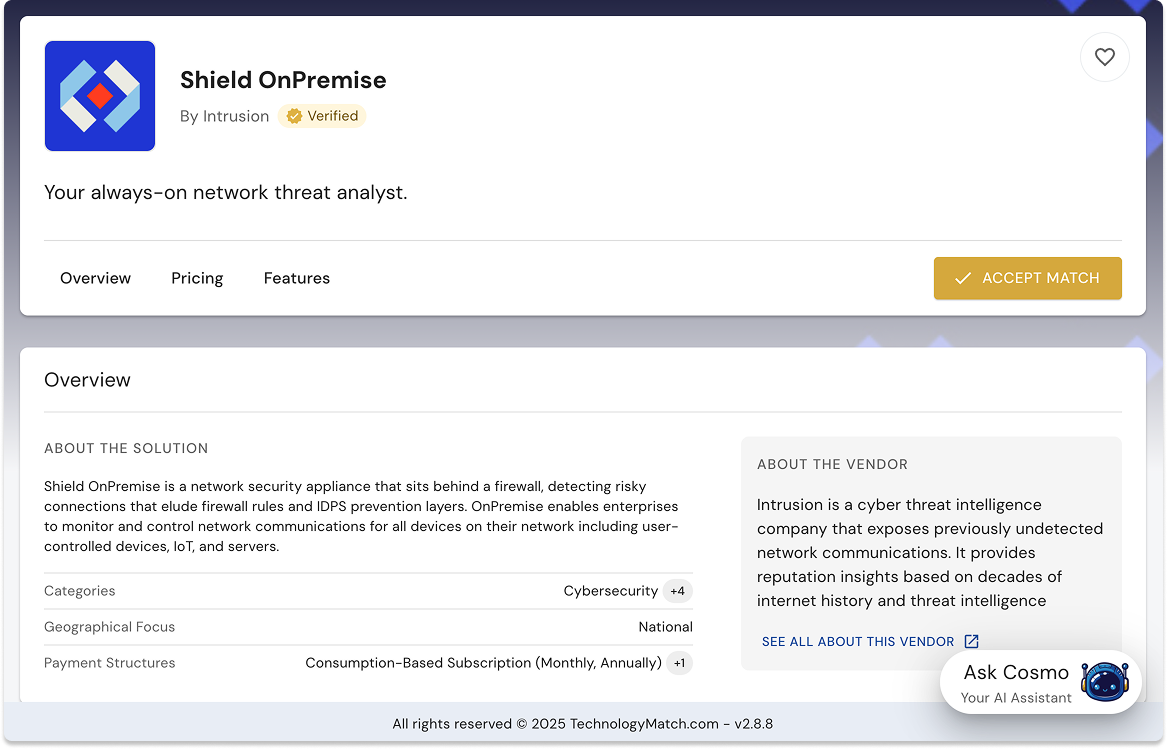
Intrusion Shield
Category: Operational Technology Threat Detection & Prevention
What makes it relevant: Network-level threat protection for environments where endpoint agents can't be installed. Uses reputation-based intelligence to block malicious traffic without requiring software on PLCs, SCADA, or legacy systems.
Key capabilities:
- Agentless deployment with no production disruption risk
- Virtual patching for unpatchable systems
- Low latency design for real-time industrial operations
- DNS filtering and protocol awareness for OT environments
Deployment: Physical/virtual appliance or cloud-native (AWS Shield Gateway). Deploys at IT/OT boundary with SIEM integration via syslog.
Pricing: Per-seat monthly with no annual contract. 30-day free trial available.
Use case: National Machinery protects IP and production systems, with actionable alerts that help their lean IT team focus on genuine threats in OT environments.
Why it matters: For systems running on Windows XP embedded or other unpatchable platforms, network-level protection is the only viable option.
Best for: Legacy OT systems, environments prohibiting endpoint agents, operations requiring zero production risk.
SecurityScorecard
Category: Third-Party Vendor Security Monitoring
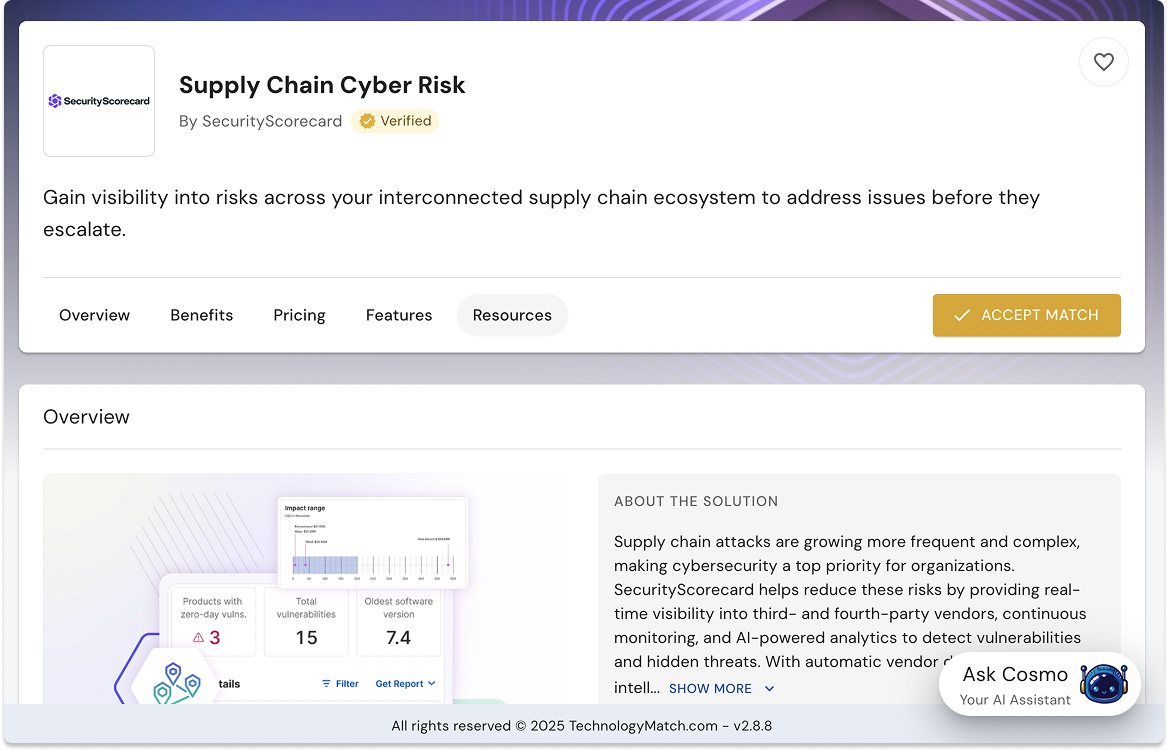
What makes it relevant: Continuous, non-intrusive security ratings for your vendor ecosystem based on externally observable factors—replacing static annual questionnaires with real-time visibility.
Key capabilities:
- Daily security ratings across 10 factors (network security, patching, DNS health, endpoint security, IP reputation, SSL certificates, etc.)
- AI-powered breach risk detection
- Dark web monitoring for supplier credential leaks
- Automated remediation workflows
Integration: REST API, SIEM export, ServiceNow connector, webhook alerts.
Pricing: Free (5 companies), Pro ($400/mo), Business ($1,000/mo), Enterprise (custom). 30-day trial monitors 50 vendors.
Case studies: Food services provider used SecurityScorecard MAX for real-time vendor monitoring. Industrial client assessed 34 critical vendors with VPN access under tight deadline using 24/7 Vendor Risk Operations Center.
Why it matters: When suppliers get breached, you need immediate visibility to rotate credentials and assess exposure—not wait weeks for notification.
Implementation approach:
- Tier 1 (Critical): Quarterly assessments, continuous monitoring, custom questionnaires
- Tier 2 (Important): Annual assessments, continuous ratings
- Tier 3 (Standard): Ratings only, automated alerts
Best for: Complex supplier networks (100+ vendors), suppliers with production system access, supply chain security attestation requirements.
Red Canary
Category: 24/7 Threat Detection and Response
What makes it relevant: 24/7 managed threat detection combining advanced analytics with human-led hunting. Provides confirmed threats with detailed remediation guidance—critical for teams without dedicated SOC resources.
Key capabilities:
- 99% threat accuracy (minimal false positives)
- Pre-encryption ransomware detection (catches credential dumping, lateral movement, backup deletion attempts)
- Production-aware response with zero-tolerance for downtime
- Multi-source telemetry (endpoints, cloud, identity, network, SaaS)
Technical approach: Standardizes telemetry from multiple EDR platforms (CrowdStrike, Microsoft Defender, SentinelOne, Carbon Black), applies behavioral analytics and threat intelligence correlation, with human analyst review before alerting.
Coverage: 308 petabytes analyzed in 2024 across 1,400+ customers. Monitors Windows/macOS/Linux, AWS/Azure/GCP, Active Directory/Azure AD/Okta.
Deployment: 2-4 weeks including tuning. 60-90 day optimization period expected.
Pricing: Starts at $100/user and $120/endpoint. Flat-rate options available.
Case study: Global manufacturer stopped active ransomware during credential dumping phase before reaching OT networks, preventing production shutdown. Detection occurred at 2 AM Saturday when internal staff unavailable.
Why it matters: Ransomware operators dwell in networks 21 days on average, mapping environments and identifying backups. Red Canary catches them during this window, before encryption and production impact.
Best for: Companies without dedicated SOC, those needing 24/7 monitoring without building teams, organizations requiring expert threat hunting.
DataEndure
Category: Ransomware-Resilient Backup and Business Continuity
What makes it relevant: Managed backup and DR with immutable storage and rapid recovery for environments where downtime costs $10,000-50,000+ per hour. Provides guaranteed recovery SLAs with OT-aware orchestration.
Key capabilities:
- Immutable backups (WORM storage ransomware cannot encrypt)
- Air-gapped architecture prevents attacker access to backups
- OT-aware recovery (understands ERP, MES, SCADA, historian dependencies)
- Customized RTO/RPO based on production criticality
- Multi-vendor support (Veeam, Commvault, Veritas, etc.)
Architecture: 3-2-1-1 strategy (3 copies, 2 media types, 1 off-site, 1 air-gapped immutable).
Recovery tiers:
- Tier 1 (Production-critical): RTO < 4 hours, near-zero RPO
- Tier 2 (Business-critical): RTO < 24 hours, RPO 1-4 hours
- Tier 3 (Important): RTO < 72 hours, RPO 24 hours
Services: 24/7 monitoring, automated failover, compliance support (FDA 21 CFR Part 11, ITAR), regular recovery testing.
Deployment: Fully managed, co-managed, or hybrid. Works with existing platforms or greenfield.
Pricing: Based on data volume, retention, and RTO/RPO targets. Includes 24/7 support with defined SLAs.
Why it matters: Even with domain admin credentials, attackers cannot reach DataEndure's immutable, air-gapped backups. Regular recovery testing ensures procedures actually work—most companies discover backup gaps only during real incidents.
Best for: Limited backup management staff, guaranteed recovery SLA requirements, ransomware-proof architecture without capital investment.
enVista

Category: Supply Chain Technology Integration and Consulting
What makes it relevant: Connects WMS, MES, and ERP platforms for operational efficiency. As manufacturing becomes more connected, these integrations create security implications IT leaders must address.
Key capabilities:
- ERP-WMS-MES integration with seamless data flow
- Warehouse automation (robotics, WCS)
- Supply chain visibility and real-time tracking
- Deep expertise in Microsoft Dynamics 365, SAP, Oracle
Integration benefits:
- Automated material flow from ERP to warehouse
- Real-time inventory accuracy across systems
- Quality traceability with lot tracking
- Production scheduling optimization
Security implications IT leaders must address:
- API connections create entry points—require strong authentication/encryption
- Real-time supplier data sharing needs access controls and governance
- Third-party portal access requires privileged access management
- Warehouse automation requires OT security considerations
Critical questions for enVista projects:
- How are API connections authenticated and encrypted?
- What network segmentation between automation and corporate IT?
- How is supplier portal access controlled and monitored?
- What data governance prevents third-party over-sharing?
- How does architecture support future zero trust requirements?
Implementation: Assessment (4-6 weeks), Design (6-8 weeks), Implementation (12-24 weeks), Go-live (4-8 weeks).
Investment range:
- Small (single-site): $200K-500K, 3-6 months
- Mid-size (multi-site): $500K-1.5M, 6-12 months
- Enterprise (full transformation): $1.5M+, 12-24 months
Why it matters: Supply chain projects are often operations-driven with IT brought in late. You must ensure security is designed in from the start—not bolted on afterward.
Your role as IT leader:
- Participate in architecture design for security controls
- Require network segmentation between automation and corporate IT
- Implement privileged access management for supplier portals
- Ensure strong API authentication and encryption
- Document third-party access for risk management
Best for: Digital transformation initiatives, warehouse automation implementation, integrating fragmented ERP/WMS/MES systems.
Vendor Management Best Practices
Avoid Vendor Lock-In
Insist on open standards:
- SIEM integration via syslog/CEF
- REST APIs for data export
- MITRE ATT&CK mapping for detection tools
- Standard authentication (SAML, OAuth, LDAP)
The "rip and replace" test: Ask vendors how you'd migrate away in 3 years. If they say "you won't want to," that's a red flag.
Build orchestration layers: Use SOAR platforms to abstract integrations. Replacing a tool means updating one integration, not rebuilding workflows.
Negotiate Manufacturing-Aware Contracts
Maintenance windows: Vendor maintenance must align with your production schedule, not arbitrary "Tuesday 2-4 AM" windows.
Emergency support: Guarantee response times for production-impacting issues with direct escalation paths.
Pilot programs: Test on non-critical lines first with defined success criteria and exit options.
Contract language example: "Vendor scheduled maintenance shall be coordinated 14 days in advance during Customer's planned downtime. Emergency maintenance affecting production requires Customer approval except during active security incidents."
Manage Vendor Access Securely
Privileged Access Management:
- Vendors connect through jump boxes with session recording
- Time-limited credentials that expire after maintenance
- MFA with no exceptions
- Application-level access, not network-level
Audit regularly: Quarterly review of all vendor access. Auto-deactivate unused credentials after 90 days.
Measure Vendor Performance
Define success metrics:
- Threat detection: MTTD, MTTR, false positive rate
- Supply chain risk: Vendor coverage, actionable insights, incidents prevented
- Backup: Success rate, recovery testing, RTO/RPO compliance
- Integration: Timeline adherence, post-implementation stability
Quarterly business reviews: Assess performance against SLAs, value delivered, roadmap alignment, issue resolution.
Build Partnerships, Not Just Contracts
Invest in relationships:
- Regular communication beyond problem-solving
- Share context about your environment
- Provide feedback for improvement
- Participate in vendor advisory boards
Knowledge sharing is bidirectional: You teach vendors about manufacturing challenges. They share intelligence from hundreds of customers.
Plan for Transitions
Build transition plans proactively:
- Can you export all data? In what format?
- Document configurations independently
- Maintain internal expertise, not just vendor expertise
- Cross-train staff to avoid knowledge silos
Contract language: "Upon termination, Vendor shall provide reasonable assistance (not to exceed 40 hours) in transitioning, including data export, configuration documentation, and knowledge transfer."
Closing Thoughts
Manufacturing IT leaders need security solutions designed for operational realities and not for traditional IT. The five solutions outlined here address specific manufacturing challenges: Intrusion Shield for OT security, SecurityScorecard for supply chain risk, Red Canary for threat detection, DataEndure for backup resilience, and enVista for supply chain integration.
Your next steps:
- Assess current gaps in the five categories
- Prioritize based on where incidents would cause the most operational damage
- Request demos focused on your manufacturing environment
- Build business cases translating security to downtime prevention
- Pilot on non-critical systems before enterprise deployment
You don't have to fix everything at once. Start with the highest-risk gap, prove value, and build from there. Security that respects operational realities is achievable, it just requires solutions designed for manufacturing, not traditional IT.
Read more: Tenable vs. Qualys vs. Rapid7: The IT Leader's Guide to Vulnerability Management
Looking for IT partners?
Find your next IT partner on a curated marketplace of vetted vendors and save weeks of research. Your info stays anonymous until you choose to talk to them so you can avoid cold outreach. Always free to you.
FAQ
What is OT security and why is it different from IT security?
OT security protects industrial equipment (PLCs, SCADA) that can't be patched or rebooted without stopping production. Unlike IT security that uses endpoint agents, OT security requires agentless network monitoring that understands industrial protocols like Modbus and DNP3 without introducing latency or requiring system modifications.
How much does MDR cost for manufacturing?
MDR services typically cost $100-$120 per endpoint or user. A mid-sized manufacturer with 500 endpoints pays $50,000-$60,000 annually—far less than the $500,000+ needed to build an in-house SOC with staff and infrastructure.
What are immutable backups?
Immutable backups use WORM technology that prevents modification or deletion—even by ransomware or administrators. Critical for manufacturing because attackers spend weeks in networks corrupting traditional backups before deploying ransomware. Ensures recovery capability even if attackers gain admin access.
How do you monitor supplier security risk?
Use continuous security rating platforms like SecurityScorecard that scan suppliers externally, analyzing network security, patching, and credential leaks without requiring questionnaires. Provides real-time alerts when vendor ratings drop, enabling immediate response before breaches impact your operations.
What security matters for ERP-WMS-MES integration?
Key requirements: encrypted APIs with strong authentication, network segmentation between automation and corporate IT, privileged access management for supplier portals, and role-based access controls. Ensure security is designed into integration architecture from the start, not added afterward.