



ITSM Tools Comparison: ServiceNow vs. Jira Service Management vs. Freshservice
ServiceNow, Jira Service Management, and Freshservice compared on pricing, implementation complexity, AI capabilities, and real TCO — with an interactive recommender and calculator.

Every IT leader I’ve spoken to in the last two years has either just signed a new ITSM contract, is regretting the one they signed three years ago, or is quietly shopping for alternatives.
The frustration is consistent: the platform that looked right during the demo costs twice as much in practice, takes six months to configure, and still requires a full-time admin just to keep it running.
This comparison covers the three platforms that come up most often in those conversations: ServiceNow, Jira Service Management (JSM), and Freshservice. I’m not here to sell any of them.
I’m going to give you the pricing reality, the implementation truth, the AI hype vs. fact, and what real users actually say after 12 months of use.
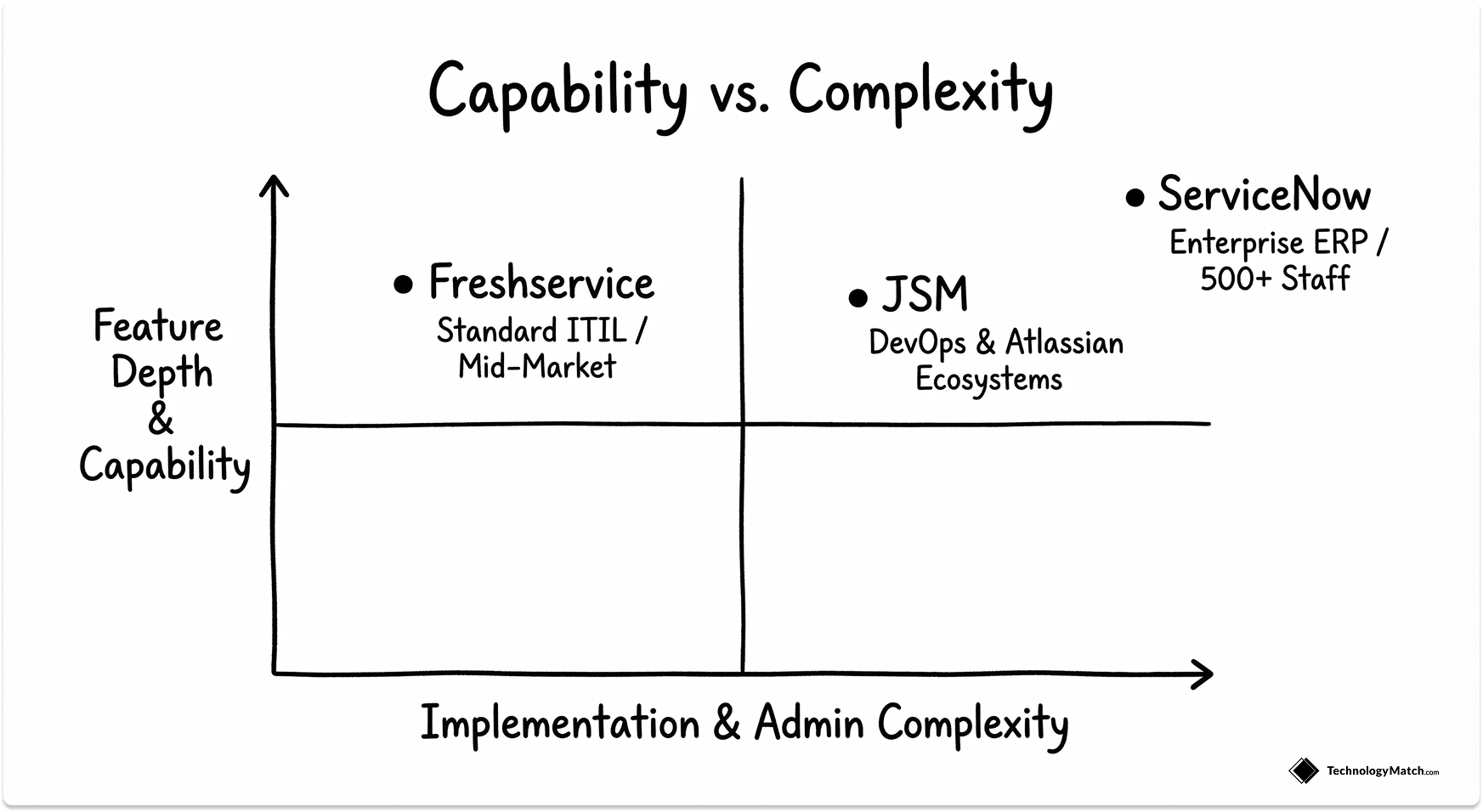
Each platform represents a distinct philosophy. ServiceNow is maximum capability with maximum complexity. JSM is developer-native, Atlassian-integrated, and built for teams that operate like engineering orgs.
Freshservice is speed-to-value, clean UX, and mid-market fit. The right choice depends on your team size, IT maturity, and how much complexity you can actually absorb.
Before diving in, it is worth noting that ITSM platform selection is ultimately a vendor management decision as much as a technology one. How you evaluate, negotiate, and manage the relationship post-signature matters as much as the feature set.
If you have not already established a framework for that, this practical guide to IT vendor management is worth reading alongside this comparison.
Scope: What This ITSM Comparison Covers
This covers pricing and total cost of ownership, implementation complexity, core ITSM capabilities, AI and automation depth, integration ecosystems, and real user sentiment. It does not cover niche use cases like HR service delivery or customer-facing portals because those require their own evaluation.
Pricing and Total Cost of Ownership
Pricing pages lie by omission. Here is what you actually spend.
ServiceNow Pricing: What the Sales Team Won’t Tell You
ServiceNow does not publish pricing. Every contract is negotiated, which means your number depends heavily on your org size, the modules you select, and how much leverage you have at renewal.
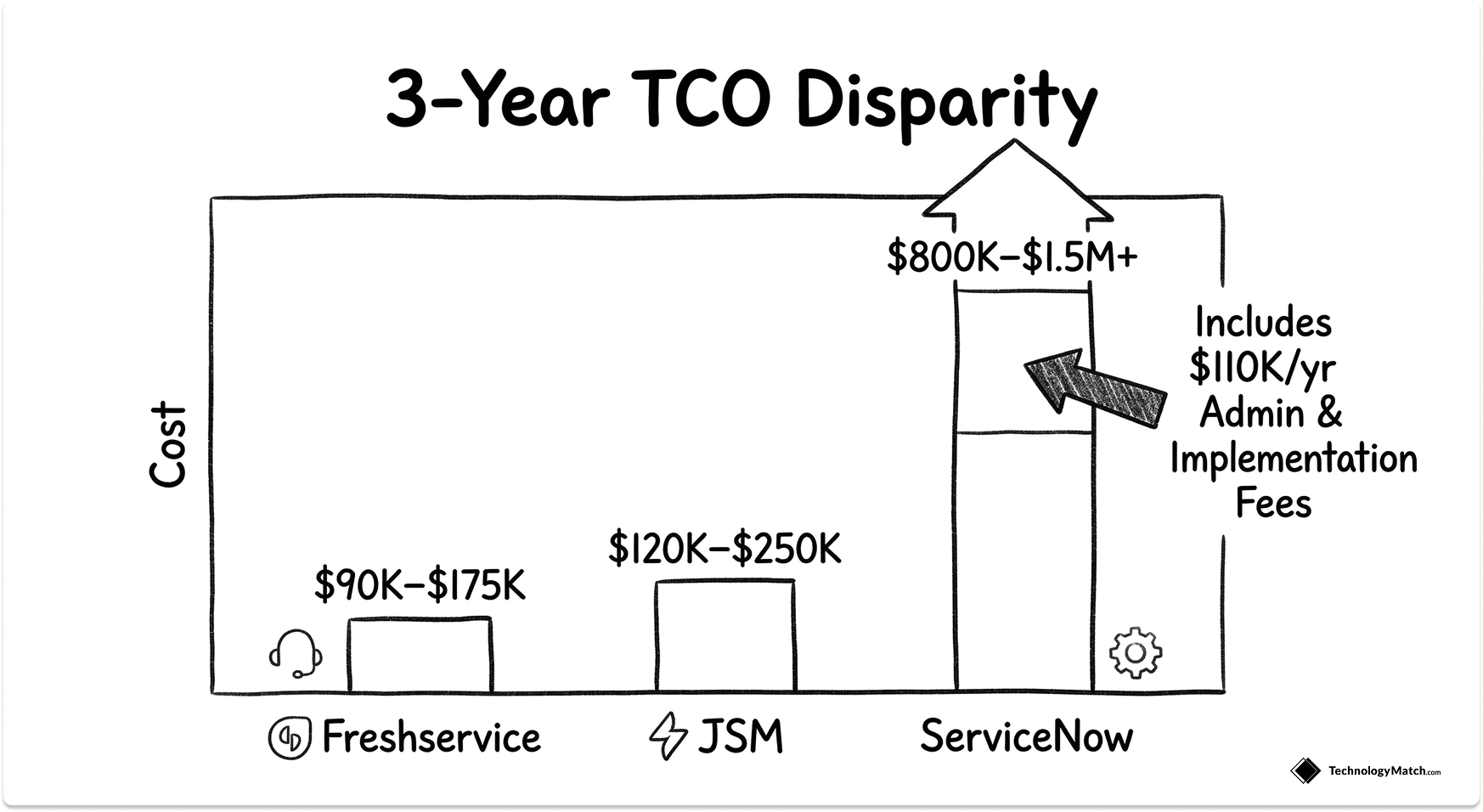
From what I’ve seen across enterprise conversations, annual licensing starts around $100,000 for mid-sized teams and scales past $500,000 for large enterprises with multiple modules active. That is before you factor in:
- Implementation partner fees: Most ServiceNow deployments require a certified partner. Expect $50,000 to $200,000+ for a standard ITSM implementation.
- Dedicated ServiceNow admin: The platform does not run itself. A certified ServiceNow administrator earns an average of $110,000/year in the US. Many mid-market orgs end up paying for two.
- Module-based upsells: IT Operations Management, IT Business Management, and Now Assist (AI) are all separately licensed.
- Fulfiller vs. requester licensing: Fulfiller seats are priced at a premium. As your IT team grows, this model creates unpredictable cost spikes.
The r/servicenow subreddit is one of the most useful unfiltered sources on this. Licensing frustration is among the top recurring themes, particularly around renewal negotiations and the cost of adding fulfiller seats mid-contract.
3-year TCO for a 50-agent team (estimated): $800,000 to $1,500,000+, including implementation, admin headcount, and licensing growth.
Jira Service Management Pricing: Transparent by Design
Jira Service Management publishes its pricing, and that transparency alone is a differentiator.
- Free: Up to 3 agents
- Standard: $17.65/agent/month
- Premium: $44.27/agent/month (includes Rovo AI, advanced automation, and multi-team planning)
- Enterprise: Custom pricing for 201+ agents
The hidden cost to flag: if your organisation is not already running Jira Software or Confluence, you will likely need both to get full value from JSM. For orgs already paying for the Atlassian suite, JSM’s incremental cost is low. No dedicated JSM admin is typically required at mid-market scale.
3-year TCO for a 50-agent team (estimated): $120,000 to $250,000, depending on Atlassian ecosystem adoption.
Freshservice Pricing: Clean Tiers, Watch the Add-Ons
Freshservice uses a straightforward per-agent subscription model:
- Starter: $19/agent/month
- Growth: $49/agent/month
- Pro: $99/agent/month
- Enterprise: $129/agent/month
Freddy AI features are increasingly bundled into higher tiers, but advanced capabilities carry additional costs depending on your contract. One issue that surfaces consistently across G2 reviews for Freshservice: auto-renewal clauses with tight exit windows. Read the contract before you sign, and flag the renewal date to your procurement team the day you go live.
3-year TCO for a 50-agent team (estimated): $90,000 to $175,000, depending on tier and AI add-ons.
The hidden costs of staying locked into any of these platforms after a poor fit is discovered are well-documented. For a deeper look at what that costs operationally, read The Hidden Costs of Staying With the Wrong Vendor.
Pricing and Deployment: At a Glance
TCO at a Glance: 50-Agent Team
Use the calculator below to model your own numbers based on team size, implementation complexity, and projection period.
Implementation Complexity and Time to Value

ServiceNow: Budget 6 Months, Not 6 Weeks
ServiceNow is designed to be configured, not deployed out of the box. A standard ITSM implementation runs 8 to 12 weeks for basic modules. Complex, multi-department deployments routinely run 6 to 12 months. According to Gartner Peer Insights, implementation complexity is the single most cited complaint category for ServiceNow customers.
The most common failure mode: over-customisation in year one. Teams build complex workflows and custom tables early. By year three, those customisations block upgrades and require specialist contractors to untangle.
If you are in the process of evaluating ServiceNow or building a business case, the vendor evaluation framework for IT leaders is worth working through before you commit.
Jira Service Management: Fast If You’re Already in Atlassian
JSM deployments run 4 to 8 weeks for standard ITSM configuration. If your teams already use Jira Software or Confluence, that timeline compresses further. The risk is cultural: JSM’s interface is built for teams that think in queues, sprints, and code reviews. IT generalists who are not development-adjacent often find the UX harder to adopt than expected.
Freshservice: The Fastest Path from Zero to Running
For standard ITSM workflows, Freshservice can be live in days to two weeks. No implementation partner is required for most mid-market deployments. The trade-off is ceiling, not speed. The simplicity that makes Freshservice fast to deploy becomes a constraint as workflow complexity grows. Enterprises that push it beyond standard ITIL processes frequently hit limits in the automation engine and custom reporting.
Core ITSM Capabilities: Head-to-Head
Three things the table does not show. First, ServiceNow’s CMDB is the most powerful in the market, but it demands dedicated ownership. A CMDB that nobody actively maintains becomes a source of false data that breaks downstream automation. For IT teams already managing asset management complexity, the Top 5 IT Asset Management Solutions guide covers complementary tooling worth considering alongside your ITSM platform.
Second, JSM’s change management has improved considerably since 2023 but still trails on complex CAB workflows and multi-stage approval chains. If change management is a compliance requirement, test it hard before committing.
Third, Freshservice’s asset management works well for organisations managing under 500 endpoints. Above that threshold, gaps in discovery, reconciliation, and dependency mapping start to surface.
AI and Automation: What’s Real vs. What’s on the Roadmap
Every ITSM vendor is marketing AI heavily right now. Here is what is actually in production.
ServiceNow Now Assist
Now Assist covers generative AI for case summarisation, resolution note drafting, virtual agent responses, and ticket routing. It is the most mature AI layer of the three, partly because ServiceNow has the largest pool of enterprise training data. The catch: Now Assist is not included in base licensing. It is a separate SKU. The AI quality also depends on the cleanliness of your CMDB and historical ticket data. If your data is messy, Now Assist’s outputs reflect that.
Jira Service Management + Atlassian Rovo
Rovo covers search, ticket summarisation, knowledge base suggestions, and agent assist. Its strongest use case is in teams that use Confluence as their knowledge base — Rovo’s ability to surface relevant articles during an active ticket is genuinely useful. Complex incident correlation remains weaker than ServiceNow. It is well-suited to knowledge retrieval and summarisation, not autonomous triage.
Freshservice Freddy AI
Freddy AI handles ticket auto-categorisation, suggested responses, sentiment analysis, and a basic virtual agent. For mid-market teams with well-defined workflows, Freddy works and is the most accessible AI entry point on a cost-per-feature basis. The limitation is data model depth: Freddy’s intelligence is bounded by Freshservice’s narrower data architecture. In complex environments with irregular ticket patterns, it struggles.
For a broader perspective on how IT leaders are applying AI across operations, this guide on AI use cases for IT leaders is worth reading.
Integration Ecosystems and Tech Stack Fit
ServiceNow offers 1,000+ integrations through IntegrationHub, with deep connectors for SAP, Salesforce, Oracle, and major cloud providers. IntegrationHub spokes are licensed separately. It is the strongest integration option for orgs running complex ERP environments.
Jira Service Management connects natively with the full Atlassian suite and has 3,000+ apps in the Marketplace. Its real strength is in the DevOps toolchain: GitHub, GitLab, PagerDuty, Datadog, and Opsgenie all connect cleanly. If your organisation is also evaluating CI/CD tooling, this comparison of Jenkins vs. GitLab CI vs. CircleCI vs. GitHub Actions maps the same vendor landscape on the development side.
Freshservice covers 500+ integrations with strong out-of-box connectors for Slack, Microsoft Teams, Zoom, and Google Workspace. Depth for complex enterprise integrations is more limited than the other two.
The decision trigger: if your IT org runs an Atlassian toolchain, JSM’s integration advantage is difficult to argue against. If your environment is SAP-heavy or ERP-centric, ServiceNow is the more defensible choice.
What Real Users Actually Say
These are patterns from G2, Gartner Peer Insights, and Reddit — not vendor-sourced testimonials.
ServiceNow users praise: configurability for complex workflows, reporting depth at enterprise scale, and reliable uptime. They complain about: licensing opacity, a UI that feels dated compared to modern alternatives, the cost of keeping a dedicated admin, and upgrade cycles blocked by prior customisations.
JSM users praise: seamless developer experience, transparent pricing, a fast modern UI, and a no-code automation builder that IT managers can actually use. They complain about: the interface being less intuitive for non-technical IT staff, change management still catching up to enterprise requirements, and the product feeling like a service desk layer on Jira rather than a purpose-built ITSM tool.
Freshservice users praise: fastest time to a working ITSM setup, a clean low-training-overhead interface, and strong customer support at Growth tier and above. They complain about: auto-renewal contract terms, the workflow automation ceiling at enterprise scale, and reporting that is weaker than competitors at higher tiers.
If you are wondering how review platforms like G2 compare as a source of vendor intelligence, this breakdown of G2 vs. Capterra vs. Trustpilot vs. TechnologyMatch covers the strengths and blind spots of each.
Which ITSM Platform Is Right for Your Team?
Choose ServiceNow if:
- Your IT org has 500+ staff and complex, multi-department service workflows
- You run SAP, Salesforce, or enterprise ERP environments that need deep integration
- You have budget for a dedicated admin and a certified implementation partner
- CMDB accuracy and asset governance are a compliance or audit requirement
Choose Jira Service Management if:
- Your IT team works closely with engineering or already operates like a DevOps team
- You are already paying for Jira Software or Confluence
- You want transparent pricing and a deployment timeline measured in weeks, not months
- Change management tied to code deployments and CI/CD pipelines is a priority
Choose Freshservice if:
- You are an IT team of 10 to 150 people who need ITSM operational fast
- Your processes follow standard ITIL workflows without heavy customisation requirements
- You want AI-assisted ticketing without enterprise-tier AI licensing costs
- TCO matters more than feature depth on day one
If you are still working through the evaluation criteria before narrowing down, the essential IT vendor selection criteria checklist gives you a structured framework to pressure-test any shortlist.
The Switching Cost Nobody Accounts For
If you are already on one of these platforms and evaluating a move, the switching cost is real and consistently underestimated.
CMDB migration is the hardest part of any ITSM transition. Historical ticket data, asset records, custom fields, and automation rules rarely transfer cleanly between platforms. ServiceNow exits are the most painful — the platform’s proprietary data structures and deep customisation mean migration projects commonly run 6 to 12 months and require specialist contractors.
JSM and Freshservice have better data export tooling, but the real cost is retraining staff, rebuilding integrations, and the productivity dip during transition. That dip typically runs 6 to 10 weeks for a team of 50 agents.
Budget 20 to 30% of your first-year platform cost for migration and transition. That number rarely makes it into the business case, and it is almost always the first surprise after signing. For a detailed look at the operational and financial cost of a vendor switch, How to Switch IT Vendors or Partners Without Downtime or Loss of Control covers the process step by step.
Before you trigger a full migration, run a 90-day structured pilot of your target platform. Stand it up in parallel. Process a real subset of tickets through it. The gaps you find in 90 days are the same ones that will cost you after you have cancelled the old contract.

The Bottom Line on This ITSM Tools Comparison
ServiceNow is the most powerful ITSM platform available. It is also the most expensive, the most complex, and the most demanding to operate. For large enterprises with the budget and the internal capability to match, it earns its place. For everyone else, you are likely paying for power you will never use.
Jira Service Management is the strongest mid-market option for technology-forward IT teams in the Atlassian ecosystem. Its pricing is honest, its deployment is fast, and its DevOps integration is a genuine differentiator.
Freshservice wins on speed-to-value and simplicity. For IT teams under 150 people with standard ITIL workflows, it is difficult to beat on a cost-per-outcome basis.
The worst decision is not choosing the wrong platform. The worst decision is staying on the wrong platform too long because switching feels expensive. Run the numbers, pilot the alternative, and make the call before the next renewal cycle locks you in for another three years.
Looking for IT partners?
Find your next IT partner on a curated marketplace of vetted vendors and save weeks of research. Your info stays anonymous until you choose to talk to them so you can avoid cold outreach. Always free to you.
FAQ
Is ServiceNow worth the cost for mid-sized IT teams?
For most mid-sized IT teams — under 500 agents — ServiceNow is difficult to justify on a cost basis alone. The platform delivers genuine value at enterprise scale with complex, multi-department workflows, deep ERP integrations, and compliance-driven CMDB requirements. Below that threshold, you are likely paying for capability you will never use while carrying the overhead of a dedicated admin and a certified implementation partner. Jira Service Management or Freshservice will cover the majority of mid-market ITSM needs at a fraction of the total cost.
What is the real difference between Jira Service Management and ServiceNow?
The core difference is philosophy. ServiceNow is built as a configurable enterprise platform — it ships as a framework and you build your workflows on top of it. Jira Service Management is a product that ships ready to use, with templates for incident, change, and problem management. ServiceNow offers more depth and configurability at scale; JSM offers faster deployment, transparent pricing, and a modern developer experience. If your IT team is DevOps-adjacent and already uses Atlassian tools, JSM is the stronger choice. If your org runs SAP, Salesforce, or complex ERP environments, ServiceNow’s integration depth is harder to match.
Can Freshservice scale to enterprise requirements?
Freshservice scales well for IT teams up to roughly 150 agents with standard ITIL workflows. Above that, limitations in the workflow automation engine, CMDB depth, and custom reporting become noticeable. Enterprises that push Freshservice beyond standard processes frequently hit these ceilings and end up evaluating a migration. If you expect significant growth or require heavy customisation from the start, factor that ceiling into your platform decision before you commit.
How long does a ServiceNow implementation take?
A standard ServiceNow ITSM implementation covering incident, change, and problem management takes 8 to 12 weeks with a certified implementation partner. Complex deployments — multiple departments, deep ERP integrations, custom workflows — routinely run 6 to 12 months. Over-customisation in year one is the most common failure mode: teams build elaborate workflows early that block upgrades and require specialist contractors to untangle by year three. Budget conservatively and resist the temptation to configure everything on day one.
What does ITSM migration actually cost when switching platforms?
Migration costs are consistently the most underestimated line item in any ITSM platform switch. CMDB migration is the hardest part — historical ticket data, asset records, custom fields, and automation rules rarely transfer cleanly between platforms. ServiceNow exits are the most painful given its proprietary data structures. As a planning baseline, budget 20 to 30% of your first-year platform cost for migration, retraining, and the productivity dip during transition. For a 50-agent team, that dip typically runs 6 to 10 weeks. Run a 90-day parallel pilot on the target platform before you cancel your existing contract.
Which ITSM platform has the best AI capabilities in 2025?
ServiceNow’s Now Assist is the most mature AI layer of the three — covering case summarisation, resolution note drafting, virtual agent responses, and ticket routing — but it is a separate, additional-cost SKU. Atlassian Rovo in JSM is strongest for teams that use Confluence as their knowledge base, where it surfaces relevant articles during active tickets. Freshservice’s Freddy AI is the most accessible entry point on a cost-per-feature basis and is included in higher tiers. The honest assessment: AI quality depends heavily on the cleanliness of your underlying data. A well-maintained CMDB and clean ticket history will get more out of any AI layer than a messy environment with the most expensive AI SKU.
Does Jira Service Management require Jira Software?
JSM works as a standalone product, but you will not get full value from it without the broader Atlassian ecosystem. Confluence is particularly important — Rovo AI’s knowledge base suggestions, which are one of JSM’s most useful features, depend on it. If your organisation is not already using Jira Software or Confluence, factor in the ecosystem adoption cost as part of your TCO calculation. For teams already embedded in Atlassian, JSM’s incremental cost is low and the integration benefits are immediate.


