ServiceNow vs. BMC Helix vs. Jira Service Management: The Enterprise ITSM Decision Guide
ServiceNow vs. BMC Helix vs. Jira Service Management: Which ITSM tool to pick in 2026? A strategic guide for IT leaders on pricing, AI, and migrating from tools like Cherwell.

In 2026, the market for IT Service Management (ITSM) has changed. It is no longer just a feature battle. It is a choice between three distinct paths for your IT organization.
You have ServiceNow, the standard platform that aims to run your entire company. You have BMC Helix, the specialist for complex infrastructure and operations. And you have Jira Service Management (JSM), the fast option that connects IT support directly with software developers.
This decision is about more than just buying a ticketing system. It is about choosing an operating system for your teams.
There is also immediate pressure for some buyers. Cherwell Service Management support ends on December 31, 2026. If you use Cherwell, you must move. This is a chance to reset your strategy rather than just replacing one tool with another.
This guide analyzes these three leaders to help you decide which path fits your needs. We also have another guide comparing ServiceNow, Jira Service Management, and FreshService.
You need to understand the primary goal of each platform before comparing features.
- ServiceNow is the Consolidator. Its goal is to replace fragmented tools across IT, HR, and Customer Service with one single system. It is powerful but expensive.
- BMC Helix is the Operator. Its goal is to prevent outages. It focuses on connecting your help desk to your servers and mainframes to maintain stability.
- Jira Service Management is the Accelerator. Its goal is speed. It helps teams deploy and fix services quickly without heavy bureaucratic processes.
ServiceNow
Best For: Large global enterprises that want to run IT, HR, and Customer Service on one platform.
ServiceNow is the market standard for large companies. It has won the battle for the enterprise IT service desk.

AI Agents
ServiceNow now uses AI Agents that do more than chat. They can perform tasks autonomously. For example, an AI Agent can check a server status, restart a service, and email the user to confirm the fix without a human involved. This reduces ticket volume but requires accurate data to work safely.
Strengths
- Unified Data: IT, HR, and Facilities requests live in one database. This makes reporting across departments very easy.
- Strategic CMDB: It has the best system for mapping your business services to your infrastructure. You can see exactly which server powers which business application.
- Ecosystem: The developer community is massive. If you need a specific integration, it likely already exists.
Weaknesses
- High Cost: It is the most expensive option. You pay for the software and for the expensive developers needed to maintain it.
- Implementation Time: Deployments often take six to eighteen months. It is a major commitment.
BMC Helix (formerly Remedy)
Best For: Organizations with complex infrastructure like mainframes or multi-cloud environments.
BMC Helix is a modern, containerized platform. It runs on Kubernetes and is the preferred choice for organizations that need deep control over their operations.
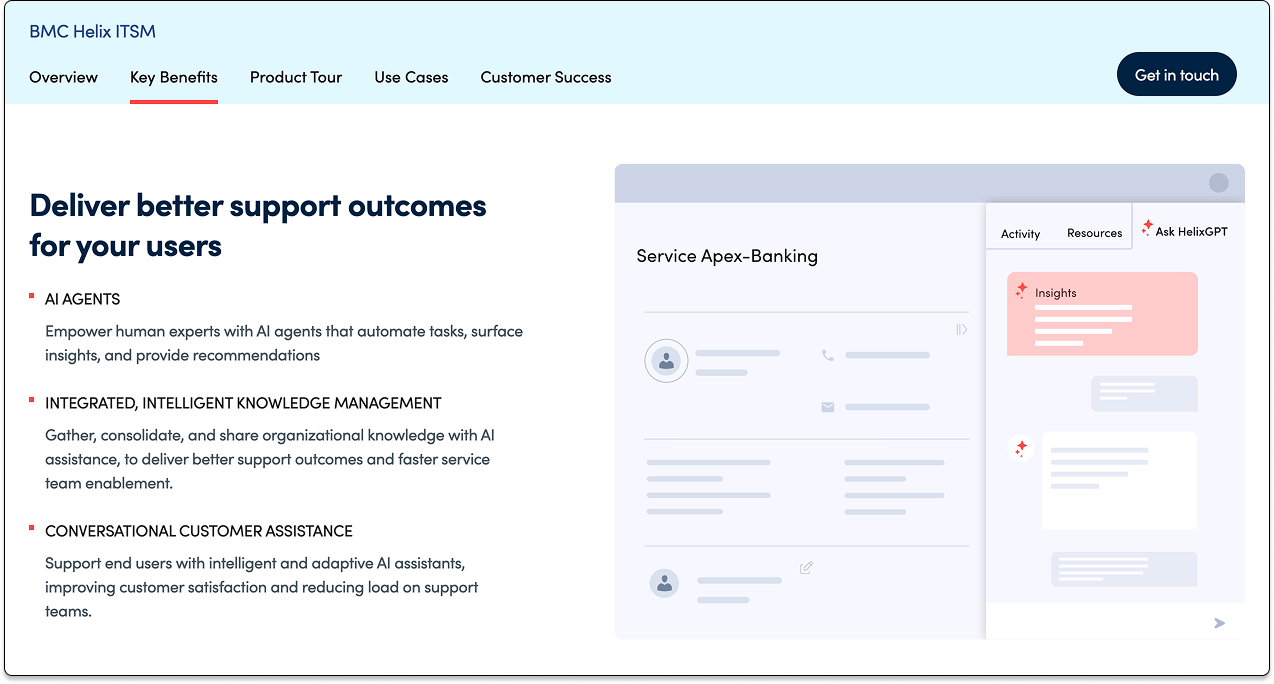
Key Differentiator: ServiceOps
ServiceNow focuses on workflows. BMC focuses on infrastructure health. It bridges the gap between IT operations and the service desk. It can ingest millions of server alerts and correlate them to a single incident ticket. This helps you find the root cause of an outage much faster.
Strengths
- Deployment Flexibility: Unlike ServiceNow, which is primarily SaaS, BMC Helix can run on-premise or in your private cloud. This is critical for government and defense customers.
- Mainframe Visibility: It provides deep visibility into mainframe environments that cloud-native tools often miss.
- Complexity: It handles complex setups and multi-tenant environments better than most competitors.
Weaknesses
- User Experience: The interface feels more industrial and less modern compared to ServiceNow or Jira.
- Market Trends: Finding new talent familiar with BMC Helix is harder than finding experts for ServiceNow or Jira.
Jira Service Management (JSM)
Best For: Engineering-led companies and teams that need a fast replacement for legacy tools.
Atlassian has disrupted the market with JSM. It rejects heavy processes in favor of speed and integration with development teams.

Dev and Ops Fusion
JSM is the only tool that natively understands software development. If a bad code deployment crashes your site, JSM automatically links the incident ticket to the code change in Bitbucket or GitLab. Support teams can instantly see what caused the problem.
Strengths
- Speed to Value: You can deploy JSM in weeks. This speed reduces risk for organizations that need to migrate quickly.
- Transparent Pricing: The pricing is public and clear. You do not need to negotiate complex contracts to know what you will pay.
- Integration: If your developers use Jira Software, adding JSM is seamless. It breaks down the wall between IT support and engineering.
Weaknesses
- Complexity Limits: It struggles with highly complex workflows outside of IT, such as rigid HR compliance processes.
- Asset Management: The asset tool is flexible but requires more manual setup than the out-of-the-box discovery tools in ServiceNow.
Feature Comparison of ITSM Tools
Artificial Intelligence
- ServiceNow: Best for autonomous action. Its agents can execute tasks across different systems.
- BMC Helix: Best for prediction. Its AI analyzes infrastructure data to predict outages before they happen.
- JSM: Best for assistance. Its AI summarizes tickets and helps agents write responses faster.
Pricing
- ServiceNow: High and complex. You pay per agent, plus extra for additional modules like IT Operations or HR.
- BMC Helix: High and variable. It is enterprise-grade pricing but often discounted to compete with ServiceNow.
- JSM: Medium and transparent. The premium tiers include most features, costing significantly less than the legacy giants.
Deployment Speed
- ServiceNow: Slow. Changes require governance and testing. This ensures stability but slows down innovation.
- JSM: Fast. Teams can create their own service desks quickly.
- BMC Helix: Slow. It takes time to set up the secure infrastructure but is very stable once running.
How to Decide
Use these scenarios to choose the right ITSM tool for your organization.
Scenario 1: The Cherwell Migration
Context: You are on Cherwell and need to migrate before the end of 2026. You have a limited budget and timeline.
Recommendation: Jira Service Management.
Why: It offers the fastest migration path. Its low-code design allows you to replicate essential workflows quickly. It gets you onto a modern platform without a massive consulting bill.
Scenario 2: The Digital Transformation
Context: You want a single portal for all employee requests including IT, HR, and Facilities.
Recommendation: ServiceNow.
Why: No other tool handles enterprise service management as well as ServiceNow. Its dedicated modules for HR and Customer Service are best-in-class products.
Scenario 3: The Critical Infrastructure
Context: You are a bank or government agency running mainframes and private clouds. You cannot put data in a public cloud.
Recommendation: BMC Helix.
Why: You need the option to deploy on-premise. You also need deep visibility into your infrastructure to correlate alerts with service tickets.
Closing Thoughts
The ITSM market in 2026 requires you to align your tool with your strategy.
- Choose ServiceNow if you have the budget to transform your entire company into a single digital workflow. It is the safe standard for the largest companies.
- Choose BMC Helix if your business relies on the health of complex, hybrid infrastructure. Its operational depth is unmatched for banks and telcos.
- Choose Jira Service Management if you value speed and developer integration. For most organizations leaving Cherwell, JSM is the modern and fast path to the future.
Also read more: Ping Identity vs. Okta vs. OneLogin: An IAM Comparison Guide in 2026, Rubrik vs. Cohesity vs. Veeam: Which Cyber Reslience Tool is Best for You
Looking for IT partners?
Find your next IT partner on a curated marketplace of vetted vendors and save weeks of research. Your info stays anonymous until you choose to talk to them so you can avoid cold outreach. Always free to you.
FAQ
Can Jira Service Management replace ServiceNow for large enterprises?
Yes, but mainly for IT workflows like incidents and changes. If you need complex HR onboarding or facilities management, ServiceNow is stronger. Many large companies use ServiceNow for the enterprise layer and JSM for technical teams.
Is BMC Helix just the new name for Remedy?
The brand name changed, but the architecture is new. BMC Helix runs on containers and modern cloud infrastructure. It can run on any cloud or on-premise, which the old Remedy could not do efficiently.
What happens if I stay on Cherwell past 2026?
You will be on an unsupported platform. You will receive no security patches or bug fixes. This is a major security risk and will likely cause you to fail compliance audits.
Why is ServiceNow so expensive?
You pay for the robust platform and security, but you also pay for separate modules. You buy the ITSM module, then pay extra for IT Operations or HR. You also need specialized consultants to maintain it, which raises the total cost.
Which tool has the best AI?
It depends on what you need. ServiceNow has the best AI for executing tasks autonomously. BMC Helix has the best AI for predicting server outages. Jira Service Management has the best AI for helping agents summarize tickets and write responses.