The Essential IT Vendor Selection Criteria Checklist
IT vendor selection criteria checklist for supplier evaluation and software vendor selection. Complete vendor qualification process template and guide.

What is vendor selection criteria checklist and why it matters
In high‑stakes IT decisions, you're committing to security, uptime, and change management. A clear vendor selection criteria checklist can translate business goals, risks, and constraints into measurable standards that guide every step of the vendor selection process.
Having a strong vendor similarity comparison criteria can do the heavy lifting before you meet a potential vendor. They focus vendor discovery on credible options, fair comparisons, and expose trade‑offs early. This is also where a strong vendor similarity comparison criteria can make a lot of difference.
By defining must‑haves, deal‑breakers, and evidence requirements up front, you prevent scope creep and avoid months of demo churn. This structured approach works for both vendor and supplier selection criteria.
Selection criteria also make decisions defensible. A structured vendor evaluation process ties requirements to scores, scores to rationale, and rationale to outcomes. That creates an audit trail your security, finance, and legal teams can stand behind, while giving you leverage for SLAs, pricing, and exit terms.
Finally, criteria carry forward into operations. The same standards that narrowed the field inform onboarding checklists, day‑one KPIs, and quarterly reviews.
This turns IT vendor selection into a repeatable discipline, not a one‑off project. When the yardstick is clear, the best vendors self‑select and the wrong ones opt out early.
Btw, if you're evaluating or looking for vendors, we can help you find the right fit. You tell us your requirements over a meeting and we will find vendors that fit from a catalog of 1200.
If you're ready to talk them, we'll prep them before the meeting so your conversations start with context. Also, this service is free to you.
The hidden cost of getting vendor selection wrong
Before diving into how to build effective vendor selection criteria and creating a checklist for it, it's worth understanding what's at stake when organizations skip this discipline or execute it poorly. The financial and operational costs of inadequate software vendor evaluation are staggering, and largely preventable.
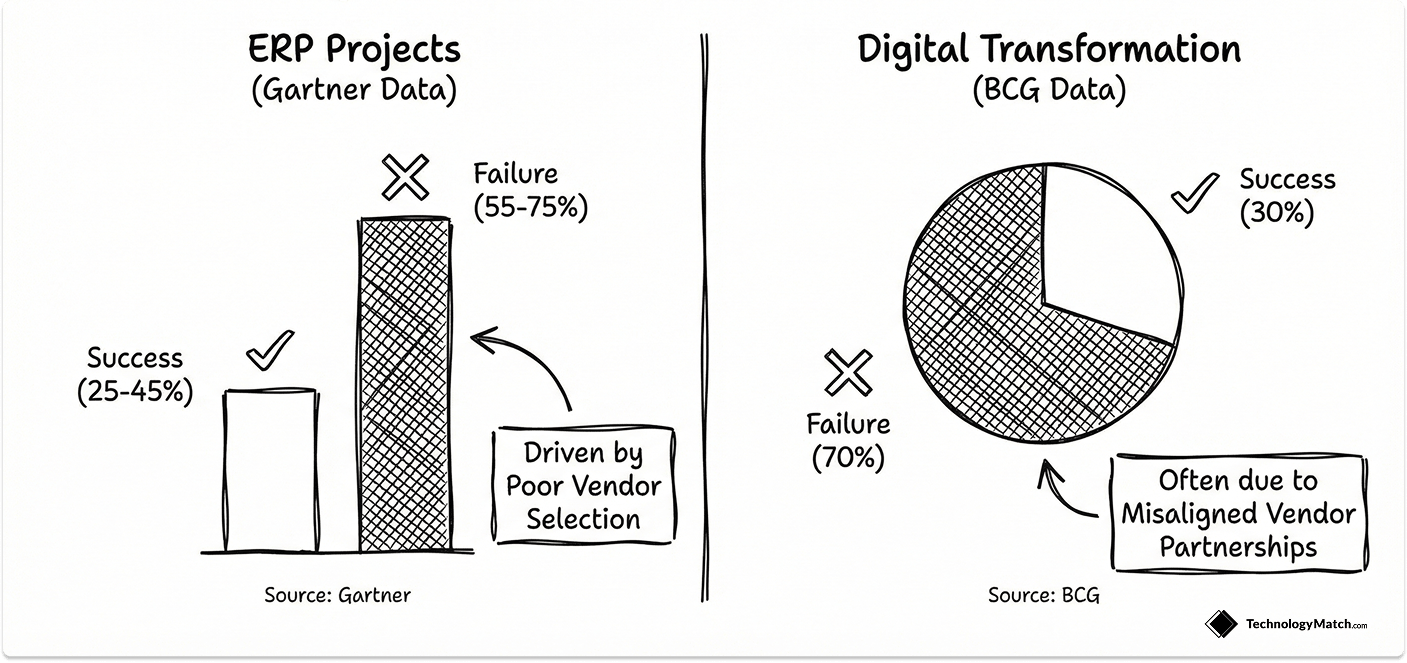
According to research by Gartner, approximately 55% to 75% of ERP projects fail to meet their objectives, with poor vendor selection playing a significant role in these failures. More broadly, BCG estimates that 70% of digital transformation initiatives fail, often due to misaligned vendor partnerships and inadequate vendor vetting processes.
The consequences extend beyond individual projects. McKinsey research from 2020 found that 17% of large IT projects go so badly that they threaten the very existence of the company. When you consider that many of these projects involve significant vendor relationships, the importance of rigorous software vendor selection becomes crystal clear.
Organizations that skip structured vendor evaluation face dramatically higher failure rates. Research shows that companies using a structured vendor selection process are 30% more likely to achieve successful outcomes compared to those relying on informal or ad-hoc approaches.
The financial impact of poor vendor decisions
The cost of choosing the wrong vendor extends far beyond the initial contract value:

- Data quality and vendor management overhead: Procurement and finance teams lose up to 27% of work-hours fixing supplier data issues and vendor-related problems, according to industry research. Poor supplier data alone costs the average company roughly $15 million per year, per Gartner estimates.
- Implementation failures and overruns: When software vendor evaluation is inadequate, implementation timelines stretch and budgets balloon. While successful projects managed by "champions" often complete faster and under budget, poorly selected vendors contribute to the opposite outcome—with some projects exceeding their planned scope by over 85%.
- Hidden costs compound over time: Organizations that cut corners during vendor selection face long-term cost overruns, delayed delivery of critical capabilities, and subpar service levels. These aren't one-time hits—they accumulate quarter after quarter, eroding the business case that justified the investment in the first place.
- Security and compliance exposure: Vendor-related data breaches carry massive financial consequences. The Ponemon Institute found that the majority of provider organizations have experienced one or more data breaches caused by their vendors, with average breach costs reaching millions of dollars when regulatory fines, remediation, and reputational damage are factored in.
Time wasted in broken vendor selection processes
Even when vendor decisions don't result in outright failure, inefficient vendor selection processes drain valuable time and resources:
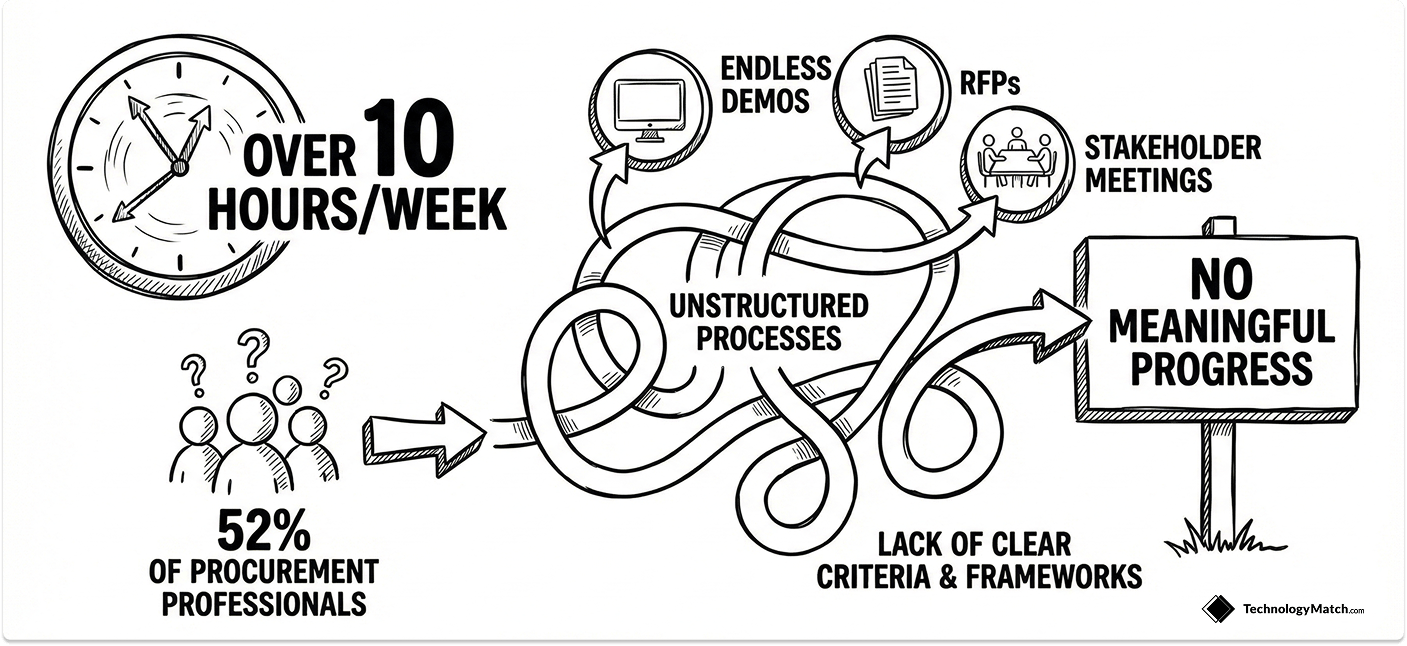
- Evaluation cycles drag on: Research indicates that 52% of procurement professionals spend over 10 hours per week just processing vendor-related tasks. Without a clear vendor selection criteria checklist and structured evaluation frameworks, teams cycle through endless demos, RFPs, and stakeholder meetings without making meaningful progress.
- Decision fatigue and analysis paralysis: When organizations lack a vendor selection criteria checklist, they struggle to compare options objectively. This leads to extended evaluation periods, missed deadlines, and mounting frustration across IT, procurement, and business stakeholders.
- Rework and re-evaluation: Teams that skip proper vendor vetting often discover critical gaps or misalignments post-contract, forcing them to either live with suboptimal solutions or restart the vendor selection process entirely, sometimes within the first year.
The opportunity cost of vendor lock-in
Perhaps the most insidious cost of poor software vendor selection is vendor lock-in, which limits your ability to adapt as business needs evolve:
- Proprietary data formats and exit barriers: When vendor evaluation doesn't adequately assess data portability and exit terms, organizations find themselves trapped in relationships that no longer serve them. Migration costs can reach 2-3x the original implementation investment.
- Inflexible contracts and renewal leverage: Without clear vendor selection criteria around commercial terms, organizations sign contracts with auto-renewal clauses, punitive uplift provisions, and limited negotiation leverage at renewal time.
- Innovation stagnation: Vendors who know they have you locked in have less incentive to innovate, respond to support requests promptly, or invest in the integrations and capabilities you need. This compounds over time, widening the gap between what your business requires and what your vendor delivers.
Risk exposure and business continuity threats
Poor vendor vetting processes also introduce operational and strategic risks:

- Vendor financial instability: Research from Riskmethods revealed that 79% of businesses have lost 4% of revenue due to supply chain disruptions in the past three years. When software vendor evaluation doesn't include financial health assessment, you risk partnering with vendors who may be acquired, restructured, or shut down, leaving you scrambling for alternatives.
- Service level degradation: Vendors experiencing financial stress often cut support staff, delay product updates, and reduce infrastructure investment. Without ongoing vendor evaluation tied to your original vendor selection criteria checklist, these declines go unnoticed until they impact your operations.
- Regulatory and compliance gaps: As regulations evolve (GDPR, CCPA, SOC 2, ISO 27001), vendors must keep pace. Organizations that don't establish compliance requirements as core vendor selection criteria find themselves exposed to regulatory violations, fines, and audit failures.
The ROI of getting vendor selection right
The flip side of these costs is the measurable value of disciplined vendor selection:
- Vendor Management Systems (VMS) and structured processes typically cost around 0.5% of total spend but deliver ROI through cost savings (10-25% procurement cost reduction), improved quality, process efficiencies, and reduced risk exposure.
- Automation and AI in vendor evaluation can reduce RFP evaluation time by 50% while improving decision quality, according to recent studies. Organizations using AI-powered vendor vetting processes report faster time-to-decision and higher stakeholder satisfaction.
- Structured evaluation reduces failure rates: Enterprises using scenario-based, structured software vendor evaluation report a 45% lower vendor failure rate within 18 months.
How to build criteria that stick (before you evaluate)
Start with outcomes, not features
Define the business results you must achieve: security posture, uptime targets, integration boundaries, migration timelines, and budget constraints.
If a requirement doesn’t tie to an outcome, cut it.
This anchors your vendor selection criteria checklist to what actually matters in the vendor selection process.
- Expand the outcome model into measurable targets your vendor evaluation can score: p95 latency for critical user flows, error budgets per service, MTTR/MTTD improvements, and compliance outcomes (e.g., SOC 2 gap closure, data residency adherence by region).
- Translate each business outcome into a criterion with an owner, evidence type, and verification method so vendor management can track it post‑award.
- Trace outcomes to risks and costs. For every outcome, list the top risks (security, integration, adoption) and cost drivers (consumption, support tiers, services). This ensures your vendor selection criteria checklist reflects both value and exposure.
- Use baselines from your current stack to quantify expected deltas so vendor evaluation compares like‑for‑like.
- Create a “no‑regret” outcome set for day one. These are the minimum viable outcomes you must realize within 30–90 days of go‑live, which helps vendor management enforce early accountability and makes vendor selection criteria checklist actionable from kickoff.
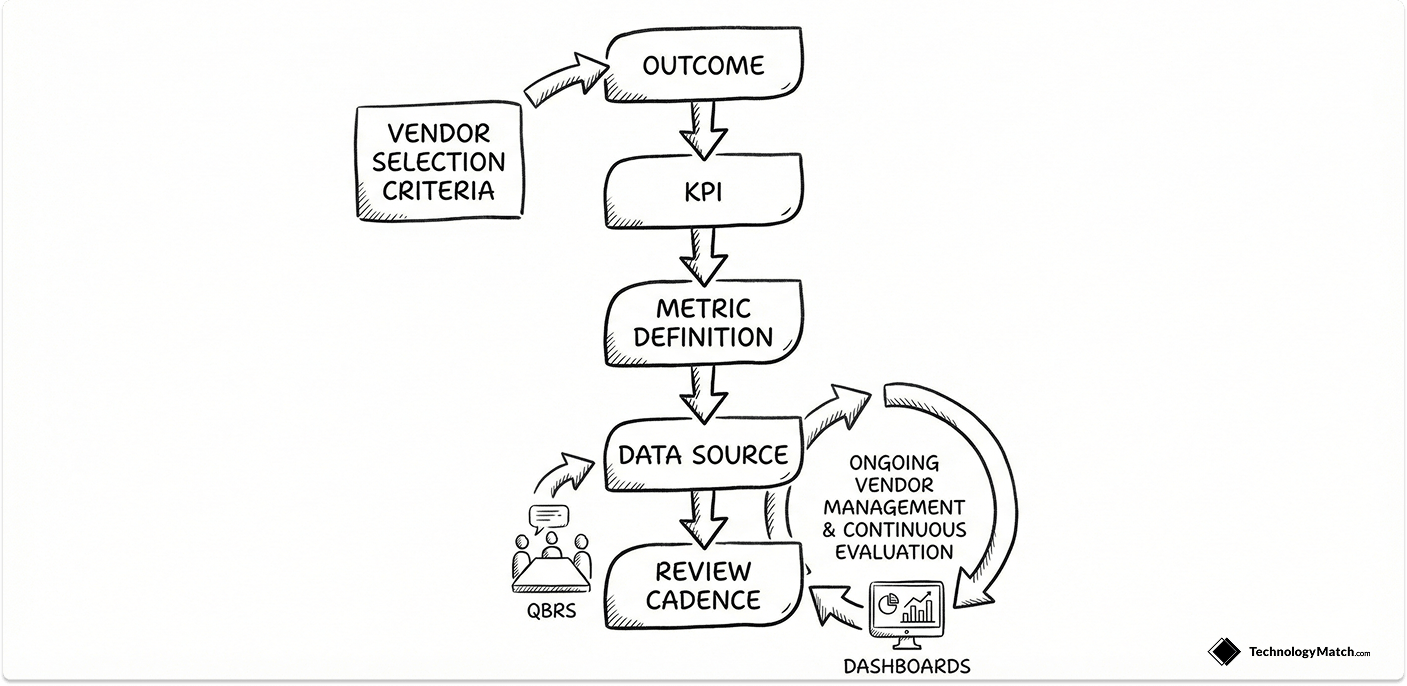
- Build a measurable success tree: Outcome → KPI → Metric definition → Data source → Review cadence. This connects vendor selection criteria to ongoing vendor management, ensuring continuous vendor evaluation through QBRs and dashboards.
Codify non‑negotiables
Draw a hard line between must‑haves, nice‑to‑haves, and deal‑breakers.
Examples: SOC 2 Type II, SSO/SAML, data residency, RTO/RPO, API coverage, and exit terms for data portability.
State evidence required for each (audit reports, RCAs, PoC logs).
- Add freshness windows for evidence: SOC 2 period end within 12 months; pen test within 12 months with remediation status; subprocessor list <90 days old.
- In vendor evaluation, any expired artifact triggers auto‑disqualification unless a documented exception is approved by security and legal.
- Specify depth for identity and data controls in your vendor selection criteria: SCIM 2.0 for provisioning, JIT + role mapping, customer‑managed keys where feasible, field‑level encryption, and DLP profiles aligned to your data classifications. Vendor management can then audit these controls during onboarding.
- Include operational non‑negotiables tied to resilience: documented incident notification timelines (e.g., ≤72 hours), vulnerability remediation SLAs by severity (e.g., critical CVEs patched in X days), and change control with rollback plans. This elevates vendor selection criteria from paper compliance to operational reality.
- Define exit readiness as a non‑negotiable: full‑fidelity exports, schema documentation, and re‑hydration instructions proven in PoC. This protects vendor management from lock‑in and informs renewal‑time vendor evaluation.
Weight what moves the needle
Apply a scoring model that mirrors risk and impact.
Security/compliance and integration fit often carry the heaviest weights, followed by reliability/SLAs and TCO.
Publish the weights so stakeholders understand trade‑offs before the vendor evaluation process begins.

- Freeze weights before outreach to avoid bias during vendor evaluation. For transparency, publish category weights (e.g., Security 35%, Integration 25%, Reliability 20%, TCO 15%, Viability 5%) and a short rationale tied to business risk.
- Add a documented exception path. If stakeholders request reweighting based on new information, require a risk ticket with justification, approvals, and timestamp. Vendor management can then audit changes in future cycles.
- Use sub‑weights inside categories in your vendor selection criteria checklist. For example, within Security, split weight across IAM, data protection, incident response, and vulnerability management to prevent score inflation on a single strong area.
- Run a calibration round on two known vendors (or incumbents) to ensure the scoring curve yields meaningful separation. This increases signal quality in vendor evaluation and simplifies governance for vendor management.
Make comparisons objective
Convert each criterion into specific tests and questions, latency under X load, supported identity flows, change management playbooks, DLP controls, and incident response time.
Use a 0–5 scale with proof links. This keeps vendor evaluation defensible and repeatable.
- Define objective scoring rubrics per test: what constitutes a 0, 3, or 5? For example, “IR time‑to‑containment ≤4 hours with tabletop evidence = 5; ≤12 hours with partial evidence = 3; no data = 0.” This eliminates ambiguity in vendor evaluation and strengthens downstream vendor management.
- Require proof types in your vendor selection criteria: architecture diagrams, load‑test logs, RCAs, trust portal artifacts, and references from similar environments. Link artifacts in the scorecard so vendor management retains an audit trail.
- Standardize response formats (e.g., CSV/JSON for control matrices) to reduce interpretation overhead. This speeds vendor evaluation and ensures vendor management can import results into dashboards.
- Include negative tests and edge cases. Validate webhook retry/idempotency, rate‑limit behavior, and failure‑mode handling. These tests reduce post‑contract surprises and help vendor management prioritize early risk mitigations.
Design the PoC before you meet vendors
Write scenario scripts tied to must‑haves: real data, real integrations, real failure modes. Define pass/fail gates and success KPIs.
If a vendor can’t test against your reality, they’re not a fit for IT vendor selection.
- Script golden‑path and failure‑path flows with clear pass criteria tied to vendor selection criteria: p95/p99 latency thresholds, consistency guarantees, permission boundaries, backpressure behavior, and rollback steps. This creates a high‑signal vendor evaluation and actionable artifacts for vendor management.
- Establish data and environment rules up front: sandbox tenants, least‑privilege test accounts, synthetic or scrubbed datasets unless a DPA is in place. This safeguards compliance while keeping vendor evaluation realistic.
- Cap PoC duration and scope (e.g., 2–4 weeks, two integrations, one failure drill). Over‑long PoCs inflate costs and blur outcomes; a crisp PoC aligns vendor management timelines and accelerates decision gates.
- Require a PoC close‑out pack: results, gaps, mitigations, and contract‑ready KPIs. Vendor management uses this pack to seed SLAs, QBR scorecards, and day‑one checklists.
Align the team and assign owners
Name the technical, security, finance, and operations leads. Set decision gates (shortlist, PoC, negotiation) and minimum thresholds.
Miss a threshold? Disqualify and move on. This prevents a slow pace controlled by the vendor
- Publish a RACI for each stage with a single decision authority. This eliminates ambiguity during vendor evaluation and ensures vendor management has clear escalation paths.
- Define conflict‑of‑interest and lobbying rules to keep vendor selection criteria unbiased. Log all vendor interactions and materials in a central tool to maintain auditability for vendor management.
- Introduce an exceptions register. Any threshold misses require a dated remediation plan, owner, and deadline. Unresolved exceptions block progression—this protects the integrity of vendor evaluation and supports disciplined vendor management.
- Time‑box each gate and pre‑schedule stakeholder reviews. Predictable cadence reduces decision drift and keeps vendor evaluation aligned to business timelines.
Keep the funnel tight
Use criteria to focus vendor discovery, not expand it. You want fewer, stronger candidates and not a crowded spreadsheet.
That’s how experienced teams run IT vendor selection with speed and confidence.
- Set explicit entry gates tied to vendor selection criteria: evidence‑ready must‑haves, referenceability in your segment, and capacity to meet timelines. This yields a smaller, higher‑signal pool for vendor evaluation and lowers noise for vendor management.
- Cap the longlist (e.g., 6–8) and shortlist (2–3). Any additions require a written justification against must‑haves and evidence. This maintains rigor in vendor evaluation and protects vendor management bandwidth.
- Centralize rationale, disqualifiers, and evidence requests. A single repository prevents re‑litigation, speeds vendor evaluation, and preserves institutional memory for vendor management.
- Track sourcing channel quality over time (analyst lists, peer references, curated marketplaces). Prioritize channels with higher PoC pass rates to continuously improve vendor selection criteria and the efficiency of vendor management.
The essential IT vendor selection criteria checklist and template
This vendor evaluation checklist ensures comprehensive assessment across all critical areas.
Whether you're conducting software vendor selection or broader supplier evaluation, these criteria provide the framework for your vendor qualification process.
Our vendor vetting checklist includes these essential categories:
Use these vendor selection criteria to keep the vendor selection process objective and defensible.
For each, capture proof in your vendor evaluation tool to streamline the vendor evaluation process and ongoing IT vendor management.
Technical and integration fit:
- Vendor evaluation checklist: capability coverage, APIs/SDKs, data model compatibility, SSO/SAML/OIDC, performance under load.
- Verify: reference architectures, PoC against your stack, latency/throughput benchmarks.
- Red flags: custom code for basics, brittle connectors, vague or shifting roadmap.
Security, privacy, and compliance:
- Vendor vetting checklist: SOC 2/ISO 27001, IAM controls, DLP, encryption, incident response maturity, data residency.
- Verify: audit reports, pen test summaries, DPAs, breach history with RCAs.
- Red flags: expired/partial certs, evasive logging/retention answers, third‑party gaps.
Reliability, SLAs, and support:
- Check: uptime targets, RTO/RPO, response/resolution times, escalation paths, global coverage.
- Verify: historical status/SLA reports, sample RCAs, staffed on‑call schedules.
- Red flags: broad SLA exclusions, weak penalties, mismatch between tiered support and your needs.
Cost transparency, TCO/ROI, and pricing flexibility:
- Check: unit economics, growth/overage policies, service fees, renewal clauses.
- Verify: multi‑year TCO scenarios, pricing benchmarks, discount structures.
- Red flags: hidden add‑ons, punitive uplifts, lock‑in via proprietary data.
Implementation and change management:
- Check: deployment playbooks, migration tooling, training/adoption programs, and success ownership.
- Verify: project plans with resources/timelines, cutover runbooks, and adoption KPIs.
- Red flags: "services will figure it out," unclear roles, soft timelines.
Scalability and roadmap:
- Check: multi‑region scale, performance ceilings, release cadence, backward compatibility, deprecation policy.
- Verify: capacity tests, roadmap briefings, support windows.
- Red flags: breaking changes, slow fixes, opaque prioritization.
Data governance and portability:
- Check: data ownership terms, export formats/APIs, residency, retention/deletion guarantees.
- Verify: schema docs, export SLAs, exit provisions tested in PoC.
- Red flags: partial exports, extra fees for data access, unclear deletion.
Vendor viability and references:
- Check: financial health, leadership stability, customer concentration, partner ecosystem.
- Verify: reference calls with similar environments, independent reviews, analyst notes.
- Red flags: high churn, M&A turbulence, opaque ownership structures.
Cultural fit and collaboration:
- Check: transparency, responsiveness, consultative approach, QBR cadence, willingness to co‑own outcomes.
- Verify: success plans, named team, communication SLAs.
- Red flags: pitch‑heavy behavior, slow follow‑ups, resistance to shared KPIs.
Use this vendor qualification checklist to systematically evaluate every aspect of potential vendors and suppliers.
Below is the worksheet for evaluating vendors right here. Use the interactive vendor selection criteria checklist below to cross off vendor checkpoints and mark red flags when you observe them. The marked red flags are counted at the bottom so you can reference them throughout your evaluation and make an informed decision about a vendor.
Turning criteria into your vendor assessment framework
This vendor selection criteria checklist becomes your operational framework when applied consistently across your organization.
Whether you're conducting supplier evaluation, software vendor selection, or service provider assessment, these criteria ensure objective scoring throughout the vendor qualification process.
Your supplier selection criteria must adapt to different vendor types while maintaining consistency.
For software vendor selection, weight technical integration and API capabilities heavily.
For infrastructure suppliers, emphasize reliability and support. The framework flexes without breaking.
The vendor qualification process you build from these criteria drives measurable outcomes.
Each element in your vendor evaluation checklist translates to specific scores, creating supplier evaluation that's both rigorous and repeatable.
Software vendor selection becomes systematic rather than subjective.
Remember: supplier selection criteria without clear implementation are just theory. Your vendor evaluation criteria checklist transforms gut feelings into governance, turning the vendor qualification process into a predictable discipline that delivers consistent results.
Where criteria live inside the vendor selection process
This vendor evaluation criteria checklist helps maintain consistency across all stages of the vendor qualification process:
Use your vendor selection criteria as the backbone of every stage.
This keeps the vendor selection process objective, fast, and defensible, and turns IT vendor selection into a repeatable discipline.
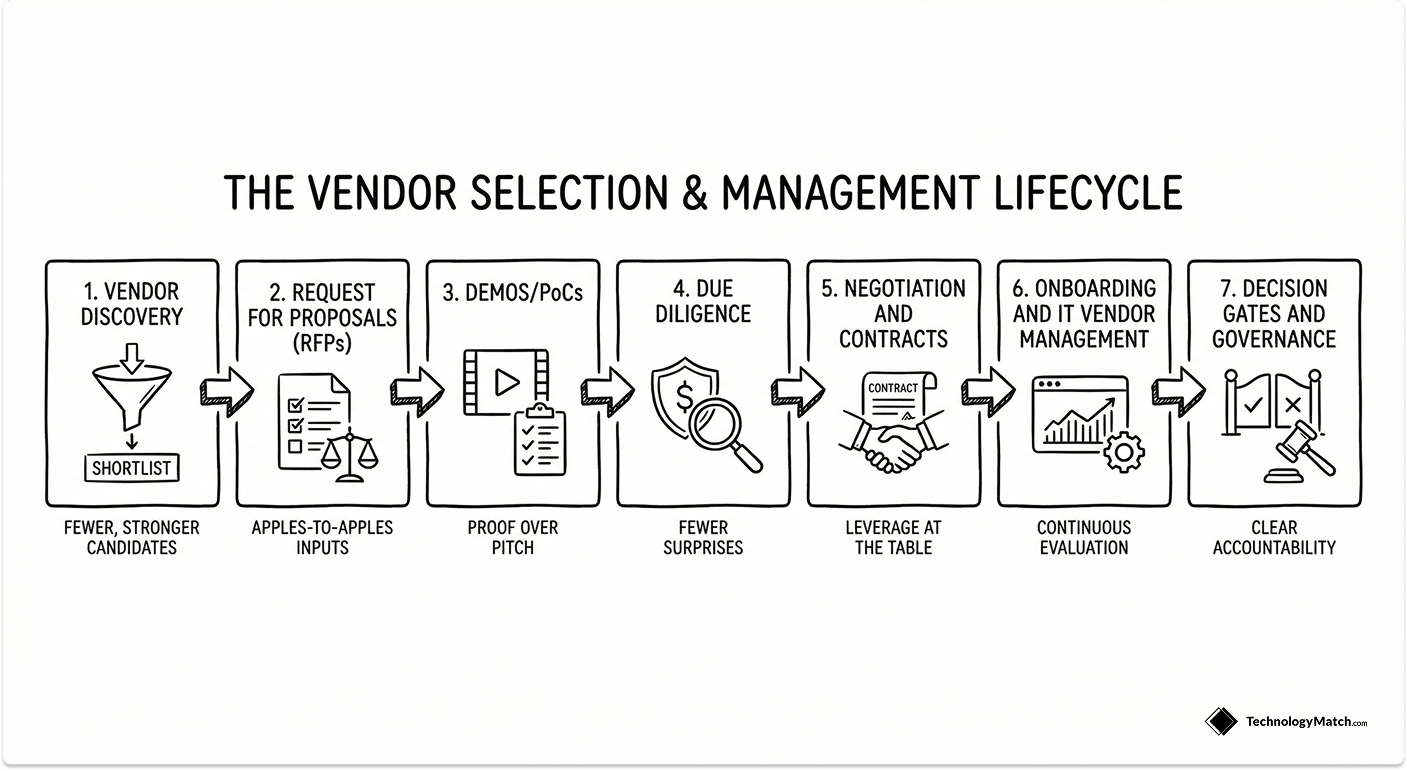
Vendor discovery:
- Apply must-haves and deal-breakers as entry gates to build a reasoned longlist and shortlist.
- Capture rationale, evidence requests, and disqualifiers in your vendor evaluation tool or spreadsheet.
- Outcome: fewer, stronger candidates; faster IT vendor management handoffs.
- Convert criteria into structured questions with standardized response formats and required evidence (certs, RCAs, architecture).
- Publish weights up front; map each question to a criterion to drive a clean vendor evaluation process. This structured approach works equally well for supplier evaluation and software vendor selection.
- Outcome: apples-to-apples inputs and audit-ready scoring.
Demos/PoCs:
- Script scenarios tied to must-haves (real data, real integrations, failure modes). Define pass/fail gates and success KPIs.
- Log results, trade-offs, and limitations in the vendor evaluation tool.
- Outcome: proof over pitch; faster "no-go" calls and clearer "go" decisions.
- Deep dives on security/compliance, financials, legal, and references anchored to the criteria (e.g., IAM, DLP, data protection, incident history).
- Findings adjust weightage for each criterion; red flags trigger stop/mitigation paths.
- Outcome: fewer post-contract surprises; stronger vendor evaluation.
- Codify criteria into SLAs, data ownership, exit terms, support tiers, and penalties; align pricing to TCO scenarios.
- Attach evidence and obligations as contractual exhibits; preserve the audit trail from the vendor evaluation process.
- Outcome: leverage at the table and contracts that reflect reality.
Onboarding and IT vendor management:
- Promote criteria to day-one KPIs, dashboards, QBR agendas, and renewal readiness checks.
- Track performance, exceptions, and remediation plans in your vendor evaluation tool; keep continuous vendor evaluation alive.
- Outcome: smooth handoff to operations and a durable vendor management process.
Decision gates and governance:
- Set thresholds for shortlist, PoC exit, and award; define automatic disqualifiers.
- Record rationale and exceptions to keep IT vendor selection—and even IT vendor selection workflows—consistent and defensible.
- Outcome: predictable timelines, clear accountability, and exportable artifacts for audit.
Operationalizing with a vendor evaluation tool
Once you have the criteria, vendor selection takes a systematic shape, clarifying any and all doubts you would have about where to begin or what to look for.
Tools like TechnologyMatch understand your requirements and connect you to the right vendors on the platform who would stand out from an already crowded vendor market, most of which is noise.
It's much easier to choose from a handful of well-vetted, proven vendors than to sift through dozens who waste your time with generic demos. This is especially valuable for software vendor selection where technical requirements can be complex.
Vendor evaluation tools in the market let you centralize the entire process so you don't bury yourself with a dashboard and burnout before onboarding.
Use workflows to capture requirements and align stakeholders before outreach.
Centralize communication, responses, and scorecards so the vendor selection process stays traceable end‑to‑end.
Orchestrate RFx in one place. Standardize questions, timelines, and even scorecards. When proposals arrive, score them against your model. Compare vendor options side-by-side so you have a much clearer view of the whole process.
Strengthen negotiations with data. Use SLAs and pricing benchmarks to set expectations and push for value.
Document terms, obligations, and assumptions so that what you negotiated is exactly what lands in the contract.
Some best practices:
- Use reliable, well-vetted sources for vendor discovery to reduce noise.
- Buyer‑first controls (anonymity, pace, scheduling) to avoid vendor‑led cycles and spam.
- Reusable playbooks for RFx, PoCs, and due diligence to compress timelines without losing progress.
- Continuous feedback loops so outcomes inform renewals and the next IT vendor selection.
For more tips on better vendor selection, here are 10 best practices for you to consider.
Building the right criteria is how you win at vendor selection
When you anchor decisions in clear vendor selection criteria and evaluation checklists, you turn the vendor selection process from guesswork into governance.
Whether you're focused on software vendor selection or broader supplier evaluation, criteria make expectations explicit and introduce practicality in the whole vendor qualification process.
Those same standards power every stage: vendor discovery, RFIs/RFPs, demos/PoCs, due diligence, negotiation, and onboarding.
They also carry forward into IT vendor management, becoming the KPIs you review, the SLAs you enforce, and the renewal signals you trust.
Operationalize it. A solid vendor evaluation tool captures requirements, weights priorities, structures the vendor evaluation process, and preserves an audit trail your security, finance, and legal teams can stand behind.
Follow a structure, and even IT vendor selection becomes repeatable, defensible, and measurably better with each cycle, even if you have to end vendor contracts and find new ones. That's how you reduce risk, speed time‑to‑value, and build partnerships that last.
Looking for IT Vendors?
Vendor selection is lenghty and exhausting. You might not have the time or bandwidth to find and demo possible vendors. Which is where we can help. You tell us your requirements and we will come to you with vendors who fit. It's up to you if you want to talk or not.
FAQ
What are the essential IT vendor selection criteria checklists and how should I apply them?
Focus on security/compliance (SOC 2, ISO 27001), technical/integration fit (APIs, SSO, data model), reliability/SLAs (uptime, RTO/RPO), cost/TCO, data governance/exit, scalability/roadmap, implementation/adoption, and vendor viability/references. Convert each into weighted, evidence-backed checks for a defensible it vendor selection.
How do I build a defensible vendor evaluation process and scorecard?
Define must-haves vs. nice-to-haves, set weights by risk/impact, write scenario tests, and require proof (audits, PoC logs, RCAs). Use a vendor evaluation tool to capture scores, rationale, and artifacts—turning vendor evaluation into an audit-ready workflow.
Where do criteria fit within the vendor selection process?
Use criteria to: screen during vendor discovery, structure RFIs/RFPs, script demos/PoCs, guide due diligence, lock SLAs/exit terms in contracts, and set day‑one KPIs for it vendor management. Criteria should drive each gate from shortlist to award.
What pitfalls derail IT vendor selection and how do I avoid them?
Pitfalls: over-indexing on price, vague SLAs, weak exit terms, unscored demos, and skipping adoption plans. Fixes: weight security/integration and TCO, demand measurable SLAs/penalties, define data portability, run scenario-based PoCs, and require training/success metrics.
How does a vendor evaluation tool help beyond selection?
It standardizes the vendor evaluation process, centralizes evidence, and maintains the audit trail into operations. Tie criteria to QBRs, SLA monitoring, risk flags, and renewal readiness—making ongoing it vendor management (and even it vendor vendor selection at scale) consistent and repeatable.