Vendor Management Best Practices for IT Leaders in 2026
Vendor management best practices for IT leaders: Master the IT vendor management process, proven strategies, and frameworks to reduce costs and risk.
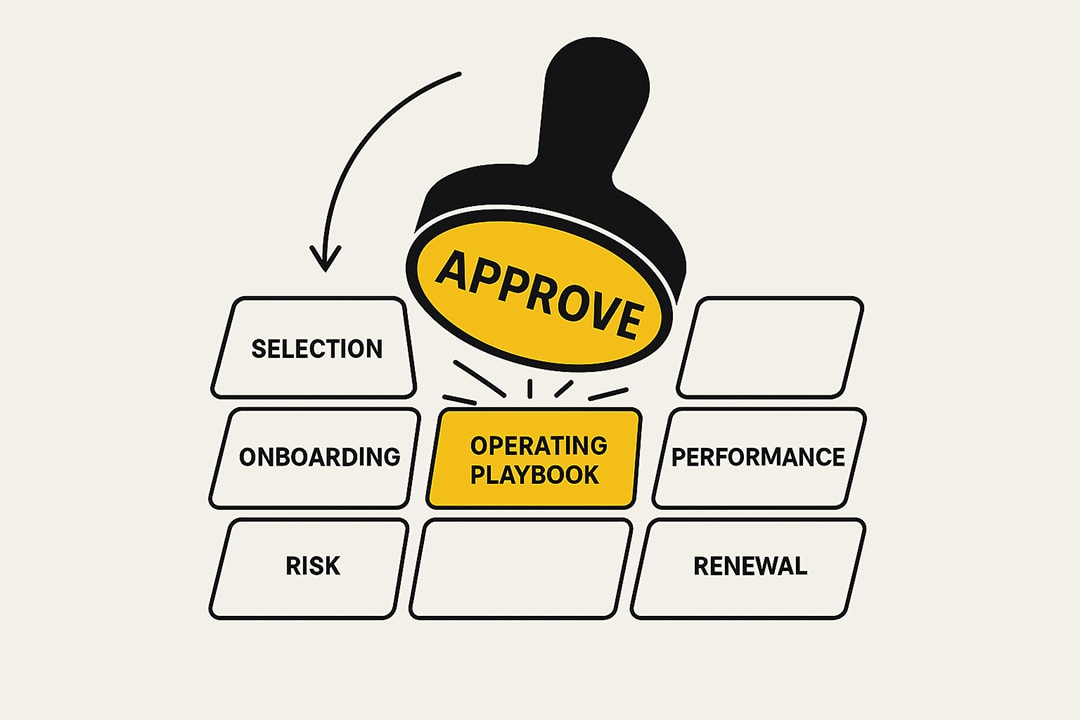
IT vendor management is where most IT outcomes are won or lost. Every cloud platform, SaaS tool, managed service, and infrastructure partner brings value, risk, and cost into your environment simultaneously. Managing that complexity across dozens or hundreds of vendor relationships requires more than good intentions and a shared spreadsheet.
What Is the IT Vendor Management process?
IT vendor management is the strategic process of selecting, onboarding, monitoring, and optimizing relationships with technology suppliers throughout the entire vendor lifecycle.
Unlike general procurement, IT vendor management addresses the unique complexities of technology partnerships: security vulnerabilities, system integrations, data access, compliance requirements, and business continuity risks.
For IT leaders managing 50 to 500+ vendor relationships, effective vendor management best practices transform a chaotic vendor ecosystem into a structured program that reduces risk, controls costs, and gives you defensible decisions when leadership or auditors ask hard questions.
Why IT Vendor Management Matters More Than Ever
You are managing more vendors than you can count. Cloud providers, SaaS platforms, security tools, infrastructure partners, support contractors. The list grows every quarter, and so does the complexity.
The cost of poor IT vendor management is staggering. Redundant licenses bleeding budget. Shadow IT creating security holes. Vendors underperforming while you are stuck in multi-year contracts. Integration failures that cascade into operational nightmares.
Vendor management is not an administrative task you delegate to procurement. It is a strategic lever that determines whether you are seen by the C-suite as a cost center or a value driver.
This article isn't about vendor management theory. It's about the practical frameworks and vendor management best practices that separate overwhelmed IT managers from strategic IT leaders.
You'll learn how to structure your vendor ecosystem, navigate the full lifecycle from selection to exit, implement proven practices that scale, and overcome the challenges that trip up even experienced leaders.
Understanding IT Vendor Management
What Makes IT Vendor Management Different
IT vendor management is not like managing office suppliers or facility services. The stakes are categorically different.
Your technology vendors have access to your data. They integrate with your core systems. They can take down your operations if they fail. A bad vendor decision in IT does not just cost money. It creates security vulnerabilities, compliance violations, and business continuity risks.
The complexity multiplies fast. Your CRM integrates with your marketing automation platform, which connects to your data warehouse, which feeds your analytics tools. One vendor's API change can break three other systems. One security breach at a third-party provider can expose your entire customer database.
Technology vendors move faster than suppliers in other categories. Vendors get acquired, pivot their product strategy, or sunset features with little warning. The SaaS platform you built workflows on two years ago might be end-of-life next quarter. You are not just managing current relationships. You are constantly assessing future viability.
Shadow IT makes everything harder. Business units do not wait for IT approval anymore. They swipe corporate cards and spin up new tools before you know they exist. By the time you discover them, there are integration dependencies, workflow commitments, and political battles over shutting them down. Gartner found 41% of employees acquired technology outside IT's visibility in 2022, and projects that number reaches 75% by 2027.
The Real Costs of Poor Vendor Management
The financial waste is obvious but still shocking. Redundant licenses for tools that do the same job. Auto-renewals at list price when you could have negotiated 30% discounts. Paying for seats nobody uses. Shelfware that seemed essential during the sales demo but never got deployed.
The operational costs are harder to quantify but equally real. Integration failures that require expensive custom development. Vendor outages that cascade into customer-facing problems. Security incidents from vendors with weak controls. Support tickets that bounce between your team and the vendor with no resolution.
Strategic costs compound over time. Vendor lock-in that prevents you from adopting better solutions. Proprietary data formats that make migration prohibitively expensive. Contract terms that seemed reasonable at signing but constrain your options for years.
Poor IT vendor management does not just waste budget. It erodes your credibility, limits your strategic options, and turns your role into an endless series of fires to put out.
The Four Pillars of Strategic IT Vendor Management
.png)
Effective IT vendor management rests on four interconnected pillars. Get these right, and everything else becomes easier.
Performance Management means knowing whether vendors are actually delivering value, not just uptime metrics. Are users productive? Are integrations reliable? Is support responsive? You need scorecards that measure what matters, regular reviews that surface issues early, and accountability mechanisms that give you leverage when performance slips.
Risk Management is non-negotiable in IT vendor management. Security assessments before vendors touch your systems. Compliance verification for regulatory requirements. Financial stability checks so you are not surprised by vendor bankruptcies. Business continuity planning for critical vendors. Third-party risk cascades because your vendor's vendors are your problem too.
Relationship Management separates transactional vendor management from strategic partnerships. The best IT leaders do not just enforce SLAs. They build relationships with vendor executives, align roadmaps with business objectives, and create mutual accountability. They communicate regularly, not just when things break.
Financial Optimization is where vendor management best practices directly impact your budget. Smart contract negotiation. Understanding total cost of ownership beyond sticker price. Timing renewals to maximize leverage. Benchmarking pricing against market rates. Consolidating spend to increase negotiating power.
Proven Vendor Management Best Practices for IT Leaders
Knowing the lifecycle is one thing. Executing it consistently across dozens or hundreds of vendors is another. These vendor management best practices separate IT leaders who stay in control from those who get overwhelmed by complexity.
Best Practice 1: Centralize Vendor Data and Workflows
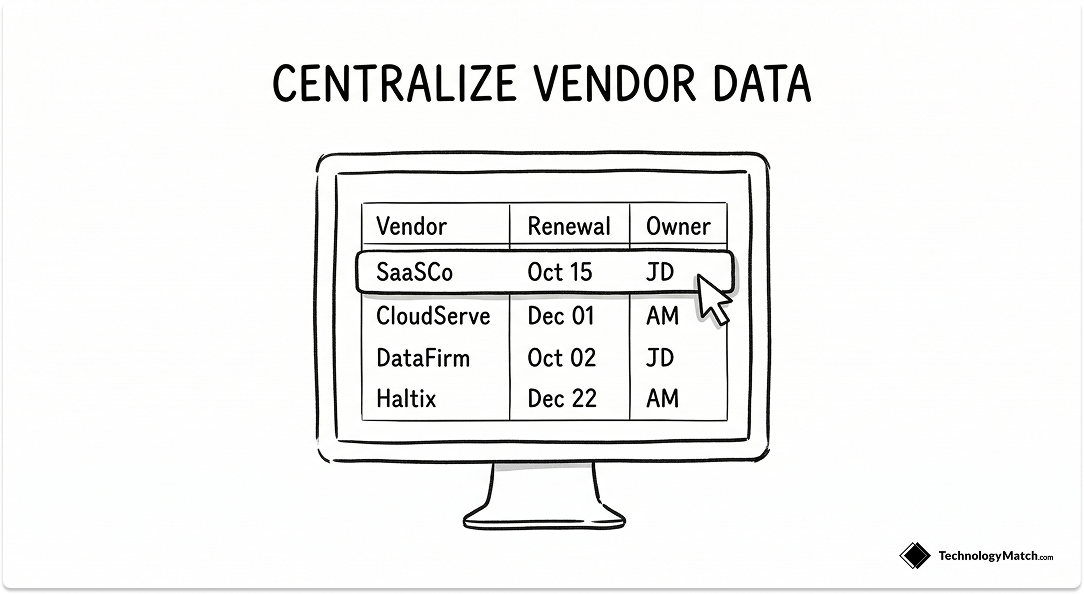
What it is: Consolidate all vendor information, including contracts, compliance documents, KPIs, communications, and performance data, into a single dedicated vendor management platform or system of record.
Why it matters: Scattered vendor information is the root cause of most vendor management failures. When contracts live in one person's inbox, compliance documents sit in SharePoint, performance data exists in someone's memory, and invoices route through finance with no connection to the source, the program breaks down. Every vendor record should contain the renewal date, notice period, SLA terms, auto-renewal status, and the named owner responsible for that relationship.
How to implement:
- Select a centralized platform: a dedicated vendor management system, SaaS management tool, or contract lifecycle management solution
- Migrate all existing vendor data into the central repository
- Assign clear ownership for maintaining and updating each vendor record
- Make the central system the path of least resistance for all vendor-related activities
- Ensure all stakeholders across IT, procurement, finance, legal, and security have appropriate access
Common mistake: Building a centralized system but failing to enforce its use, leading to parallel processes and outdated information.
The payoff: When vendor data is centralized, intake becomes trackable, due diligence does not start from scratch at every renewal, performance reviews pull real data, and renewals trigger in advance with full context. Audits stop being scavenger hunts. Negotiations stop relying on gut feel.
Best Practice 2: Establish IT Vendor Governance and Approval Processes

What it is: Define standardized policies, decision rights, approval workflows, and role assignments across IT, procurement, business units, legal, and finance for all vendor-related activities.
Why it matters: Without clear governance, vendor management becomes a free-for-all where shadow IT proliferates, security reviews get skipped, contracts contain unfavorable terms, and nobody knows who is accountable when things go wrong.
How to implement:
- Create tiered approval thresholds based on contract value and risk level. For example: contracts under $10K require manager approval, contracts over $100K require director approval, and any vendor handling regulated data requires security sign-off regardless of value
- Document the end-to-end procurement workflow from initial request through contract signature
- Define a clear RACI matrix for vendor decisions across IT, procurement, legal, and finance
- Build fast-track processes for pre-approved, low-risk vendors so teams can move quickly within boundaries
- Establish exception processes for urgent needs that maintain oversight without creating bottlenecks
- Maintain an approved vendor catalog so teams can see what is already available before requesting a new tool
Common mistake: Creating governance so bureaucratic it takes six months to procure anything, driving frustrated teams to work around the process entirely.
The payoff: Appropriate governance prevents compliance gaps, ensures security requirements are met, maintains budget control, and speeds decision-making through clarity rather than bureaucracy.
Best Practice 3: Conduct Risk-Based Vendor Segmentation for IT Relationships
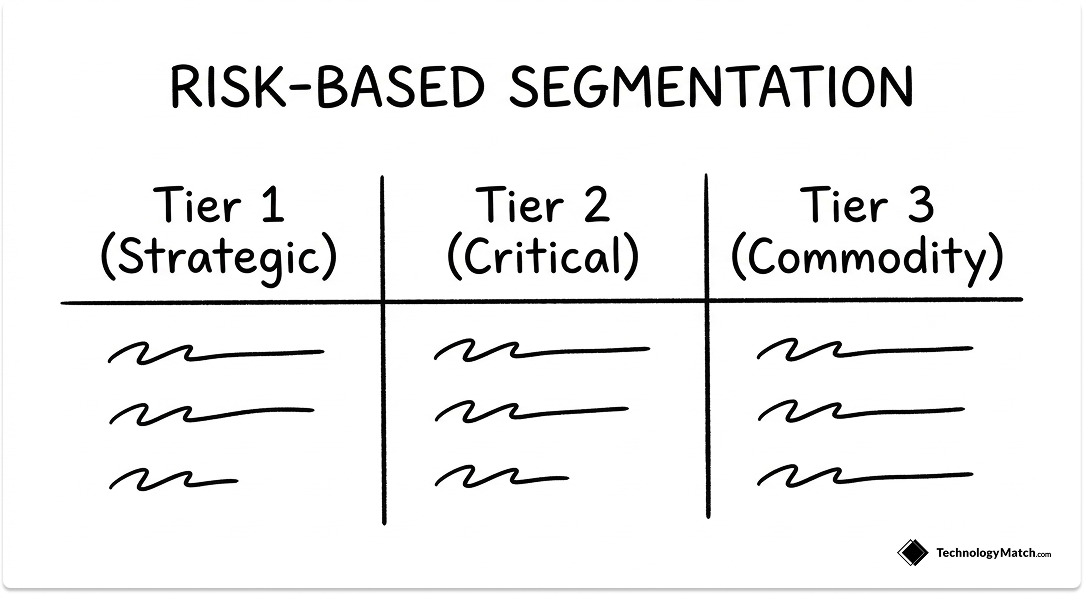
What it is: Categorize vendors by strategic importance, business criticality, and risk level to allocate management effort appropriately and apply the right level of oversight to each relationship.
Why it matters: Not all vendors deserve the same attention. Treating every vendor equally wastes your most valuable resource: time. Twenty percent of your vendors typically represent 80% of your spend, risk, and strategic value. The $20,000 security monitoring tool with production access carries more operational risk than many larger contracts.
How to implement:
Segment vendors into tiers:
- Tier 1 (Strategic): Vendors that enable competitive advantage or business transformation, including cloud infrastructure, core business applications, and customer data platforms. These get executive sponsors, quarterly business reviews, continuous security monitoring, and renewal planning starting 120 days out.
- Tier 2 (Critical): Vendors that keep operations running without differentiating, including email platforms, productivity suites, and network services. These get defined SLAs, semi-annual security attestation, and annual performance reviews.
- Tier 3 (Commodity): Vendors providing standardized services at scale, including basic utilities and generic infrastructure. These get standardized processes, competitive bidding at renewal, and annual usage audits to catch shelfware.
Re-tier vendors annually. A tool that starts as tier 3 and gets integrated into five core workflows over 18 months has become a tier 2 vendor.
Common mistake: Applying the same intensive oversight to all vendors, burning out your team on low-value relationships while missing strategic opportunities with critical partners.
The payoff: You focus energy where it generates the most value, manage strategic vendors as true partnerships, and handle commodity vendors efficiently without micromanagement.
Best Practice 4: Implement a Rigorous IT Vendor Selection Process
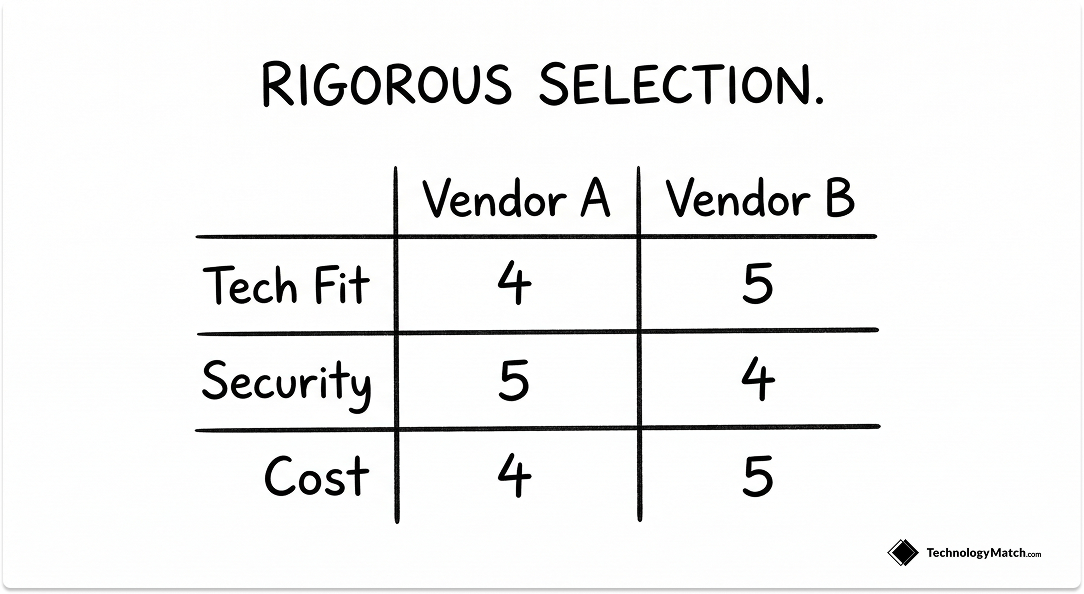
What it is: Use standardized, documented criteria and evaluation frameworks to assess and compare potential vendors before making selection decisions.
Why it matters: Poor vendor selection creates problems that compound over years: security vulnerabilities from integration mismatches, underperformance against unspecified SLAs, and lock-in to solutions that never delivered the promised value. Getting selection right prevents these downstream failures.
How to implement:
Define weighted evaluation criteria across key dimensions before talking to a single vendor:
- Technical fit: capabilities, integrations with your existing stack, scalability, and architecture
- Security and compliance: certifications such as SOC 2 and ISO 27001, data handling practices, and privacy controls
- Financial stability: company viability, funding, customer base, and market position
- Total cost of ownership: licensing, implementation, training, ongoing support, and exit costs
- Vendor viability: roadmap alignment, support quality, customer references, and strategic fit
Run scenario scripts instead of feature tours. Define five to eight specific workflows that matter to your environment and ask vendors to execute them live with your data. Score what you see, not what they claim. Use an anchored 0-5 rubric per criterion so scoring is consistent across evaluators.
Require proof of capabilities through demos, trials, or proof-of-concept work. Conduct reference checks with organizations of similar size and complexity. Involve end users and business stakeholders in the evaluation. Document the selection rationale with scores and evidence for future accountability.
Common mistake: Making vendor selection decisions based on the best sales pitch, personal relationships, or whoever presents most confidently rather than objective criteria.
The payoff: Better vendor selection produces fewer surprises, stronger performance, reduced security risk, and partnerships that actually deliver the promised value.
Best Practice 5: Negotiate IT Vendor Contracts with Strategic Leverage

What it is: Approach contract negotiations armed with market intelligence, competitive alternatives, and an understanding of vendor sales cycles to secure favorable terms and pricing.
Why it matters: Every dollar saved in vendor negotiations is a dollar available for strategic investments. Every favorable term secured is leverage you will use when you need it. Contract negotiation is a core IT vendor management competency, not a procurement afterthought.
How to implement:
Conduct market research before any negotiation:
- Know what competitors charge for comparable capabilities
- Know what discounts are standard in this category
- Know the vendor's fiscal year-end, and time negotiations to quarter-end when sales teams have quota pressure
Understand the commercial tradeoffs:
- Multi-year contracts offer lower unit cost but reduced flexibility
- Annual commitments cost more per year but give easier exit and renegotiation rights
Negotiate key contract terms beyond price:
- SLAs with meaningful credit formulas and defined claim windows
- Data ownership and portability provisions specifying export format and delivery timeline
- Termination rights and exit assistance obligations quantified in hours and days
- Auto-renewal elimination or explicit written approval requirements
- Price escalation caps tied to CPI or a fixed annual percentage
- Subprocessor change notification rights with a defined objection window
Common mistake: Accepting vendor proposals at face value without negotiation, or negotiating only on price while leaving the terms that create future risk untouched.
The payoff: Better economics, favorable terms that protect you during disputes, and leverage at renewal based on documented performance and market alternatives.
Best Practice 6: Create a Structured IT Vendor Onboarding Process

What it is: Implement a standardized, repeatable process for integrating new vendors into your environment, ensuring all security, compliance, integration, and operational requirements are met before go-live.
Why it matters: Poor onboarding creates security gaps, integration failures, compliance violations, and user adoption problems that persist for years. A structured approach to vendor lifecycle management starts with getting onboarding right.
How to implement:
Create onboarding checklists covering:
- Security review and access provisioning: enforce IdP-based SSO before any users receive access, configure SCIM provisioning for automated user lifecycle management, apply least-privilege RBAC from day one
- Compliance documentation collection and verification
- Integration planning and testing with defined acceptance criteria
- Data migration and validation
- User training and change management
- Performance baseline establishment
- Support escalation path definition
Set go/no-go criteria that must be met before production deployment and hold to them. Document configuration decisions and integration points at the time they are made. Conduct a post-onboarding review within 30 days to capture what the process revealed.
Common mistake: Rushing through onboarding to meet arbitrary deadlines, skipping security reviews because the project is already delayed, and creating technical debt that becomes expensive to fix later.
The payoff: Vendors that are properly integrated, secure from day one, and compliant with requirements create far fewer problems at renewal, audit, or exit.
Best Practice 7: Set IT Vendor KPIs That Measure Business Impact, Not Just System Availability
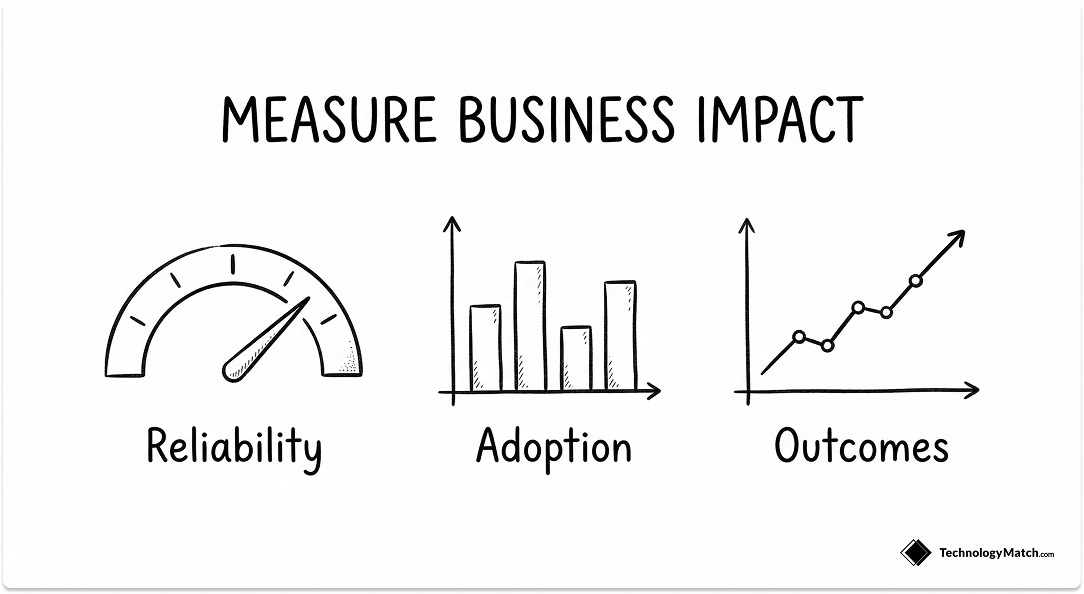
What it is: Define clear, measurable KPIs and service level agreements for each vendor relationship, then track and review performance against those metrics regularly.
Why it matters: Without measurable KPIs, vendor performance is subjective and anecdotal. Subjective performance assessments at renewal produce vendors that should not be renewed getting renewed because the relationship is comfortable. You cannot negotiate renewals effectively without performance data.
How to implement:
Define KPIs across five dimensions for every significant vendor relationship:
- Reliability: Uptime against contracted SLA, MTTR for incidents above a defined severity threshold, incident frequency and trend over 12 months
- Adoption: Active users versus licensed seats by team, feature utilization rates for the capabilities that justified the purchase
- Outcomes: Business impact metrics tied to the original selection rationale: tickets deflected, process hours reduced, cost avoided
- Compliance: Certification currency with expiration dates tracked, open audit findings with remediation deadlines
- Support: First-response time against contracted SLA, ticket resolution time by severity tier, escalation rate as a percentage of total volume
Include KPIs in contracts with explicit measurement methodologies. A KPI without a defined measurement method is not a KPI, it is a future dispute. Build vendor scorecards that visualize 12-month trends rather than point-in-time snapshots. Tie performance to consequences: service credits for SLA misses, renewal decisions based on scorecard results.
Common mistake: Defining KPIs but never actually tracking them, or tracking metrics that do not connect to business outcomes.
The payoff: Objective performance data drives vendor accountability, informs renewal decisions, strengthens your negotiating position, and identifies issues before they become crises.
Best Practice 8: Automate IT Vendor Monitoring, Alerts, and Renewal Tracking

What it is: Implement automated systems to track contract renewals, compliance deadlines, performance thresholds, and spending alerts without relying on manual effort or human memory.
Why it matters: Manual vendor management does not scale beyond a handful of relationships. At 50 vendors, critical renewal windows slip. At 200, compliance certification lapses go unnoticed until an audit surfaces them. Automation is the force multiplier that lets small IT teams manage large, complex vendor portfolios without missing critical deadlines.
How to implement:
Configure automated alerts for:
- Contract renewals at 120, 90, 60, and 30-day advance intervals
- Compliance certification expirations with enough lead time to collect updated documentation
- Performance threshold breaches that trigger a review before the next scheduled assessment
- Spending limit approaches and unexpected consumption spikes
- Security incident notifications from vendors and their known subprocessors
For continuous security posture monitoring, platforms like SecurityScorecard and BitSight surface risk signals between annual assessment cycles: newly exposed credentials, certificate lapses, open vulnerabilities, and security rating changes that the vendor will not proactively disclose.
Implement usage analytics to identify unused licenses and shelfware, declining adoption that signals dissatisfaction before it becomes a cancellation conversation, and unexpected access patterns that may indicate security issues.
Use AI-powered contract analysis tools to extract key terms automatically, flag non-standard or risky clauses, identify auto-renewal provisions, and compare terms across vendors in your portfolio.
Common mistake: Building automated systems but not acting on the alerts they generate, rendering the automation useless.
The payoff: Nothing falls through the cracks. Your team manages more vendors with the same resources, and you have early warning of issues while there is still time to address them proactively.
Best Practice 9: Create Cross-Functional Vendor Review Boards for Tier 1 IT Vendors
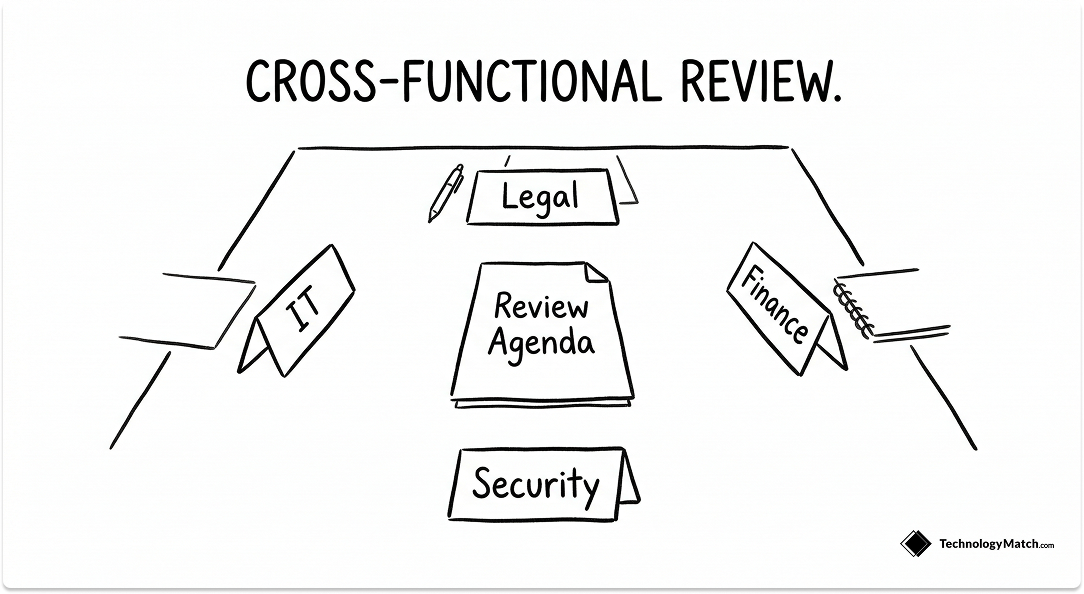
What it is: Establish regular forums that bring together IT, procurement, finance, legal, security, and business stakeholders to review vendor performance, discuss optimization opportunities, and make strategic decisions about vendor relationships.
Why it matters: IT vendor management fails when IT tries to do it alone. Finance holds budget authority. Legal holds contract authority. Security holds risk authority. Business units hold the operational context that determines whether a vendor is actually delivering value. Decisions made without all of those inputs are incomplete.
How to implement:
Create vendor review boards for tier 1 relationships with:
- Clear membership: IT, procurement, finance, legal, security, and business unit leaders
- Defined meeting cadence: quarterly for strategic vendors, annually for others
- Standard agenda: performance review against KPIs, risk assessment update, optimization opportunities, and renewal recommendations
- Decision-making authority for renewals, contract changes, and relationship escalations
Establish communication protocols:
- Regular touchpoints with business unit leaders on vendor impact and adoption
- Collaboration with procurement on renewal strategy and negotiation positioning
- Partnership with security on risk assessments and compliance findings
- Alignment with finance on budget and ROI against original business case
Document every decision and action item with a named owner and deadline.
Common mistake: Creating review boards that become talking shops without decision authority or accountability for outcomes.
The payoff: Cross-functional alignment prevents siloed decisions, surfaces issues earlier, combines complementary expertise, and ensures vendor decisions reflect enterprise priorities rather than departmental preferences.
Best Practice 10: Build Strategic IT Vendor Partnerships, Not Just Transactional Contracts

What it is: Build genuine relationships with strategic vendors through regular communication, joint problem-solving, roadmap alignment, and mutual accountability that goes beyond contract enforcement.
Why it matters: The best vendor relationships are partnerships where both sides are invested in mutual success. Strategic vendors become extensions of your team. They proactively solve problems, prioritize your escalations when resources are constrained, and align their roadmap with your needs. That level of engagement does not come from enforcing SLAs. It comes from building the relationship deliberately.
How to implement:
- Establish executive sponsor relationships for tier 1 vendors so your leadership and theirs have a direct relationship independent of the account management layer
- Conduct quarterly business reviews that go beyond SLA reporting: discuss strategic initiatives, share feedback on what is working and what is not, explore opportunities for deeper value creation
- Create joint success metrics that align vendor incentives with your outcomes
- Communicate regularly during calm periods, not just during incidents
- Provide constructive feedback and recognition when performance is strong
- Involve vendors early in planning for initiatives where they can add meaningful input
Document every material commitment, escalation, and decision in the vendor record. Memory is not a governance mechanism. When account teams change or negotiations get difficult, the documentation is what makes your position defensible.
Common mistake: Treating all vendor relationships as purely transactional, missing the strategic value that comes from true partnerships with critical vendors.
The payoff: Vendors that proactively solve problems, prioritize your needs, provide early access to roadmap developments, and deliver value beyond the contract because they are invested in your success.
From Operational Burden to Strategic Advantage
IT vendor management does not have to be the chaotic, stressful mess it is for most leaders. The difference between drowning in vendor relationships and managing them strategically is not talent or resources. It is intentionality.
The IT leaders who master vendor management best practices share a common trait: they treat vendor relationships as strategic assets, not administrative necessities. They invest time upfront in selection and contracting because they know it saves exponential time later. They build systems and processes that scale because they understand manual approaches break down. They cultivate relationships during calm periods because they know crises are inevitable.
Start with visibility. Conduct the vendor inventory audit you have been postponing. Identify your top vendors by spend and strategic importance. Review what is renewing in the next six months. Pick one vendor management best practice and implement it this week.
The personal payoff is real. Less stress from unexpected renewals and budget overruns. More credibility with the C-suite through demonstrated cost savings and risk reduction. Greater strategic influence by freeing up time and mental energy for innovation instead of firefighting.
Looking for IT partners?
Find your next IT partner on a curated marketplace of vetted vendors and save weeks of research. Your info stays anonymous until you choose to talk to them so you can avoid cold outreach. Always free to you.
FAQ
What are vendor management best practices for IT leaders?
IT vendor management best practices include centralizing vendor data into a structured system of record, conducting risk-based vendor segmentation, establishing clear governance and approval processes, leveraging automation for renewal tracking and spend monitoring, building cross-functional review boards, mastering contract negotiation timing, prioritizing security assessments, and planning exit strategies. These practices transform IT vendor management from reactive chaos into a strategic advantage that reduces risk and controls cost.
How is IT vendor management different from general vendor management?
IT vendor management differs because technology vendors access sensitive data, integrate with core systems, and create security and compliance risks that can disrupt operations. Unlike commodity vendors, IT vendors require rigorous security assessments, ongoing compliance monitoring, complex integration planning, and business continuity strategies. Poor IT vendor management creates cascading failures across interconnected systems in ways that general vendor management frameworks were not designed to handle.
What are the four stages of the IT vendor management lifecycle?
The IT vendor management lifecycle includes strategic sourcing that focuses on business outcomes, contract negotiation that secures favorable terms and enforceable SLAs, ongoing management through centralized tracking and structured business reviews, and optimization or exit decisions based on performance data. Mastering each stage is essential for effective vendor management best practices. Weaknesses at any stage compound at the stages that follow.
How can IT leaders reduce costs through better vendor management?
IT leaders reduce costs through vendor management best practices by eliminating redundant licenses, negotiating during vendor fiscal year-ends for discounts, consolidating spend for volume pricing, using usage analytics to identify waste, preventing auto-renewals at list price, and entering every renewal with market benchmark data and a credible alternative. Most organizations recover 20-30% of software spend through structured IT vendor management applied consistently.
What tools help with IT vendor management at scale?
IT vendor management at scale requires vendor management platforms like Vendr, SaaS management solutions like Zylo or Productiv, and contract lifecycle management systems. These tools automate renewal tracking, provide usage analytics, flag compliance issues, generate dashboards, and use AI for contract analysis, enabling small teams to manage large vendor portfolios effectively.