



The 7 Step Supplier Selection and Evaluation Process
A complete 7-step framework for IT and procurement teams: define requirements, build a weighted scorecard, run RFx, conduct due diligence, and negotiate contracts that protect your organisation.

What is supplier evaluation?
Supplier evaluation is a structured, criteria‑driven discipline for identifying, evaluating, and awarding third parties that can reliably deliver the goods, services, or technology your organization needs. In practice, the supplier selection process translates business requirements into comparable proposals, applies explicit supplier evaluation criteria, and documents a defensible decision.
For IT leaders, this discipline safeguards security and compliance, preserves architectural integrity, and accelerates time‑to‑value by aligning Procurement, Security, Legal, Finance, and the business around a single decision framework.
It spans SaaS and platforms, implementation partners, managed services, hardware, and specialized providers, and ends with clearly defined service levels, data protections, integration approaches, onboarding plans, and performance metrics.
How it differs from adjacent practices:
- Strategic sourcing explores markets and shapes demand; this stage makes the specific award decision.
- Procurement executes purchasing and contracting; this stage frames the evaluation and scoring.
- supplier management governs performance after signature with KPIs, risk reviews, and continuous improvement.
Typical inputs include a problem statement, scope and constraints, stakeholder requirements, risk thresholds, and a target business case. Typical outputs include an awarded supplier, negotiated terms, and a clean operational handoff with KPIs and governance.
Think of supplier evaluation as the bridge between strategy and execution—turning intent into a well‑qualified, low‑risk partnership.
When you're evaluating suppliers, sometimes you don't have the time or bandwidth for it. Which is where we can help. You can talk to us about your requirements and we will give you a shortlist of suppliers that fit.
Why is supplier evaluation important?
Choosing the right partners shapes cost, risk, resilience, and speed-to-value for years. Effective supplier evaluation turns a high-stakes decision into a repeatable capability that consistently delivers better fit and fewer surprises.
A disciplined supplier evaluation process creates transparency and accountability. By applying clear supplier evaluation criteria and documenting how scores lead to the award, organizations reduce bias, satisfy audit requirements, and protect budget and reputation.
It also drives performance and innovation. Comparable proposals, scripted demos, and targeted pilots reveal true capability, while strong SLAs and exit terms protect availability and future flexibility.
Robust evaluation also strengthens resilience. Diversified sourcing, geographic redundancy, and contractual exit paths reduce concentration risk and vendor lock‑in. Financial health checks, compliance attestations, and security evidence (e.g., SOC 2, ISO 27001) surface weaknesses before they impact operations.
And by assessing roadmaps and integration maturity, you ensure today’s choice can scale with demand, support new use cases, and adapt to regulatory change without costly rework.
Finally, it aligns stakeholders and sets up long-term success. A clean handoff with KPIs, QBRs, and improvement backlogs provides a running start for supplier management, so value is realized, risks are tracked, and the partnership keeps improving after the contract is signed.
Step 1: Define and align business requirements
Clarity at the front end prevents chaos later. Start by translating the problem you're solving into concrete outcomes, guardrails, and measures of success. This is where the supplier evaluation process becomes real: you anchor scope, budget, timelines, and risk tolerance so every bidder is solving the same defined problem.
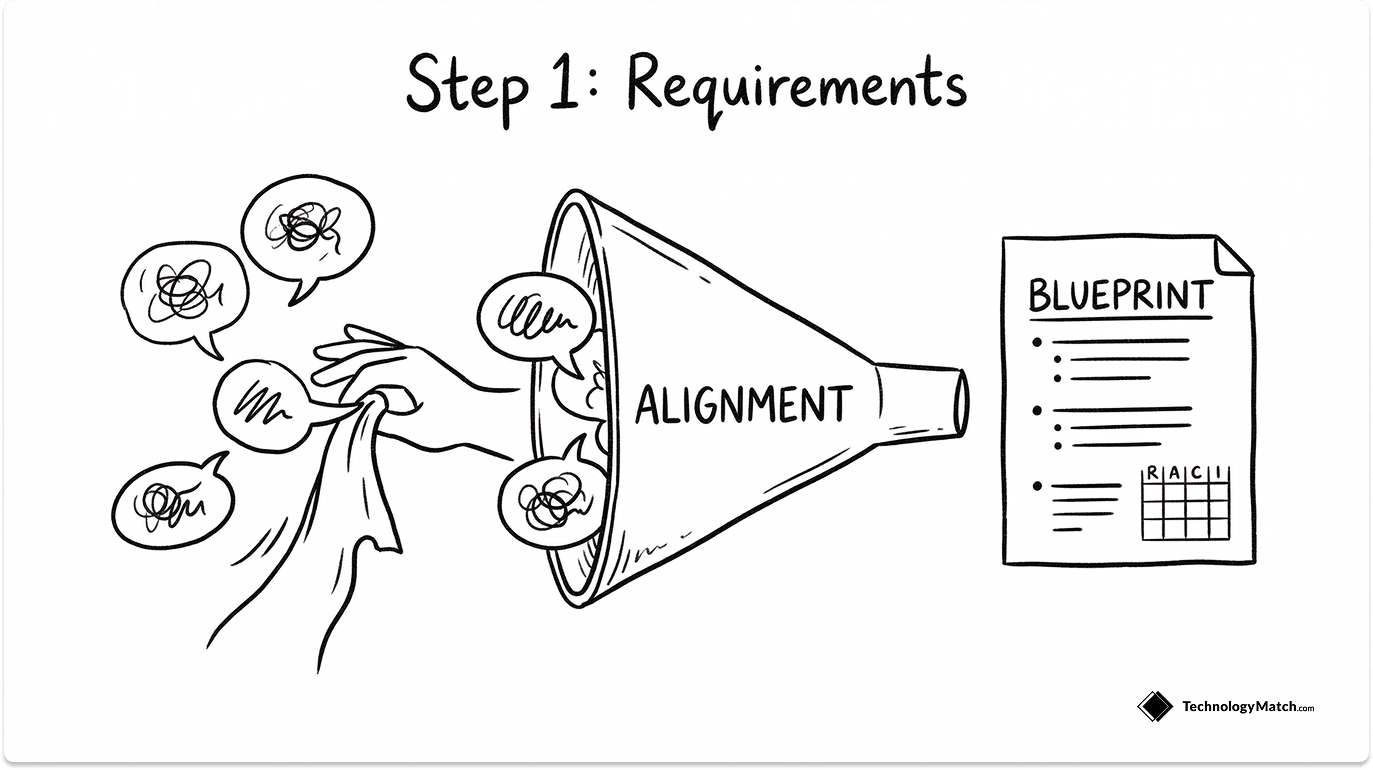
Capture what "good" looks like. Specify use cases, service levels, data flows, volumes, and nonfunctional needs such as availability targets, RTO/RPO, and support hours. Lock in interoperability requirements early—APIs, eventing, SSO/SCIM, data models, and reporting—so integration effort is visible and comparable.
Set your baselines for security and compliance. Call out required attestations (e.g., SOC 2, ISO 27001), privacy obligations (GDPR/CPRA), data residency, encryption standards, incident response, and audit rights. These items later convert into measurable supplier evaluation criteria and become gating checks during due diligence.
Align stakeholders and decision rights. Establish a cross‑functional RACI (IT, Security, Procurement, Legal, Finance, business owners), define scoring responsibilities, and agree on when to pilot versus award directly. Document everything in a brief BRD with success metrics, a target TCO model, and a change‑control approach.
Establish quality thresholds and performance benchmarks early. Define specific, measurable quality standards rather than vague expectations—for example, "defect rate below 0.1%" or "99.9% uptime" instead of "high quality" or "reliable service."
These concrete benchmarks become essential supplier evaluation criteria that prevent ambiguity during scoring and create accountability once the supplier management phase begins.
Map dependencies and integration touchpoints systematically. Document all systems, data sources, and processes that will interact with the supplier's solution. Identify single points of failure, critical path dependencies, and handoff protocols between internal teams and the supplier.
This mapping exercise surfaces hidden complexity early and ensures your supplier evaluation accounts for the true cost and risk of integration, not just the standalone solution.
Define measurable business outcomes tied to strategic objectives. Go beyond functional requirements to articulate how success will be measured in business terms: cost savings, revenue enablement, risk reduction, cycle time improvement, or customer satisfaction gains.
Quantify baseline metrics and target improvements so proposals can be compared on business impact, and supplier management can track value realization against the original case.
Build in flexibility and scalability requirements from day one. Specify how the solution must adapt to volume growth, geographic expansion, new use cases, or regulatory changes over the contract lifetime. Define acceptable change management processes, version upgrade cadences, and backward compatibility expectations. This foresight prevents lock-in and ensures your supplier evaluation favors partners who can evolve with your needs rather than requiring costly replacements.
The outputs like a crisp requirement pack, evaluation rubric, and decision governance, set up fair competition, comparable bids, and a clean handoff into contracting and supplier management once an award is made.
Step 2: Establish evaluation criteria and sourcing strategy
This step translates objectives into a fair, comparable playing field. You'll decide how to evaluate proposals, how to balance value against risk, and which sourcing model fits your constraints, so the supplier evaluation process is consistent and auditable.

Start with a weighted scorecard. Define supplier evaluation criteria across cost, capability, delivery, security and privacy, compliance, financial stability, ESG, and roadmap fit. Assign weights that reflect what the business values most, and specify deal‑breakers such as mandatory certifications, data residency, or minimum service levels.
Choose your sourcing approach. Decide single versus multi‑source, regional redundancy, and whether to run discovery via RFI before an RFP or RFQ. Set rules for demos, proof‑of‑concepts, bidder Q&A, and how addenda will be shared to keep the field informed and comparable.
Clarify who scores what, how ties are resolved, and when an executive gate is required.
Incorporate total cost of ownership into your supplier evaluation criteria. Look beyond unit pricing to include implementation costs, training, ongoing support, integration effort, license true-ups, exit costs, and opportunity costs of delayed deployment. Build a standardized TCO model that all bidders must populate so proposals are financially comparable across their full lifecycle, not just the initial contract period.
Define minimum qualification thresholds before weighting. Establish pass/fail gates for critical requirements such as required certifications, minimum financial reserves, or mandatory geographic presence, that eliminate unqualified bidders before scoring begins. This two-tier approach prevents a strong price from masking fundamental capability gaps and keeps your supplier evaluation focused on viable partners.
Build evaluation criteria that test adaptability and partnership quality. Include scoring dimensions for responsiveness during the RFx process, quality of references, willingness to customize terms, transparency in pricing breakdowns, and cultural fit indicators. These softer signals often predict how well supplier management will function after the contract is signed, yet they're frequently overlooked in favor of purely technical or financial measures.
Document governance. Publish the scoring rubric, evaluation team roles, and the decision memo template that will capture rationale and risks. This upfront clarity reduces disputes, shortens cycle time, and ensures the eventual supplier evaluation leads to a clean handoff into contracting, onboarding, and ongoing supplier management. Archive artifacts for learning and future cycles.
How to Build a Supplier Scorecard
A supplier scorecard is the operating document for Step 2. It converts your evaluation criteria into a weighted, comparable scoring instrument. Without it, you are running a subjective process with the appearance of objectivity.
The scorecard serves two purposes: it forces internal alignment on what actually matters before vendors respond, and it gives you a defensible audit trail for the award decision.
Structure your scorecard around five weighted categories:
- Technical capability (25–30%) — Functional fit against your use cases, integration maturity (APIs, SSO/SCIM, data models), and nonfunctional requirements (uptime SLAs, RTO/RPO, scalability).
- Security and compliance (20–25%) — SOC 2 Type II, ISO 27001, GDPR/CPRA alignment, data residency, encryption standards, subprocessor controls. Treat this as a pass/fail gate before scoring begins.
- Total Cost of Ownership (20%) — License fees, implementation, migration, training, support tiers, integration effort, true-up clauses, and exit costs. Never score on headline price alone.
- Vendor stability and risk (15%) — Financial health, breach history, customer concentration, insurance coverage, and supply continuity. A technically superior vendor with a single-customer revenue dependency is a continuity risk.
- Partnership quality (10–15%) — Responsiveness during the RFx process, reference quality, roadmap transparency, and escalation access. How a vendor behaves during the sale predicts how they behave post-signature.
Scoring mechanics that matter:
- Use a 1–5 scale per criterion, not percentages. Percentages create false precision.
- Apply weights before scoring, not after. Post-hoc weighting is how bias enters the process.
- Define what a "3" looks like for each criterion in writing. Calibration prevents evaluators from scoring the same response differently.
- Set hard pass/fail gates for non-negotiables (missing SOC 2, below-minimum SLA, no data residency support). A vendor that fails a gate does not enter the scorecard regardless of performance elsewhere.
Outputs: Completed scorecard per vendor, a ranked comparison table, and a decision memo that links the award to specific scores. This is your audit trail.
Use the scorecard below to get a recommendation we recommend you to work with and which ones we don't, based on your priorities.
Step 3: Build a longlist and shortlist
The goal of this stage is to map the market, filter for basic fit, and create a competitive field that can be compared efficiently. Done well, it prevents wasted cycles later and keeps the supplier evaluation focused on partners that can actually deliver.

Start wide. Use analyst coverage, peer references, user communities, industry directories, marketplaces, and events to assemble a longlist. Apply clear pre‑qualification gates that mirror your supplier evaluation criteria: capability fit to use cases, required certifications, integration approach, geographic coverage, and capacity to deliver within your timeline. Track findings in a simple RAG log so red flags are visible and auditable.
Run early risk checks. Review financial health, ownership and sanctions, breach history, security attestations (e.g., SOC 2, ISO 27001), privacy posture, and key subcontractors. Scan litigation or negative press, confirm insurance levels, and request a high‑level delivery plan to validate feasibility. Remove vendors that fail non‑negotiables rather than carrying them forward.
Leverage diverse intelligence sources to avoid blind spots. Supplement traditional analyst reports with practitioner communities, GitHub activity for open-source components, customer review platforms, and direct outreach to peers in similar industries. Cross-reference claims against independent evidence such as public case studies, conference presentations, or third-party benchmark, to validate vendor maturity and track record before investing time in formal supplier evaluation.
Apply consistent scoring even at the longlist stage. Use a simplified version of your full supplier evaluation criteria to rate each candidate on a 1-5 scale across key dimensions: functional fit, technical maturity, financial stability, and strategic alignment. This lightweight scoring creates an audit trail, surfaces consensus quickly, and makes shortlist decisions defensible when stakeholders question why certain vendors were excluded.
Test responsiveness and engagement quality early. Note how vendors handle initial inquiries—response time, quality of answers, willingness to provide references or documentation, and ability to articulate your use case back to you. Poor engagement during discovery often predicts poor performance during supplier management, so treat early interactions as a preview of the partnership experience.
Down‑select deliberately. Aim for 15–25 in the longlist, narrow to 6–8 for RFI discovery, and take the top 3–4 to full RFP. Publish the rationale for inclusions and exclusions, note assumptions, and align stakeholders on who advances and why.
This discipline creates a fair, comparable field for the next steps in the supplier evaluation process and sets up a clean transition to contracting and, ultimately, effective supplier management.
Step 4: Run RFx (RFI/RFP/RFQ)
This is where you convert well‑defined requirements into comparable proposals. A structured RFx event levels the field, reveals true capability, and keeps the supplier evaluation process transparent and auditable from first question to final score.
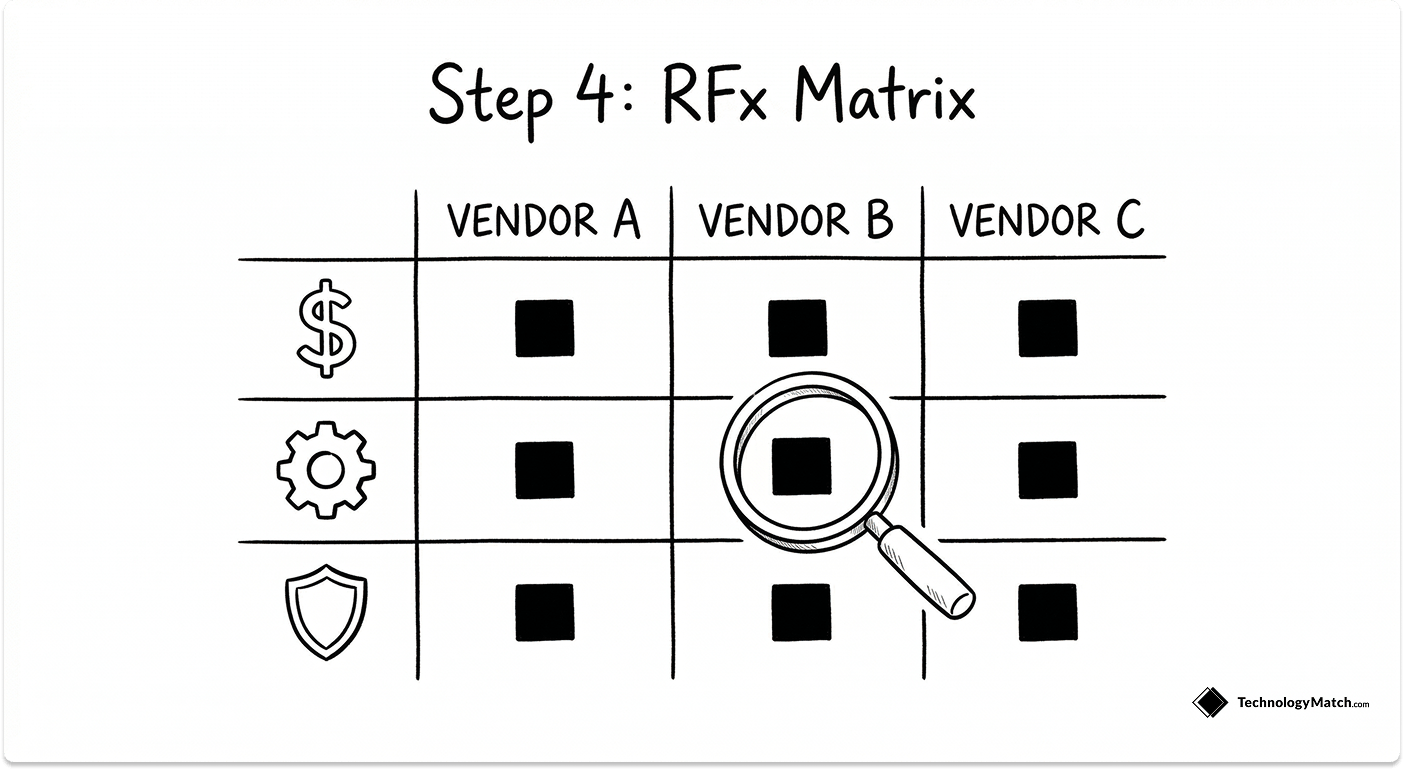
Use an RFI to explore the market and validate approaches, an RFP to compare end‑to‑end solutions against scripted scenarios, and an RFQ when scope is fixed and you're optimizing price. Pair documents with demo scripts and, for higher‑risk bets, a proof‑of‑concept that exercises real data, integrations, and support workflows.
Build RFx packs that map directly to your supplier evaluation criteria. Include scope, volumes, SLAs/SLOs, acceptance criteria, implementation and change approaches, security and privacy requirements, data residency, DPA terms, architecture and integration expectations, roadmap questions, and a standardized pricing template with TCO assumptions. Publish the scoring rubric and response format so bidders know how value will be measured.
Structure questions to expose differentiation, not just compliance. Design scenarios that reveal how vendors handle edge cases, scale constraints, failure modes, and conflicting requirements. Ask for specific examples, "Describe how your solution handled a 10x traffic spike for a similar client", rather than yes/no checkboxes. This approach surfaces real capability and makes your supplier evaluation more predictive of actual performance.
Mandate response formats that enable apples-to-apples comparison. Require vendors to populate standardized templates for pricing (with line-item breakdowns), implementation timelines (with milestone dependencies), and technical architecture (with integration points clearly labeled). Prohibit marketing content in technical sections and set page limits to force prioritization. Consistent formats accelerate scoring and reduce the risk that a well-designed proposal masks a weak solution.
Use the RFx process itself as a supplier evaluation signal. Track which vendors ask clarifying questions, meet deadlines, follow instructions, and proactively flag risks or constraints. Vendors who struggle to manage a structured RFx often struggle with structured supplier management later. Conversely, those who demonstrate discipline, transparency, and collaborative problem-solving during the process tend to be stronger long-term partners.
Run the event with discipline. Hold a bidder briefing, route all questions through a single channel, issue addenda to all participants simultaneously, and enforce deadlines. Require demos to follow your script, keep evaluators independent, log conflicts of interest, and maintain a complete decision trail for audit and stakeholder review.
The outputs should be an apples‑to‑apples comparison set, a defensible shortlist for validation, and a POC plan that de‑risks edge cases. This rigor shortens time to a confident award and sets up a cleaner transition into negotiation, contracting, and ongoing supplier management.
Step 5: Evaluate, validate, and due diligence
This stage turns proposals into proof. Move from claims to evidence so your supplier evaluation is based on verified capability, real risk posture, and total value rather than slideware.

Anchor evaluation in a weighted scorecard tied to your supplier evaluation criteria. Score functionality, interoperability, delivery method, security and privacy, compliance, commercial terms, and roadmap fit. Model total cost of ownership with clear assumptions. Use risk gates for non‑negotiables so bids that fail a must‑have don't linger.
Validate with hands‑on work. Run scripted demos against your scenarios, not vendor theater. Where impact or complexity is high, run a pilot or POC with representative data, integrations, and support workflows. Capture measurable outcomes such as performance baselines, data accuracy, migration effort, and change‑management load to keep the supplier evaluation objective.
Conduct independent reference checks with structured questions. Go beyond vendor-provided references to seek out back-channel contacts in your network who have worked with the supplier. Use a consistent question set that probes actual performance against SLAs, responsiveness during incidents, quality of account management, ease of doing business, and how well the supplier handled contract changes or disputes. These real-world insights often reveal gaps that formal supplier evaluation scoring misses.
Stress-test operational readiness and support capabilities. Request evidence of actual support ticket resolution times, escalation procedures, and customer success team structures. Ask vendors to walk through a simulated critical incident such as a data breach, service outage, or failed deployment, to assess their incident response maturity. Strong operational capability is essential for effective supplier management, yet it's rarely validated until after problems emerge.
Quantify hidden costs and implementation risks. Challenge optimistic timelines with questions about resource availability, dependency management, and change freeze windows. Request detailed implementation plans with named resources, not generic roles. Model scenarios for cost overruns, scope changes, and delayed go-lives to understand total exposure. This level of scrutiny ensures your supplier evaluation accounts for realistic delivery risk, not best-case vendor projections.
Go deep on assurance. Review SOC 2/ISO 27001 reports, pen‑test summaries, vulnerability management, subprocessors, DPAs, breach history, and incident response. Confirm financial viability, insurance, beneficial ownership, sanctions, and export controls.
For services, sample CVs, delivery playbooks, and bench capacity; for hardware, verify certifications, supply continuity, and RMA processes. Site visits or virtual audits can validate process maturity.
Close with triangulation. Conduct like‑for‑like reference calls, analyze support SLAs and observability, and check release cadences and backward compatibility. Document findings, residual risks, and mitigation in a decision memo so the supplier evaluation process remains transparent and defensible.
The outputs are a ranked comparison, clear go/no‑go on each bidder, and a de‑risked path into negotiation. You also create a head start for supplier management by capturing KPIs, reporting expectations, and improvement backlogs you will carry into contract and onboarding.
Step 6: Negotiate and award
Negotiation turns preferred proposals into balanced, durable agreements. Keep the conversation anchored to the value, risk, and outcomes defined earlier so the supplier evaluation process ends with a contract that reflects what you actually need, not just what's easy to sign.

Shape the commercial model for total value. Normalize pricing to your usage assumptions, align term lengths, consider volume tiers and ramp schedules, and address implementation, training, and change costs. Lock indexation rules, renewal caps, and incentives tied to milestones so the deal supports the business case established during supplier evaluation.
Translate performance into enforceable commitments. Define SLAs/SLOs for availability, response, and resolution, with meaningful credits, escalation paths, and service‑improvement plans. Require transparent reporting, incident reviews, and governance forums so delivery and accountability remain visible.
Negotiate performance incentives and penalties that drive behavior. Move beyond basic service credits to structure gain-share arrangements for exceeding targets, early delivery bonuses, or innovation commitments tied to your roadmap. Conversely, establish meaningful consequences for repeated failures—such as right-to-terminate clauses, price reductions, or mandatory improvement plans. These mechanisms align supplier interests with your success and create leverage for effective supplier management throughout the contract term.
Secure comprehensive audit and transparency rights. Ensure contracts allow you to verify compliance with security standards, review subcontractor arrangements, audit invoices against usage, and inspect operational metrics on demand. Include rights to third-party assessments, especially for critical services where supplier evaluation revealed residual risk. Transparency provisions prevent disputes and enable proactive supplier management by making performance visible and verifiable.
Build change management and dispute resolution mechanisms upfront. Define how scope changes, price adjustments, and service modifications will be requested, evaluated, and approved, including turnaround times and escalation paths. Establish a tiered dispute resolution process (operational, executive, mediation, arbitration) to resolve conflicts without litigation. Clear change control prevents scope creep and cost surprises, while structured dispute processes protect the relationship when disagreements arise during supplier management.
Protect data and future flexibility. Specify data ownership, portability formats, deletion timelines, and transition assistance. Clarify IP boundaries (background vs. foreground), restrict non‑permitted use of your data, and secure exit rights that prevent lock‑in. For critical software, consider escrow and step‑in provisions.
Allocate risk deliberately. Set liability caps that scale with exposure, carve‑outs for data breaches and IP infringement, and clear indemnities. Include audit rights, subcontractor approvals, regulatory obligations, cyber insurance, and compliance attestations aligned to your supplier evaluation criteria.
Conclude with a documented award. Capture final scoring, exceptions, residual risks, and mitigations in a decision memo, obtain required approvals, and issue the notice of award. This creates a clean transition into contracting, onboarding, and ongoing supplier management.
Step 7: Contract, onboard, and manage performance
Turn the preferred bid into a working agreement that mirrors how you'll run the service. Finalize the MSA, SOW, SLA, and DPA, plus security schedules, data handling terms, and change control.

Tie commitments back to the supplier evaluation criteria and assumptions used to score proposals so the contract reflects the same outcomes promised during the supplier evaluation process. Document service levels, reporting cadences, and acceptance criteria to keep delivery measurable from day one.
Onboard with precision. Set up vendor master data, tax and banking verification, and secure access via SSO with least‑privilege roles. Baseline architecture, data flows, and integrations; publish runbooks for incident, request, and change workflows; and align release calendars with your CAB.
If migration is involved, lock cutover plans, rollback steps, and data validation routines before go‑live. This is where a clear supplier evaluation handoff prevents rework.
Create a phased onboarding roadmap with clear milestones and acceptance gates. Assign transition managers from both sides, establish daily standups during critical phases, and require sign-off at each stage. This prevents chaotic go-lives and sets the foundation for disciplined supplier management.
Automate performance monitoring from day one. Instrument dashboards that track the metrics defined during supplier evaluation: availability, response times, error rates, and business outcomes. Automated telemetry makes supplier management transparent, objective, and less administratively burdensome than manual reporting.
Establish governance that scales. Stand up dashboards for availability, MTTR, quality/defect rates, delivery timeliness, and invoice accuracy. Schedule QBRs and weekly operational reviews, and track value realization against the original business case. Effective supplier management uses the same metrics you evaluated, only now they are live, automated, and tied to improvement actions.
Build a continuous improvement pipeline beyond operational metrics. Use quarterly business reviews to explore new use cases, cost optimizations, and innovation opportunities. Create a shared backlog of improvement initiatives that transforms supplier management from reactive oversight into strategic partnership.
Manage risk continuously. Monitor cybersecurity posture, privacy obligations, and regulatory attestations; exercise audit rights; and review subcontractors and data subprocessors annually.
Keep a living risk register with owners and mitigations, and refresh capacity and scalability assumptions as demand changes. Strong supplier management also plans for change: agree on a roadmap forum, service‑improvement plans, and innovation sprints that evolve the partnership.
Conduct periodic supplier evaluation refreshes every 12-18 months. Reassess against market alternatives, pricing trends, and evolving requirements to maintain competitive value and prevent complacency during supplier management.
Always maintain exit readiness. Define data return and deletion timelines, knowledge transfer, transition assistance, and escrow or step‑in rights. Having a practical exit plan reduces lock‑in and reinforces disciplined supplier evaluation that protects value across the full lifecycle.
Closing thoughts
Treating vendors as strategic partners starts with clarity and discipline. A repeatable framework turns complex choices into confident decisions, shortens cycle time, and reduces avoidable risk. With tight alignment across stakeholders, clear requirements, and transparent scoring, you transform buying from a scramble into an advantage that compounds over multiple deals.
This is the promise of a modern supplier evaluation process. Define measurable outcomes, test claims with evidence, and negotiate contracts that mirror how the service will actually run. Use explicit supplier evaluation criteria to anchor trade‑offs, document rationale, and keep audits painless.
After signature, operationalize the same metrics and cadence so delivery remains visible, issues are corrected quickly, and value is realized on schedule. Strong governance, practical exit planning, and continuous improvement ensure today’s award remains the right call tomorrow. Done well, supplier evaluation builds resilience, accelerates innovation, and protects budgets without sacrificing speed.
And by bridging evaluation with supplier management, you convert a one‑time purchase into an ongoing capability that continually improves performance, reduces risk, and strengthens trust between business and technology.
Use lessons learned to refine templates, coach evaluators, and sharpen governance so each cycle runs faster, with fewer surprises, and demonstrably better outcomes for stakeholders over time.
Looking for IT partners?
Find your next IT partner on a curated marketplace of vetted vendors and save weeks of research. Your info stays anonymous until you choose to talk to them so you can avoid cold outreach. Always free to you.
FAQ
What is the supplier evaluation process and what are its 7 steps?
Define requirements; set criteria and sourcing strategy; longlist/shortlist; run RFx; evaluate and do due diligence; negotiate and award; contract, onboard, and govern.
What are the key supplier evaluation criteria for IT and services?
Security and compliance (e.g., SOC 2, ISO 27001), interoperability and integrations, capability and quality, delivery capacity, financial stability, TCO, roadmap fit, ESG posture, and reference performance.
How long does supplier evaluation take, and how can we accelerate it?
Simple renewals: 4–6 weeks; moderate buys: 8–12; complex programs: 12–20. Accelerate with crisp requirements, standardized RFx packs, scripted demos/POCs, a weighted scorecard, and fast governance gates.
How do RFI, RFP, and RFQ fit into supplier evaluation?
Use RFI to explore approaches and filter the field, RFP to compare end‑to‑end solutions against scenarios, and RFQ to price a well‑defined scope with standardized commercial terms.
What’s the difference between supplier evaluation and supplier management?
Supplier evaluation decides who to award using structured criteria and due diligence; supplier management governs performance post‑contract with KPIs, reviews, risk controls, and continuous improvement.


