What are the Best MDR and XDR Providers for Security Teams in 2026
MDR and XDR let resource‑strapped security teams get 24/7 expert threat detection, reduced alert noise, and strong SOC coverage without building an in‑house SOC. This guide explores 5 solutions for IT leaders.

If you're an IT leader managing security with a skeleton crew, you've likely been told to "just build a SOC" or "hire more analysts." But building an internal SOC costs $1M–$3M+ annually, and good security talent is nearly impossible to find and retain in 2026.
The practical answer for resource-strapped security teams isn't doing nothing or breaking the budget, it's Managed Detection and Response (MDR) and Extended Detection and Response (XDR).
MDR gives you outsourced security experts who monitor, investigate, and respond to threats 24/7. XDR gives you a platform that unifies security telemetry and reduces alert noise. Together, they're the most realistic path to effective security without building an entire SOC from scratch.
This article walks through the best MDR and XDR providers for resource-strapped security teams in 2026, with a focus on SOC quality, integration with existing tools, SLAs that actually matter, and transparent pricing.
How Are MDR and XDR Different?
Every security vendor now claims "MDR" or "XDR," but IT leaders need clarity on what these terms actually mean.
MDR: Managed Detection and Response (The Service)
MDR is a managed security service where a third-party SOC monitors your environment 24/7, investigates threats, and responds on your behalf. You get human security analysts (the "managed" part), threat hunting, investigation and triage, incident response and containment, plus reporting and compliance documentation.
MDR solves the problem of lacking internal SOC capacity, needing expert analysts, or being unable to afford round-the-clock coverage. It's about people and process, outsourced security operations.
XDR: Extended Detection and Response (The Technology)
XDR is a security platform that collects and correlates telemetry from multiple sources—endpoints, network, cloud, email, identity—to detect threats and enable coordinated response. You get unified visibility across your security stack, automated threat correlation and alert prioritization, integrated response capabilities, and reduced tool sprawl.
XDR solves the problem of too many disconnected security tools, alert fatigue, and a lack of context across security layers. It's about platform and automation, which are better technologies to reduce noise.
Why You Often Need Both
If you have no internal security team, you need MDR (service plus people). If you have some security staff but they're drowning in alerts, you need XDR (platform to reduce noise). If you're resource-strapped, which describes most IT leaders, you need both: an XDR platform managed by an MDR service.
Many modern providers offer MDR built on XDR platforms. This is the sweet spot for resource-strapped teams.
See how EDR tools like Kandji (now Iru) compares to other tools like Microsoft Intune and Jamf Pro.
How to Evaluate MDR and XDR Solutions
Before talking to vendors, answer these questions: What's our current security stack (EDR, SIEM, firewall, cloud security)? What are our biggest gaps (coverage, expertise, alert overload)? What's our budget and team capacity for onboarding?
SOC Quality and Analyst Expertise
The quality of the MDR provider's SOC determines whether you get real protection or just alert forwarding. Evaluate analyst experience level (seasoned threat hunters vs. junior analysts following runbooks), analyst-to-customer ratio (look for less than 50:1), analyst location and shift coverage, threat intelligence sources, proactive hunting frequency, and escalation paths to senior analysts.
Ask vendors: What's the average experience level and tenure of your SOC analysts? What's your analyst-to-customer ratio? How often do you proactively threat hunt versus just responding to alerts? Can we speak directly with your SOC team during incidents?
Integration with Existing Security Stack
Ripping out your existing EDR or SIEM is expensive, risky, and disruptive. The best MDR/XDR solutions work with what you already own. Evaluate EDR compatibility (CrowdStrike, SentinelOne, Microsoft Defender), SIEM integration, cloud and SaaS coverage (AWS/Azure/GCP, M365), network visibility, identity integration, and deployment requirements.
Ask vendors: Do you natively integrate with our specific EDR/SIEM/firewall? If we already have CrowdStrike/Defender/SentinelOne, can you use that as your sensor, or must we replace it? What's the deployment effort and timeline? Can you show us a customer reference using the same stack we have?
Response Capabilities and Incident Handoff
Detection without response is just expensive alerting. Evaluate containment actions (automatic vs. waiting for approval), response speed, communication methods (phone, email, Slack, Teams, ticketing integration), incident documentation quality, escalation processes during major incidents, and remediation guidance beyond just containment.
Ask vendors: Do you take containment actions automatically, or do you need our approval first? How do you communicate incidents—real-time alerts, daily summaries, portal updates? What level of detail do we get? What does your incident handoff look like?
Coverage Scope and Service Depth
"MDR" means different things to different vendors. Evaluate what's monitored (endpoints only, or endpoints plus network plus cloud plus email plus identity), what's included in base service (monitoring, triage, containment, threat hunting, forensics, compliance reporting), what costs extra (IR retainers, tabletop exercises, custom playbooks), and mean time to detect/respond.
Pricing Transparency and Total Cost
MDR/XDR pricing can be opaque with hidden costs. Evaluate pricing models (per-endpoint, per-user, per-device, tiered packages), what's included (onboarding, integrations, training), hidden costs (setup fees, data ingestion, premium support), scalability (linear pricing or volume discounts), and contract terms.
If you're looking for more enterprise options, see how CrowdStrike, SentinelOne, and Arctic Wolf compare to each other.
Now, let’s get into the solutions.
Blumira
Who they're best for
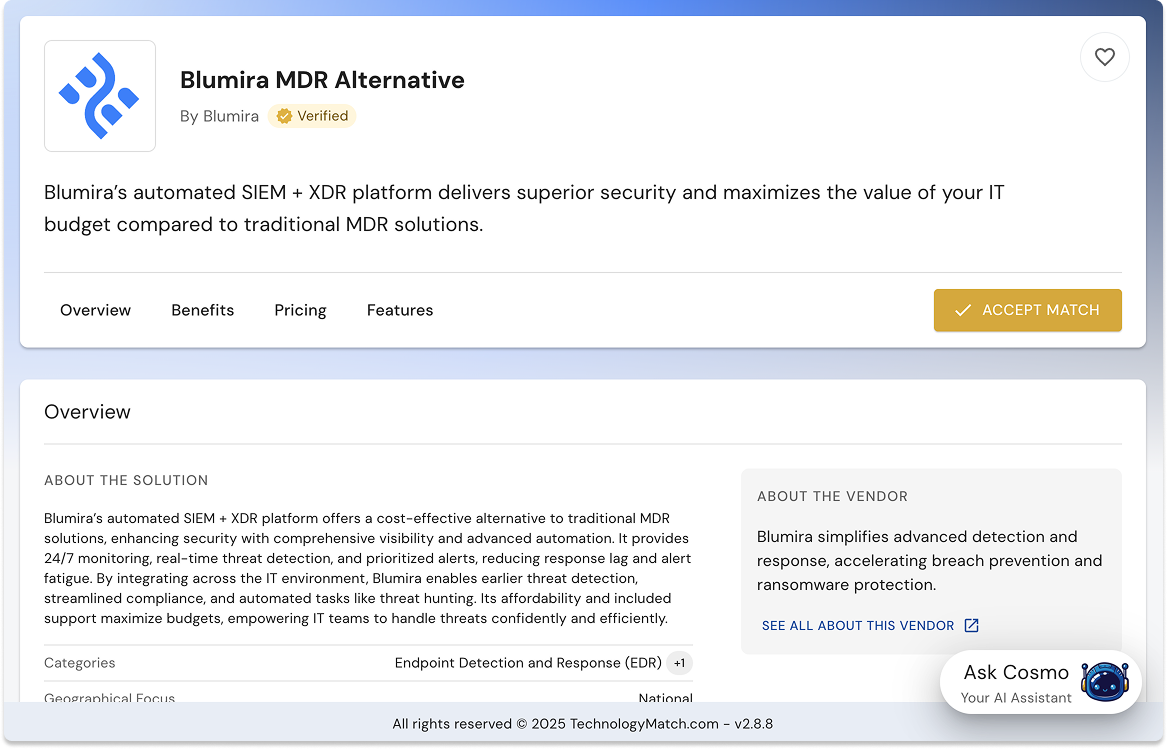
Blumira is ideal for small to mid-market organizations that want a SIEM plus XDR platform with optional managed services, rather than a traditional MDR model. They're best for teams that prefer automation and self-service with expert support available when needed, rather than fully outsourced security operations.
Key capabilities
Blumira provides a SIEM (Security Information and Event Management) platform combined with XDR capabilities that automate detection, triage, notification, and response. Their platform collects and normalizes data from applications, systems, servers, endpoints, firewalls, and cloud environments to provide continuous security monitoring with complete log retention.
Key differentiators include detection within one minute of initial activity (no manual triage delay), automated endpoint isolation to contain threats immediately, unlimited data ingestion at flat-fee pricing, one year of complete log history for compliance, and 24/7 access to their security team with 99.7% customer satisfaction and 18-minute average response time.
Strengths
Blumira's automation-first approach means the average user spends less than 15 minutes per day managing the platform—a stark contrast to traditional MDR services that still require significant interaction.
Their flat-fee unlimited data ingestion model eliminates surprise costs as you scale. Total log visibility and retention meets compliance and cyber insurance requirements.
The platform provides direct access to your logs with search, export, and reporting capabilities. Customer case studies show 60% reduction in support requests after implementation.
Limitations/Considerations
Blumira is a platform-first solution with managed services as an add-on, not a fully outsourced MDR in the traditional sense. Organizations wanting completely hands-off security operations may prefer traditional MDR providers.
Their approach requires some internal capacity to act on automated findings and guided response recommendations. Best suited for organizations comfortable with technology-driven security rather than purely people-driven services.
Questions to ask Blumira
- How does your automated detection and response compare to traditional MDR analyst workflows?
- What's the learning curve for our team to effectively use your platform?
- What level of support do we get from your security team—is it reactive only, or do you provide proactive hunting?
- How does pricing scale as we add more data sources and endpoints?
Quorum Cyber
Who they're best for
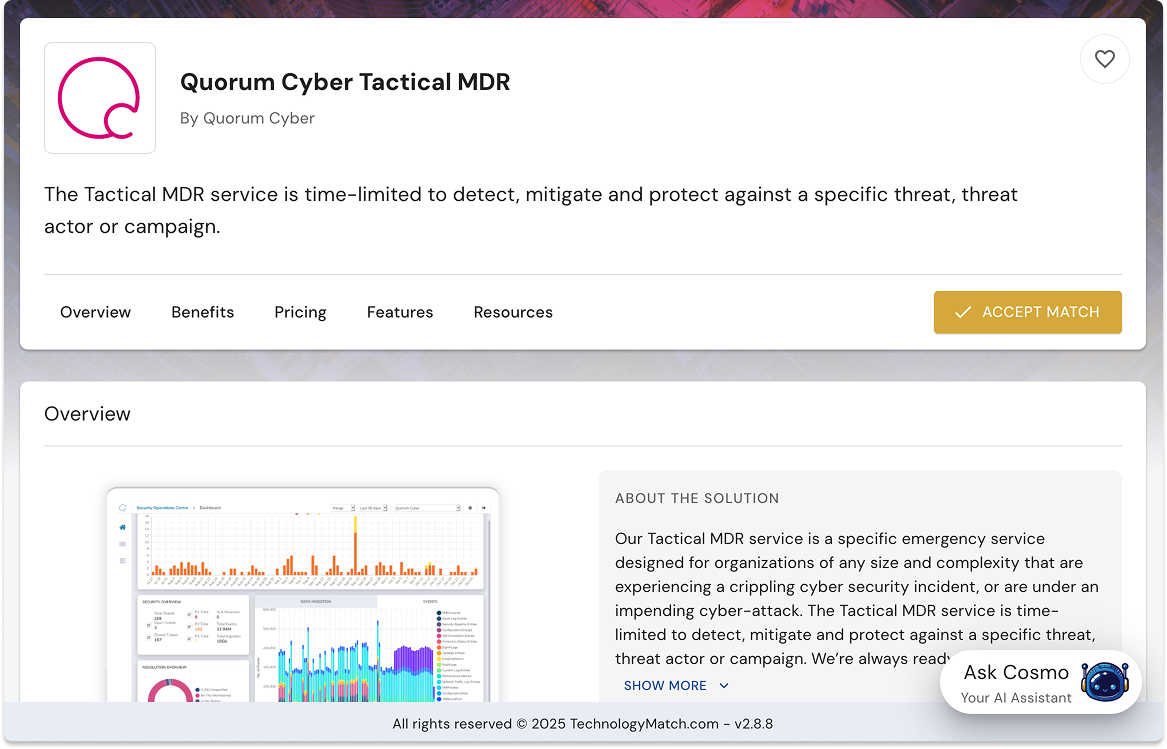
Quorum Cyber is ideal for organizations heavily invested in the Microsoft security stack (Microsoft 365, Microsoft Defender, Azure Sentinel) who want specialized expertise and a platform-agnostic approach. They're recognized in the 2025 Gartner Market Guide for MDR and won Microsoft Security MSSP of the Year.
Key capabilities
Quorum Cyber delivers managed detection and response through their Clarity platform, which provides real-time visibility, actionable insights, and seamless integration with existing tools.
Their service tiers include Clarity Defend (24/7 monitoring and response), Clarity Extend (enhanced coverage for Microsoft Cloud and third-party technologies), Clarity Protect (advanced detection and response), and Clarity Data (data security and DLP).
Their SOC is staffed with Microsoft-specialized analysts who provide proactive threat hunting, incident response, and continuous improvement recommendations. The Clarity platform serves as a unified command center for security operations, removing fog and providing structured paths to resilience.
Strengths
Quorum Cyber's deep Microsoft specialization means exceptional expertise in M365, Defender, Sentinel, and Azure security. Their platform-agnostic approach allows you to keep existing tools and data within your environment because you own the Microsoft licenses and data, and Quorum manages and adds value.
Limitations/Considerations
While they support third-party technologies through Clarity Extend, their core strength is Microsoft environments. Organizations with heavily diversified security stacks (Palo Alto, CrowdStrike, Splunk as primary platforms) may find better fits elsewhere.
Questions to ask Quorum Cyber
- What's your approach to integrating with non-Microsoft security tools in our environment?
- What are your specific SLAs for detection, triage, and containment across your Clarity service tiers?
- How do you handle threat hunting—frequency, scope, and reporting? Can we see examples of your Clarity platform and typical incident reports?
Red Canary

Who they're best for
Red Canary is ideal for organizations that want to keep their existing EDR (CrowdStrike, SentinelOne, Microsoft Defender, Carbon Black) and need expert MDR services layered on top. They're recognized as a leader in Forrester Wave for MDR and #1 in enterprise customer satisfaction in G2's Summer 2025 MDR Report with a 99% customer satisfaction score.
Key capabilities
Red Canary provides managed detection and response that integrates with your existing security stack rather than replacing it. Their platform combines detection-as-code engineering, proactive threat hunting, and agentic AI to uncover threats that other tools miss—they claim to find 4x more threats than traditional approaches.
Their service includes 24/7 expert SOC coverage, AI agents that reduce noise and accelerate investigations, threat intelligence tailored to your environment, and automated response capabilities. They offer managed phishing response, security data lake, training and tabletops, and seamless integration with major EDR, SIEM, cloud, and identity platforms.
Strengths
Red Canary's platform-agnostic approach means no rip-and-replace—they work with CrowdStrike, SentinelOne, Defender, Carbon Black, Palo Alto, AWS, GCP, and more. Their detection engineering and AI agents deliver high-fidelity alerts with full context, dramatically reducing false positives.
Rapid threat detection, excellent communication, and feeling like an extension of internal teams. They slash mean time to respond by 10x according to their materials.
Limitations/Considerations
Smaller organizations with limited budgets may find more cost-effective options. While they integrate broadly, optimal value comes from having a mature security stack already in place. Their AI agents and automation are sophisticated but require some internal capacity to act on recommendations.
Questions to ask Red Canary
- What's your detection methodology and how do you find threats that our existing EDR misses?
- What's your analyst-to-customer ratio and average analyst experience level?
- Can you provide specific SLA commitments for critical incident detection and response?
- What does your pricing look like for our environment size, and what's included versus add-ons?
Arraya Solutions
Who they're best for
Arraya Solutions is ideal for mid-market and enterprise organizations that want a strategic IT partner who can handle both infrastructure and security. They're particularly strong in healthcare, finance, manufacturing, and legal sectors where compliance and data protection are critical.
Key capabilities
Arraya offers managed security services as part of a broader IT solutions portfolio. Their security capabilities include endpoint security, network security, cloud security, and application security, all delivered through their managed services model. They provide 24/7 service desk support, managed network operations, and white-labeled services for MSPs.
Their approach combines strategic consulting with hands-on management, making them suitable for organizations that need help with security architecture, deployment, and ongoing operations. They emphasize AI-powered solutions and continuous assessment to identify gaps and recommend solutions aligned with business and financial needs.
Strengths
Arraya excels at providing comprehensive IT and security services under one roof, eliminating the need to manage multiple vendors. Their industry-specific expertise (healthcare, finance, legal, manufacturing) means they understand compliance requirements and sector-specific threats. They offer personalized service with dedicated account teams rather than generic, one-size-fits-all solutions.
Limitations/Considerations
As a full-service IT consultancy, Arraya may be overkill if you only need MDR/XDR and already have strong internal IT infrastructure capabilities. They're best suited for organizations looking for a long-term strategic partner, not just a point solution.
Questions to ask Arraya
- What's your typical analyst-to-customer ratio for managed security services?
- How do you integrate with our existing EDR (CrowdStrike/SentinelOne/Defender)?
- What are your SLAs for critical incident detection, notification, and containment?
- Can you provide customer references in our industry with similar security stack and company size?
What Are the Good SLAs You Need to Look Into?
SLAs look great in sales decks but fall apart during real incidents. Many vendors use vague language like "best effort," "commercially reasonable," or "during business hours." Resource-strapped teams need specific, measurable, enforceable SLAs.
Detection and Alert SLAs
For initial alert generation, good providers deliver alerts within 15–30 minutes of threat indicators; great providers deliver real-time or near-real-time (under 5 minutes). Red flags include "within 24 hours" or no specific timeframe.
For alert triage and classification, good providers triage critical alerts within 1–2 hours; great providers do it within 30 minutes. Red flags include "next business day" or "best effort."
Response and Containment SLAs
For initial response time, good providers acknowledge critical incidents within 30 minutes; great providers do it within 15 minutes. Red flags include no guaranteed response time or "during business hours only."
For containment action time, good providers initiate containment within 1–2 hours of confirmed threats; great providers do it within 30 minutes. Red flags include "upon customer approval" (which adds delay) or no specific timeframe.
For mean time to contain (MTTC), good providers deliver under 4 hours for critical threats; great providers deliver under 2 hours. Red flags include no MTTC commitment.
Communication and Escalation SLAs
For critical incident notification, good providers use phone call plus email within 30 minutes; great providers add Slack/Teams and notify within 15 minutes. Red flags include email only or "portal notification."
For incident report delivery, good providers deliver preliminary reports within 24 hours and full reports within 72 hours; great providers deliver preliminary reports within 4–8 hours and full reports within 48 hours. Red flags include "within 5 business days" or no specific commitment.
What Happens When SLAs Are Missed?
Good SLA enforcement includes service credits (percentage of monthly fee refunded for missed SLAs), escalation rights (automatic escalation to senior management), transparent reporting on SLA performance, and continuous improvement with root cause analysis.
Questions to ask about SLAs: What are your specific SLAs for detection, triage, containment, and notification? What's your actual performance against these SLAs over the last 6–12 months? What happens if you miss an SLA—service credits, escalation, or nothing? Are SLAs the same 24/7, or do they vary by time of day?
SLA Red Flags
Watch for vague language ("best effort," "as soon as possible"), no specific timeframes ("within business hours," "promptly"), too many exclusions (long list of scenarios where SLAs don't apply), no enforcement mechanism (no service credits or penalties), and different SLAs for different tiers (weak SLAs in base service, good SLAs cost extra).
Also read: Proofpoint vs Mimecase vs Abnormal Security: Security Email Comparison Guide forIT Leaders (2026)
Closing Thoughts
Choosing the right MDR or XDR provider isn't about the vendor with the flashiest marketing or the longest feature list.
For resource-strapped security teams, it's about finding a partner who has a high-quality SOC with experienced analysts who understand threats, integrates seamlessly with your existing EDR and security stack, delivers on SLAs with specific measurable commitments, communicates clearly during incidents, and prices transparently with no hidden costs.
The four providers in this article—Arraya Solutions, Quorum Cyber, Red Canary, and Blumira—each bring different strengths. The right choice depends on your existing security stack, team size, coverage gaps, and budget constraints.
For resource-strapped security teams, MDR and XDR aren't nice-to-haves—they're essential. You can't hire fast enough, you can't afford a full internal SOC, and you can't let threats go undetected because your team is underwater with alerts and operational work.
The right MDR/XDR provider gives you 24/7 expert coverage, reduces alert noise, and lets you sleep at night knowing someone is watching—and will actually respond when it matters.
Most IT leaders waste weeks evaluating MDR and XDR vendors, only to discover late in the process that the vendor doesn't integrate with their existing CrowdStrike/SentinelOne/Defender deployment, the SOC is staffed with junior analysts offshore who can't handle complex threats, the pricing model doesn't scale or has hidden costs, or the SLAs look good on paper but the vendor consistently misses them.
TechnologyMatch helps you skip that noise.
Tell us what security stack you're using today (EDR, SIEM, cloud security, firewalls), your team size and coverage gaps (nights, weekends, holidays, specialized expertise), and your constraints (budget, compliance requirements, integration complexity, onboarding timeline).
We'll connect you with pre-vetted MDR and XDR providers who have proven integrations with your existing stack, deliver high-quality SOC services with experienced responsive analysts, offer transparent pricing and realistic enforceable SLAs, and have customer references in environments like yours.
Have high-signal conversations with providers who understand your reality and can actually deliver what they promise. Because the best MDR provider isn't the one with the biggest marketing budget, it's the one that integrates with what you already own and actually answers the phone at 2 AM when you need them.
Looking for IT partners?
Find your next IT partner on a curated marketplace of vetted vendors and save weeks of research. Your info stays anonymous until you choose to talk to them so you can avoid cold outreach. Always free to you.
FAQ
1. What's the difference between MDR and XDR, and which one do I need?
MDR is a managed security service providing 24/7 monitoring and incident response through outsourced SOC analysts, while XDR is a technology platform that unifies security telemetry to correlate threats and reduce alert fatigue. Resource-strapped teams typically need both: XDR to reduce noise and MDR to provide expert human analysis when internal capacity is limited—many providers offer MDR services built on XDR platforms.
2. How much does MDR or XDR cost for small to mid-market organizations?
MDR and XDR pricing typically ranges from $5–$25 per endpoint per month for basic services up to $50+ per device for comprehensive coverage, with total annual costs from $50K–$250K+ depending on size and service tier. Hidden costs include onboarding fees ($5K–$50K), professional services, IR retainers, and data ingestion fees—always ask for total cost of ownership, not just per-seat pricing.
3. Will an MDR provider work with my existing CrowdStrike/SentinelOne/Microsoft Defender deployment?
The best MDR providers integrate with your existing EDR rather than forcing replacement. Red Canary supports CrowdStrike, SentinelOne, Defender, Carbon Black, and Palo Alto natively; Quorum Cyber specializes in Microsoft environments; Blumira integrates through their SIEM+XDR approach. Always ask: "Can you use our existing EDR as your sensor, or do we need new agents?"
4. What SLAs should I demand from an MDR provider to ensure fast response?
Demand specific SLAs: critical incident notification within 15–30 minutes, alert triage within 30 minutes to 2 hours, containment within 30 minutes to 1 hour, and incident reports within 4–24 hours. Reject vague language like "best effort" or "business hours"—ask to see actual SLA performance over the last 6–12 months and verify 24/7/365 coverage.
5. How do I choose between Arraya Solutions, Quorum Cyber, Red Canary, and Blumira?
Choose Arraya for full-service IT and security with strong compliance needs; Quorum Cyber for Microsoft-heavy environments; Red Canary for platform-agnostic MDR ith existing multi-vendor stacks; Blumira for automated SIEM+XDR with flat-fee pricing and minimal daily management. TechnologyMatch can connect you with 2–3 pre-vetted providers that fit your specific stack and constraints.