How to Build a Channel Partner Enablement Program That Generates Revenue
What a complete channel partner enablement program looks like in 2026: the enablement kit, 90-day onboarding framework, PRM selection, MDF utilization fixes, and KPIs that diagnose problems before they hit revenue.
The Revenue Math Is Already Decided by Your Enablement Program
75% of all global B2B transactions now flow through channel partners. That number has not been disputed in any serious channel research for the past two years. What gets less attention is the performance gap sitting inside it.
Partners who complete certification programs earn 6x more revenue than untrained counterparts. Mature partner programs drive 2x revenue growth and contribute up to 28% of total company revenue on average. Yet only 25-33% of companies have a formal partner education program in place.
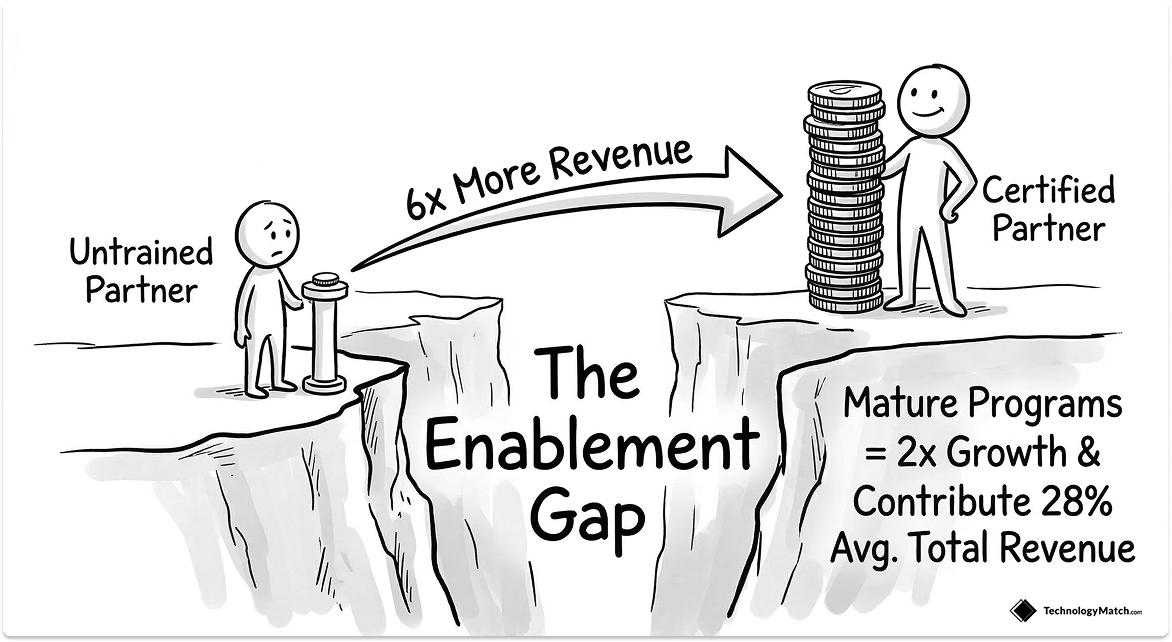
That gap is where most vendors are losing channel revenue they do not know they are losing. The partners representing your product are out there talking to prospects right now. Whether they are doing it confidently and accurately, or improvising, depends entirely on what you gave them before they walked in.
What Partners Actually Prioritize in 2026
Before building or rebuilding your enablement program, it helps to understand what partners actually want from vendors. The answer from recent research is surprising to most vendor teams.
The Channel Company's 2026 Tech Channel Roadmap, found that partners ranked "ease of doing business" above "overall revenue and profit" as their top priority. Partners cite cumbersome deal registration, poor channel conflict resolution, and complex portals as their biggest barriers to engagement. Not thin margins. Not lack of leads.

The PartnerPath survey data confirms the pattern from a different angle. When partners were asked what determines which vendors they continue to invest in, they ranked factors in this order: ease of business, relationship quality, financial reward, market demand, and enablement. Margin ranked third.
This changes the design brief for your enablement program considerably. You are not primarily competing on rebate percentage. You are competing on how frictionless it is to represent your product.
The vendors winning partner mindshare in 2025 are the ones who made the administrative overhead of working with them nearly invisible.
As Susana Cabrera put it, "Partners succeed when we treat enablement as an ongoing commitment, not a checklist. That includes delivery frameworks, co-sell collaboration, and sales assets tailored to how partners engage customers."
What a Channel Partner Enablement Kit Actually Contains
Most vendors assemble some version of a partner kit. Most of those kits are incomplete, out of date, or built for internal sales reps with the company name swapped on the cover page.
A complete enablement kit has two distinct layers.
Internal-facing content is what partners use to prepare before engaging a prospect. This includes:
- Sales playbooks: deal stage by deal stage, with qualifying questions, objection responses, and close tactics written for a non-expert who sells multiple competing products
- Battle cards: one-page competitive comparisons that give partners the specific language to counter the three or four competitors they will encounter most. Written for people who do not have your product expertise and cannot afford to look uncertain in front of a prospect
- Product training: short-form, modular, accessible on mobile. Partners do not consume 90-minute onboarding videos. Ten-minute certification modules with quizzes work. Long-form e-learning largely does not
- ROI calculators and deal qualification tools: something the partner can run with a prospect in a first meeting to surface budget and build business case simultaneously
- FAQ library: the 20 questions prospects ask that partners get wrong or hesitant on
External-facing content is what partners co-brand and deliver to prospects directly. This includes:
- Co-branded slide decks and one-pagers by industry vertical
- Case studies (anonymized if necessary) showing outcomes relevant to the prospect's sector
- Email templates and LinkedIn outreach sequences
- Demo scripts and objection-handling language for the first three prospect meetings
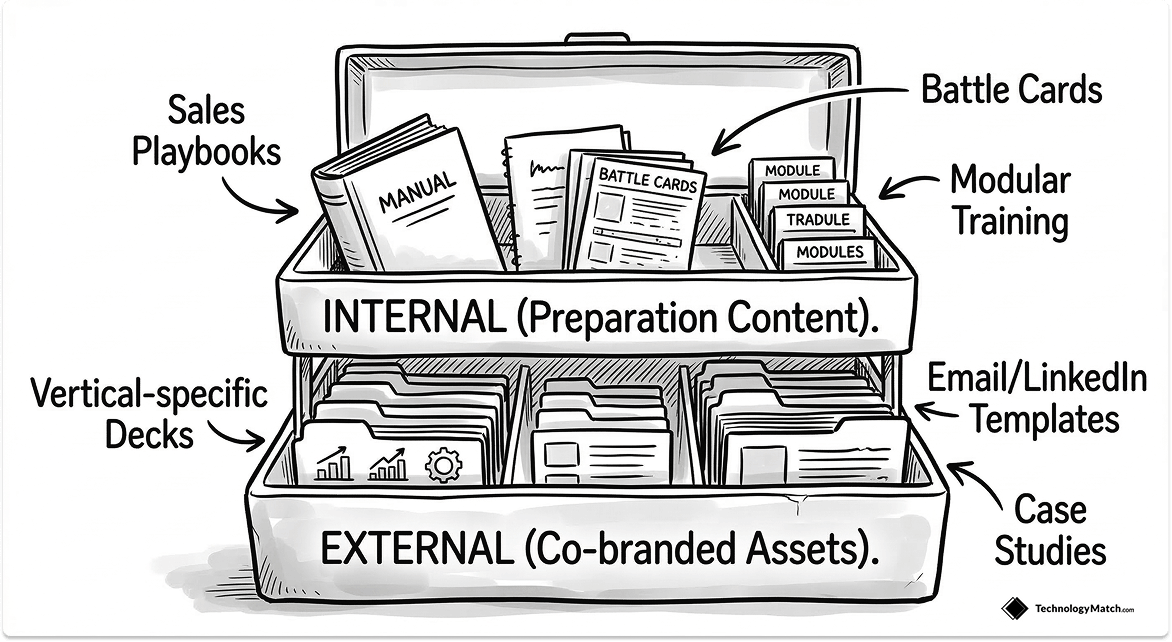
The difference between a kit that gets used and one that sits in a portal folder is specificity. Generic content written for any partner in any market gets ignored. Content that addresses the exact objection a healthcare VAR hears in their second prospect meeting gets used every week.
The 90-Day Onboarding Window That Determines Long-Term Performance
I have seen this play out repeatedly: a vendor signs 20 new partners in Q1, gives them portal access and a welcome email, and then wonders in Q3 why only four of them have registered a deal.
The first 90 days determine whether a partner becomes a revenue contributor or a dormant name in your portal. The critical mistake is treating partner onboarding as a one-time admin event rather than a structured performance ramp.
A well-designed 90-day onboarding program maps three distinct milestones:
Day 30: Portal access confirmed and actively used. First training module completed. Introduction to channel manager done. Partner has met at least one person on your sales or solutions team they can call when a deal gets complicated.
Day 60: At least one certification passed. First deal registered or first pipeline meeting held. Partner can articulate your core value proposition in their own words without referencing your materials.
Day 90: First deal in active pipeline or closed. Partner has used at least three enablement assets with a live prospect. Co-sell call with your team has happened at least once.

If a partner is not at Day 60 by the actual Day 60, that is a diagnostic signal, not a patience moment. Either the onboarding content is not landing, or the partner is not the right profile, or your channel manager coverage is too thin to catch problems early.
One operational note that consistently makes a measurable difference: executive presence at partner kickoff. Having your VP of Sales or a C-level executive on the first call with a new partner signals organizational commitment in a way that no welcome package replicates. An hour of your leadership's time at kickoff pays back in partner prioritization throughout the year.
PRM: The Infrastructure Your Program Cannot Scale Without
Email threads and shared folders work for five partners. They fail at twenty-five and collapse at fifty.
A Partner Relationship Management platform is the operational backbone of any channel program with more than a handful of active partners.
PRM centralizes deal registration, tracks enablement completion per partner, surfaces which content is being used and which is not, automates onboarding workflows, and connects partner pipeline to your CRM attribution.
Partner communities managed with the right tools delivered a 195% return on investment over a three-year period, but only when managed properly. The tool is not the program. The discipline of using it correctly is what generates the return.
The platforms in active use across the market range by maturity stage:
- Early-stage programs (under 25 partners): PartnerStack, Introw, or Channelscaler handle the core workflow without overbuilding
- Growth-stage programs (25-100 partners): Impartner, Allbound, or ZINFI add LMS integration, MDF management, and deal registration at a level that supports a dedicated channel manager
- Enterprise programs (100+ partners): Salesforce PRM or a deeply configured Impartner instance with native CRM attribution and custom tiering logic
The most common implementation failure is the same across every stage: building the portal for the vendor's internal needs rather than the partner's daily workflow. If partners need to log in three times and navigate four menus to register a deal, they will register deals late, inaccurately, or not at all. The portal exists to make partners' lives easier. If it does not, adoption collapses inside 60 days.
Before selecting a platform, map the five things your partners do most frequently and build the portal around those five tasks. Everything else is secondary.
MDF: $25 Billion in Free Marketing Budget That Partners Are Not Using
In the tech industry alone, approximately $25 billion in Market Development Funds go unused every year. Across all industries, that figure reaches $15 billion annually in the US market alone. Up to 60% of MDF funds are not claimed or used on a quarterly basis.

This is not a partner problem. It is a process problem.
The Channel Company's State of Partner Marketing 2025 research identifies the structural failure clearly: smaller partners rely on part-time or shared marketing resources, with fewer than a third having dedicated marketing staff. They cannot navigate a complex MDF approval process, wait eight weeks for reimbursement, and execute a campaign with the resources they have. So they do not bother. The funds accumulate and expire.
A 2025 survey of 4,115 channel partners by Techaisle found that MDF as traditionally structured is in structural decline, not cyclical decline. Partners increasingly view the administrative burden as not worth the return, especially for programs under $5,000 in available funds.
The fix requires three changes:
Pre-approve activity categories. Stop requiring partners to propose and justify individual campaigns from scratch. Publish a menu of pre-approved campaign types. If a partner wants to run a customer event or a LinkedIn campaign using your content templates, the answer is automatically yes. Approval is for budget amount, not activity type.
Reduce reimbursement cycle time. Partners operating on thin margins cannot wait 60-90 days for reimbursement of funds they have already spent. A 30-day maximum reimbursement cycle is the floor. Platforms like Impartner automate this; manual processes are the enemy.
Add concierge support for smaller partners. Smaller partners do not lack the will to run campaigns. They lack the marketing expertise and capacity. Providing access to a vendor-approved agency or a marketing concierge service that can execute the campaign on their behalf, within MDF budget, resolves the capacity problem immediately. Several enterprise vendors now do this as a standard program feature.
AI in Partner Enablement: What It Actually Changes
The channel is in an early but real transition around AI-powered enablement. The two meaningful applications in 2025 are learning personalization and content delivery.
Traditional partner training delivers the same certification track to every partner regardless of their background, product familiarity, or customer base. AI-powered enablement programs can provide relevant content, certification tracks, and learning paths that closely match the unique characteristics of a specific partner organization, creating experiences that address specific gaps rather than forcing everyone through the same generic program.
Ingram Micro's 2025 AI enablement program for partners is a practical example of what this looks like at scale. The program helps partners identify the right AI solutions for their specific client base rather than providing generic AI product training. The goal is long-term value creation, not one-time certification.
Cisco's AI-powered Partner Experience Platform (PXP) takes a different approach: an AI assistant integrated directly into the partner portal that handles real-time program inquiries and guides partners through the deal lifecycle without requiring channel manager intervention for routine questions.
The near-term practical application for most vendors is narrower: use AI to build a searchable knowledge base your partners can query in natural language rather than requiring them to navigate a static document library. A partner mid-conversation with a prospect who can ask "what's our response to the AWS security comparison objection?" and get an immediate, accurate answer is more effective than one who has to search a folder structure and hope they find the right battle card.
The KPI Framework: Measuring Channel Enablement Performance
Most vendors measure channel program performance by looking at revenue and pipeline per partner. Both matter. Neither is sufficient for managing an enablement program effectively.
The four measurement categories that give you diagnostic coverage across the partner lifecycle:
Activation metrics tell you whether onboarding is working.
- Portal login rate in the first 30 days
- Training completion rate by module
- Certification pass rate
- Time to first deal registered
Pipeline metrics tell you whether enablement is translating into selling activity.
- Deal registrations per active partner per quarter
- Registration-to-qualified-pipeline conversion rate
- Pipeline age by partner (old pipeline is a signal of partner confidence issues)
Revenue metrics tell you program health.
- Partner-sourced revenue as a percentage of total company revenue
- Average deal size by partner tier
- Partner quota attainment rate and distribution
Engagement metrics tell you whether partners are investing in the relationship.
- MDF utilization rate
- Content consumption by asset type (this tells you which assets are actually useful)
- QBR participation rate
One diagnostic signal that I consider more useful than most dashboards: if deal registrations spike but pipeline does not progress, you almost always have an enablement gap, a lead quality problem, or a misaligned incentive structure driving partners to register deals they cannot close. Each of those has a different fix, and none of them surface if you are only looking at revenue.
The 80/20 risk deserves specific attention. Most channel programs concentrate 70-80% of their revenue in 15-20% of their active partners. That concentration is a fragility, not just an observation. Track revenue concentration explicitly, and build an enablement program designed to move mid-tier partners up, not just to reward the partners who are already performing.
Building Your Enablement Program by Stage
Early-stage (fewer than 25 partners, first enterprise deals just beginning):
Get the fundamentals ready before you recruit. Build the enablement kit first: sales playbook, three to five battle cards, a product training module under 30 minutes, and a co-branded one-pager per target vertical. Set up a basic partner portal on PartnerStack or a similar lightweight platform. Define your 30/60/90 onboarding milestones in writing. Assign one named channel manager with clear partner coverage responsibility.
Growth-stage (25-100 partners, dedicated channel function in place):
Add a PRM platform with integrated LMS and deal registration. Build a formal MDF program with pre-approved activity categories and a concierge option for smaller partners. Introduce a certification program with tiered recognition. Start tracking activation and pipeline metrics by partner. Run quarterly business reviews with your top 20% of partners and use the data to build a structured activation program for the next 20%.
Mature program (100+ partners, channel contributing 20%+ of company revenue):
Introduce AI-powered learning personalization. Build co-sell frameworks and joint go-to-market plays for strategic partners. Develop partner-specific content libraries by vertical and buyer persona. Establish a partner advisory board with quarterly input into program design. Review revenue concentration quarterly and build a structured mid-tier activation plan. Align partner program metrics directly to company revenue forecasts.
Looking for IT partners?
Find your next IT partner on a curated marketplace of vetted vendors and save weeks of research. Your info stays anonymous until you choose to talk to them so you can avoid cold outreach. Always free to you.
FAQ
How many partners should I onboard before formalizing an enablement program?
Build the enablement program before you recruit your first partner, not after you have twenty. Partners form impressions of your program in the first 30 days. If onboarding is disorganized at the start, that reputation spreads in the channel faster than any marketing will correct it. The minimum viable enablement kit, a 30/60/90 onboarding plan, and a named channel manager are non-negotiable before you recruit.
What is the difference between a partner portal and a PRM?
A partner portal is a website where partners log in to access content and register deals. A PRM is the software platform that powers the portal and connects it to your CRM, LMS, incentive management, and analytics. Some vendors build a portal without a proper PRM behind it, which means deal data does not flow into the CRM, training completions are not tracked, and MDF approvals happen via email. A portal without PRM infrastructure is a folder with a login screen.
How do I handle the 80/20 problem?
First, measure it explicitly. Calculate revenue concentration by partner and track it quarterly. Second, diagnose why mid-tier partners are not advancing: the most common causes are insufficient enablement, no co-sell support, and MDF they cannot access. Third, build a structured mid-tier activation program. Identify the 20 partners just below your top tier and assign them dedicated channel manager attention, a joint business plan, and an MDF budget with concierge activation support for one quarter. Measure the result. The partners who respond to structured activation become your next tier-one performers.
What should go in a partner welcome kit?
The partner welcome kit is not an admin package. It is the first impression of how well you enable people to sell for you. Include: a clear one-page overview of the partner program structure and what each tier requires, your product positioning in two or three sentences a non-expert can repeat, your top three competitive differentiators with the language to defend them, the five questions prospects ask most and how to answer them, your channel manager's direct contact information, and access to the partner portal with a guided first-login checklist. Keep it short. A 40-page welcome PDF does not get read.
How do I get smaller partners to actually use MDF?
Reduce the activation energy. Pre-approve your most common campaign types so partners do not have to write proposals. Provide campaign templates they can execute without a marketing team. Offer concierge access to a vendor-approved agency for partners without dedicated marketing resources. Cut your reimbursement cycle to 30 days or less. And set a realistic minimum fund threshold: a $500 MDF allocation requires the same administrative process as a $5,000 one, and most smaller partners will not bother for amounts that small. Either raise the minimum or lower the process overhead.