Best Cloud Cost Optimization Solutions for IT Leaders in 2026
Cloud cost optimization reduces cloud spending while maintaining performance. Compare ATC, GCG, ITPartners+, Vigilis, and Brigade for IT leaders in 2026.

If you haven’t already optimized your cloud cost by 15-20% without touching performance, security, or the innovation roadmap, you’re also probably dealing with:
- Zombie resources still running from abandoned POCs
- Over-provisioned instances no one dares right-size
- SaaS subscriptions scattered across departments
- Renewal dates buried in old email threads
- Egress and logging costs that show up as surprise line items
Cloud cost optimization isn't just about turning things off anymore. It's about architectural decisions, contract management, lifecycle governance, and operational discipline, all while your team is already stretched thin.
This article walks through the best cloud cost optimization solutions and partners for IT leaders in 2026, covering tools, managed services, and consulting partners that address different parts of the problem. We'll also share selection criteria to help you choose what fits your environment, constraints, and team capacity.
Why Cloud Cost Optimization Is Important in 2026
Boards and CFOs expect year-over-year cost reductions—or at minimum, cost containment—without any impact on reliability, performance, or security. That's a tall order when you're also being asked to migrate more workloads to the cloud, adopt AI/ML tools, and support a distributed workforce.
The 2026 reality for most IT leaders includes:
- Multi-cloud and hybrid architectures spanning AWS, Azure, GCP, colocation, and on-premises infrastructure
- Sprawl across cloud infrastructure, SaaS, connectivity, and licensing with invoices coming from dozens of vendors
- Surprise bills driven by egress charges, observability/logging costs, and orphaned resources that no one remembers provisioning
IT leaders are expected to "do FinOps" without adding headcount, make cloud spend predictable (not just lower), and prove that IT is running a disciplined practice rather than cutting things at random.
Cloud cost optimization in 2026 isn't just operational—it's strategic. It involves:
- Architectural decisions: Which workloads belong where (public cloud vs. private vs. on-prem vs. edge)
- Commercial decisions: Contract negotiations, reserved instances, committed use discounts, SaaS volume pricing
- Operational discipline: Tagging standards, renewal management, lifecycle governance, and continuous rightsizing
Selection Criteria for IT Leaders When Choosing a Cloud Cost Optimization Solution
Before diving into specific tools and partners, here's a practical checklist to evaluate any cloud cost optimization solution:
1. Scope of Coverage
Does it cover cloud infrastructure (IaaS/PaaS), SaaS and licensing, and connectivity/telecom—or just a narrow slice? The best solutions address the full IT spend landscape, not just one cloud provider's bill.
2. Depth of Visibility
Can you see spend by provider, environment, application, business unit, and project? Is historical trending and forecasting included? Is it self-service for both IT leaders and finance teams?
3. Automation & Intelligence
Does it auto-ingest invoices, contracts, and usage data? Can it detect anomalies, overbilling, and unused services? Does it recommend or enforce savings actions automatically?
4. Governance & Lifecycle Control
Does it manage renewals and contract end dates? Can it flag disconnected services still being billed? Does it track migration and project status where cost changes actually originate?
5. Integration with Your Ecosystem
Does it integrate with your cloud providers (AWS/Azure/GCP), ITSM/ticketing systems (ServiceNow, Jira), finance tools, and identity/security platforms?
6. Implementation Effort & Time to Value
How long does it take to get a first useful view and achieve first savings? Is there white-glove support, or are you on your own?
7. Commercial Model & ROI
What's the pricing structure—subscription, percentage of savings, bundled into MSP services, or project-based? Are savings demonstrable and trackable? Can they show typical savings percentages and payback periods?
8. Fit with Your Operating Model
Are you a lean IT team needing "done-for-you" services, or a mature FinOps shop needing deep data and automation? Does the solution reinforce the way your team works, or fight it?
Now let's look at five solutions and partners that address different aspects of cloud cost optimization.
American Technology Consulting (ATC)
Who ATC Is Best For
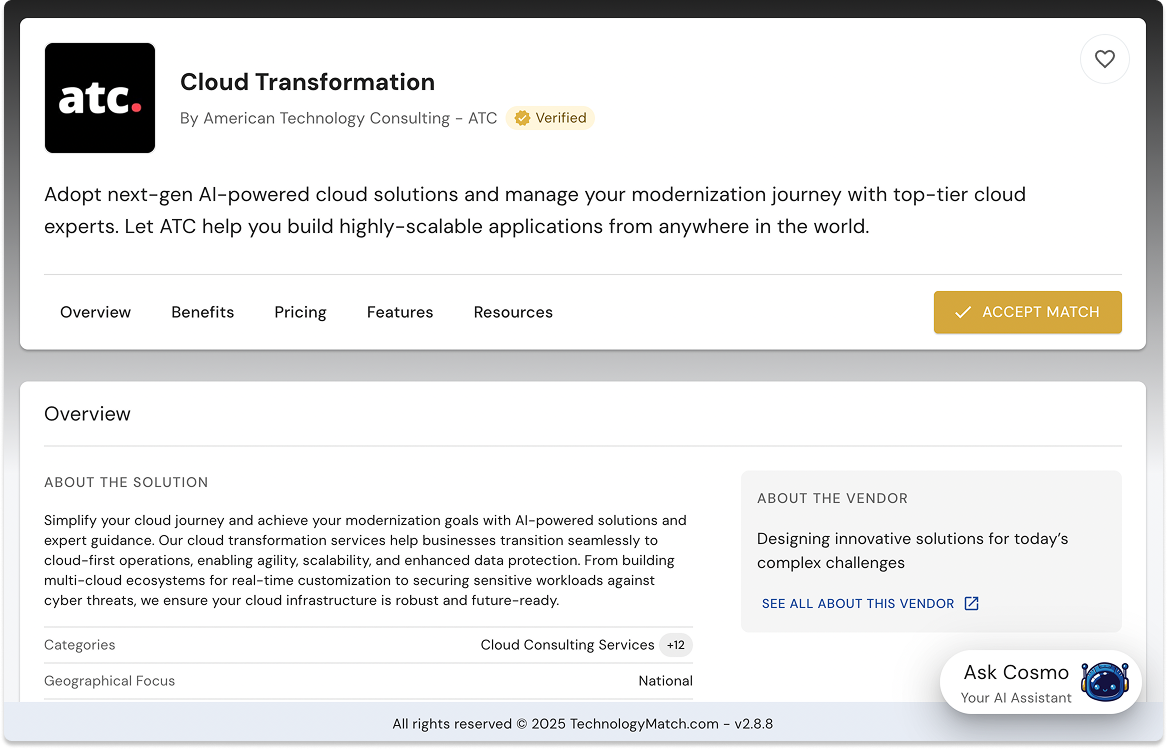
ATC is ideal for IT leaders planning or in the middle of cloud migrations, application modernization, or multi-cloud deployments. If you need both strategy and execution—not just a bill-scrubbing tool—ATC is worth considering.
Key Capabilities for Cloud Cost Optimization
ATC positions itself as a cloud transformation partner with a strong focus on multi-cloud environments and AI-powered modernization.
Their cloud cost optimization capabilities include:
- Cloud migration & modernization: Helps select the right cloud platforms and services while supporting modernization paths that avoid expensive "lift-and-shift forever" traps
- Multi-cloud infrastructure and optimization: Designs and manages multi-cloud setups to secure infrastructure, optimize resources, and improve ROI
- Managed services: Provides ongoing management of cloud workloads with continuous cost tuning through rightsizing, storage optimization, and resource governance
- Generative AI & RPA for cost reduction: Uses AI and automation to reduce development and operational effort, freeing budget and engineering time
Strengths
ATC excels at architectural and strategic cloud cost optimization, not just operational savings. They emphasize continuous assessments that consider both financial and business needs, making them a good fit for organizations that see cloud as part of a bigger modernization journey.
Limitations / Considerations
ATC is less about granular FinOps dashboards and more about transformation plus managed services. They're best when you're willing to change how workloads are built and run, not just tweak invoices.
Questions IT Leaders Should Ask ATC
- How do you measure and report cost savings and ROI from migrations and modernization?
- How do you handle multi-cloud governance (tagging, policies, reserved instances/commitments)?
- What does your ongoing optimization cadence look like after the initial migration?
GCG
Who GCG Is Best For
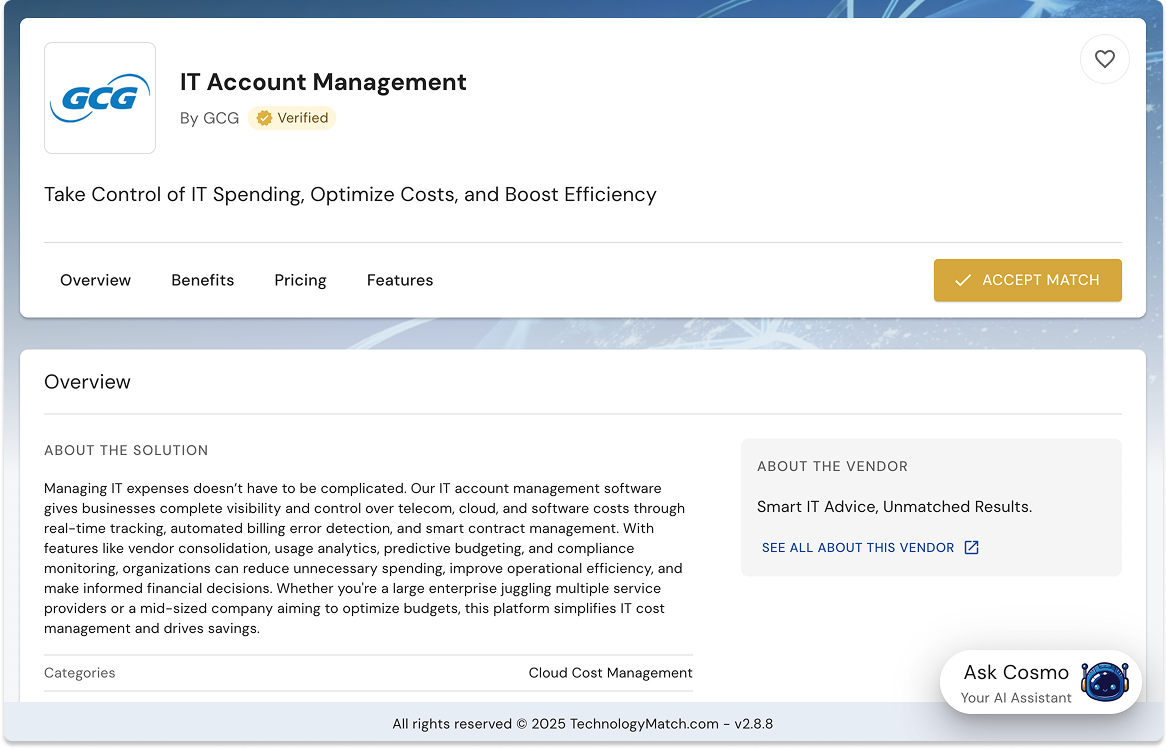
GCG is ideal for IT leaders dealing with multiple cloud, colocation, network, and SaaS providers, especially when contracts and renewals are complex. If you need vendor-neutral advice and help optimizing your provider mix, GCG is a strong option.
Key Capabilities for Cloud Cost Optimization
Founded in 2002, Global Consulting Group (GCG) is a technology consulting firm and solution provider with a specific focus on cloud optimization.
Their cloud cost optimization capabilities include:
- Cloud optimization service: Focused on matching workloads to public, private, or hybrid cloud environments and identifying misaligned deployments
- Technology account management: Manages and optimizes technology accounts with reporting and analytics, helping avoid overlapping services and missed renewals
- SaaS marketplace: Centralized hub for SaaS discovery and purchase that supports consolidated billing, volume discounts, and SaaS rationalization
Strengths
GCG excels at commercial and provider-level cloud cost optimization—helping you decide which cloud/colo/network provider to use, at what terms, and at what price. Their broad portfolio (via partnership with AppDirect) gives access to over 900 technology providers.
Limitations / Considerations
GCG is less focused on deep resource-level optimization within a single cloud bill. Their true value depends on using them early in the decision cycle, not after contracts are already locked in.
Questions IT Leaders Should Ask GCG
- How do you approach cloud optimization versus traditional data center/network optimization?
- How do you stay vendor-neutral while working with such a large provider portfolio?
- Can you show examples of cloud and SaaS contract savings and typical percentages?
ITPartners

Who ITPartners+ Is Best For
ITPartners is best for small to mid-market organizations that don't have large internal teams and want predictable IT and cloud-related run costs. If you need co-managed or fully managed IT with sensible cloud, M365, and backup decisions, they're worth exploring.
Key Capabilities for Cloud Cost Optimization
ITPartners+ is a managed service provider with a strong focus on business, enterprise, and public sector clients.
Their cloud cost optimization capabilities include:
- Managed IT & co-managed services: Operates and supports IT environments, including cloud services, with fixed per-seat pricing and no long-term contracts for the fully managed offering
- Backup and disaster recovery: Designs ransomware-resilient backup and DR solutions that directly affect storage footprints and retention costs
- Microsoft 365 migrations & management: Helps avoid over-licensing and misconfigured services that inflate M365 and related cloud costs
Strengths
ITPartners delivers budget predictability through fixed pricing and cost-sensible configuration of backup/DR and M365. They're ideal for teams who don't want to build FinOps practices in-house and prefer a capable MSP to keep cloud-adjacent costs in line.
Limitations / Considerations
ITPartners+ is not a FinOps platform. They have limited explicit focus on cloud provider bill analysis or multi-cloud dashboards. They're best when your priority is "keep total IT plus cloud running cost predictable and sane" rather than deep multi-cloud analytics.
Questions IT Leaders Should Ask ITPartners+
- How do you ensure M365 and backup/DR configurations are cost-efficient, not just "safe"?
- What visibility will I have into cloud-related costs as part of your service?
- How do you handle spikes in usage or growth under your per-seat pricing?
Socium IT (Vigilis)
Who Vigilis Is Best For
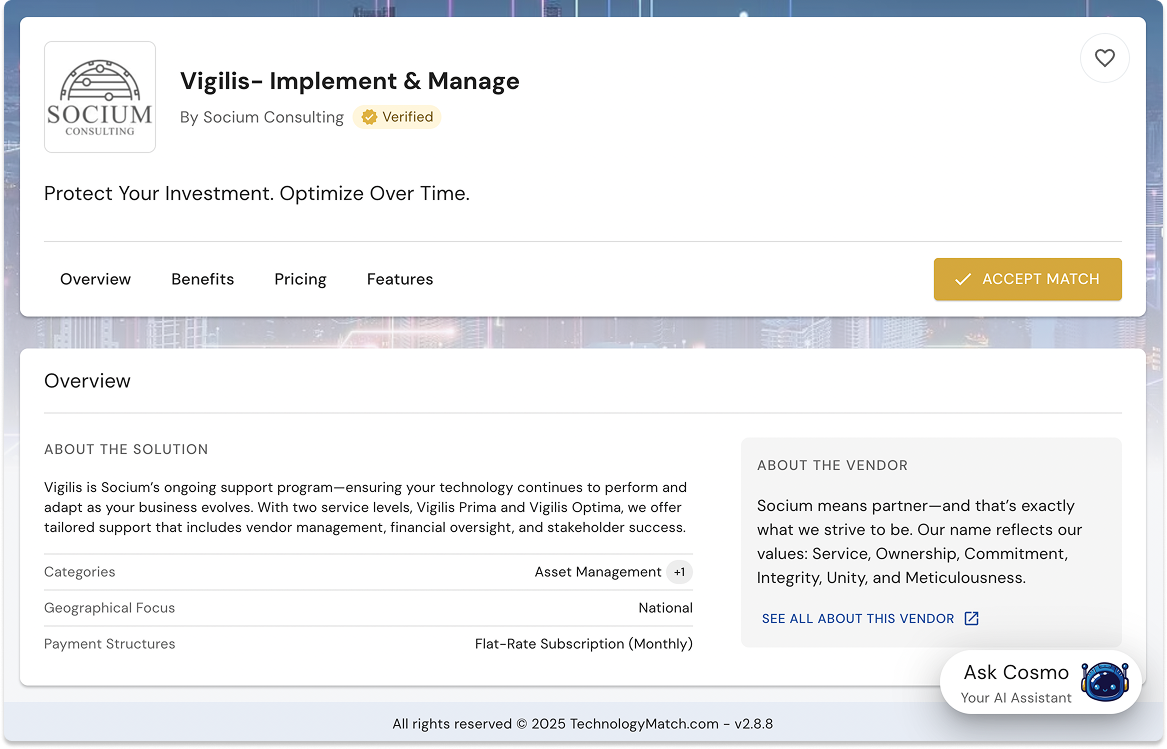
Socium IT Vigilis is ideal for IT leaders drowning in invoices across telecom, cloud, SaaS, and licensing who are tired of manual reconciliation in spreadsheets. If you want direct, measurable savings and unified expense visibility, Vigilis is purpose-built for this.
Key Capabilities for Cloud Cost Optimization
Vigilis by Socium IT is an AI-powered IT expense intelligence platform focused on telecom, SaaS, cloud, and licensing expenses.
Their cloud cost optimization capabilities include:
- Centralized IT expense visibility: Aggregates invoices from cloud infrastructure, SaaS, telecom, and licensing with real-time trending analysis by provider, service type, location, business unit, and cost center
- AI-powered invoice processing & variance detection: Automatically extracts line items from invoices, reconciles against services/contracts, and flags overbilling, charges on disconnected services, and anomalies
- Lifecycle monitoring & renewals: Tracks disconnected services in the last 6 months and upcoming renewals in the next 60 days to prevent surprise auto-renewals and "ghost" services
- Project & implementation tracking: Migrations and consolidations tracked with tasks, timelines, and vendor coordination
- Service inventory as a single source of truth: Complete view of technical details (IPs, bandwidth) and billing data (MRC/NRC, contract dates, cost centers)
Strengths
Vigilis directly tackles the "we don't know what we're really paying for" problem. They report typical ROI within 60 days, 15–33% cost reduction, and 80%+ time reduction in invoice review. They combine platform plus human expertise—they work disputes for you.
Limitations / Considerations
Vigilis is focused on spend and contract optimization, not application-level architecture. You'll still need separate tools or partners for deep performance tuning, refactoring workloads, and strategic cloud placement decisions.
Questions IT Leaders Should Ask Socium/Vigilis
- How do you model and track savings over time by category (cloud vs. SaaS vs. telecom)?
- How does your AI handle non-standard or international invoices?
- What integrations do you have with cloud providers and financial systems?
Brigade Technology

Who Brigade Technology Is Best For
Brigade Technology is best for IT leaders responsible for modern data centers, hybrid cloud environments, and critical workloads in healthcare, finance, manufacturing, and similar industries. If where workloads run is your biggest cost lever, Brigade is a strong partner.
Key Capabilities for Cloud Cost Optimization
Brigade Technology partners with organizations to deliver right-sized technology solutions focused on precision, innovation, and transformation.
Their cloud cost optimization capabilities include:
- Right-sized infrastructure and governance: Designs infrastructure that fits your business precisely, eliminating excess through appropriate storage tiers, compute capacity, and data protection scope
- Hybrid and edge architectures: Balances on-premises, colocation, cloud, and edge deployments to optimize latency, performance, egress, and connectivity costs
- Data protection & backup: Designs efficient backup strategies and DR architectures (via partners like Commvault and Veeam) that heavily influence storage costs and network/egress from cloud
- Security & compliance: Works with major vendors (Check Point, Fortinet, HPE, IBM, Microsoft, Veeam) where security and data protection choices directly affect telemetry/logging and infrastructure costs
Strengths
Brigade excels where total cost of running workloads (infrastructure plus cloud plus security plus DR) is the main concern. They have a strong vendor ecosystem and deep infrastructure expertise, making them a good partner if you need "precision" architecture that avoids over-engineering and overspending.
Limitations / Considerations
Brigade is not a FinOps or IT expense tool—they're more of an infrastructure and transformation partner. They're best used when you're open to re-architecting workloads and environments, not only trimming cloud bills.
Questions IT Leaders Should Ask Brigade
- How do you evaluate on-premises versus colocation versus public cloud from a cost and risk standpoint?
- How do your data protection and DR designs minimize long-term storage and egress costs?
- What visibility and reporting do you provide on TCO before and after your projects?
Closing Thoughts
In 2026, cloud cost optimization is a multi-dimensional problem. It spans bills and contracts (where Vigilis and GCG shine), architecture and placement (where ATC and Brigade shine), and operations and run costs (where MSPs like ITPartners+ shine).
There is no single "best tool for everyone." The right solution is usually a combination of expense intelligence (to see and fix billing waste), cloud and infrastructure partners (to design efficient architectures), and managed or co-managed services (to keep things optimized over time).
Most IT leaders don't have the time to sit through dozens of vendor pitches, validate every cost-savings claim, or guess which mix of tool plus transformation partner plus MSP fits their environment and culture.
TechnologyMatch exists to cut through exactly that noise.
You share your current cloud and IT landscape, where costs are hurting, and your constraints (budget, team capacity, regulatory needs). We connect you with a small, curated set of vetted vendors and partners: the expense intelligence platform that fits your complexity, the cloud transformation or hybrid partner sized to your ambitions, and the MSP or co-managed provider who can keep your run costs predictable.
Read also: Best Cloud Migration Solutions for IT Leaders in 2025, Best Data Backup and Recovery Solutions in 2026
Looking for IT partners?
Find your next IT partner on a curated marketplace of vetted vendors and save weeks of research. Your info stays anonymous until you choose to talk to them so you can avoid cold outreach. Always free to you.
FAQ
What is cloud cost optimization and why is it important for IT leaders in 2026?
Cloud cost optimization reduces cloud spending while maintaining performance through eliminating waste, rightsizing infrastructure, and managing commitments across AWS, Azure, and GCP. It's critical because cloud is now one of the largest IT budget line items, with leaders facing pressure to cut costs by 15–20% while dealing with multi-cloud sprawl, SaaS proliferation, and surprise charges.
What are the best cloud cost optimization tools and solutions for enterprises?
The best solutions include expense intelligence platforms like Vigilis (AI-driven invoice analysis delivering 15–33% savings), cloud transformation partners like ATC (multi-cloud architecture optimization), vendor-neutral brokers like GCG (contract negotiation and provider selection), and MSPs like ITPartners+ (fixed pricing with embedded optimization for teams without FinOps capabilities).
How much can organizations save with cloud cost optimization?
Organizations typically save 15–33% of cloud spending, with quick wins in 60–90 days delivering 10–20% through eliminating unused resources, rightsizing instances, and correcting billing errors. Long-term initiatives can reach 20–35% through refactoring, FinOps practices, and hybrid workload optimization.
What's the difference between cloud cost optimization and FinOps?
Cloud cost optimization is tactical—specific actions like eliminating waste and rightsizing instances across AWS, Azure, and GCP. FinOps is strategic—a cultural practice bringing finance, IT, and business teams together for collaborative cost management through visibility, accountability, and continuous improvement.
How do I choose the right cloud cost optimization partner or platform?
Match the solution to your challenge: visibility problems need expense intelligence platforms; architecture problems need transformation partners; contract problems need brokers; capacity problems need MSPs. Evaluate scope of coverage, automation capabilities, integration, time to value, and validate with questions about ROI timelines and customer references.