Procurement as a Service: Why Understaffed IT Teams Are Killing the Traditional RFP
Understaffed IT teams are killing the 10-week RFP. Discover how Minimum Viable Procurement and concierge matchmaking help you evaluate IT vendors privately.

If you operate a fully staffed Vendor Management Office, executing a comprehensive Request for Proposal is standard operating procedure. Teams with dedicated procurement analysts should stop reading here and follow our complete guide to IT vendor selection.
You are likely operating under different constraints. You are an IT Director navigating a recent merger, managing daily operational emergencies, and facing a strict hiring freeze. You do not have the luxury of dedicating hundreds of hours to a single software evaluation.
Industry data from Gartner shows that the average enterprise IT vendor RFP takes anywhere from six to ten weeks to complete. The RFP process timeline requires gathering technical requirements, dodging unsolicited sales calls, and reading hundreds of pages of vendor responses. This works perfectly in an ideal environment.
The reality is that 76% of IT employers globally report a severe tech talent shortage, according to ManpowerGroup. For an understaffed IT department, the traditional RFP is not a procurement strategy. It is a massive bandwidth tax.
When your internal resources are stretched to the breaking point, you cannot afford to spend two months reading marketing PDFs. IT leaders are actively ditching the traditional RFP in favor of Minimum Viable Procurement. They lean on concierge matchmaking services to offload the heavy logistical lifting.
I have seen this operational shift firsthand across hundreds of mid-market infrastructure teams. You need a way to evaluate technology safely and accurately without halting your daily operations. You also need to do it without violating your internal corporate governance policies.
Here is exactly how you execute that framework.
RFI vs. RFP vs. RFQ
Before replacing the traditional process, you must understand why it fails small teams. Enterprise procurement traditionally splits vendor selection into three distinct phases.
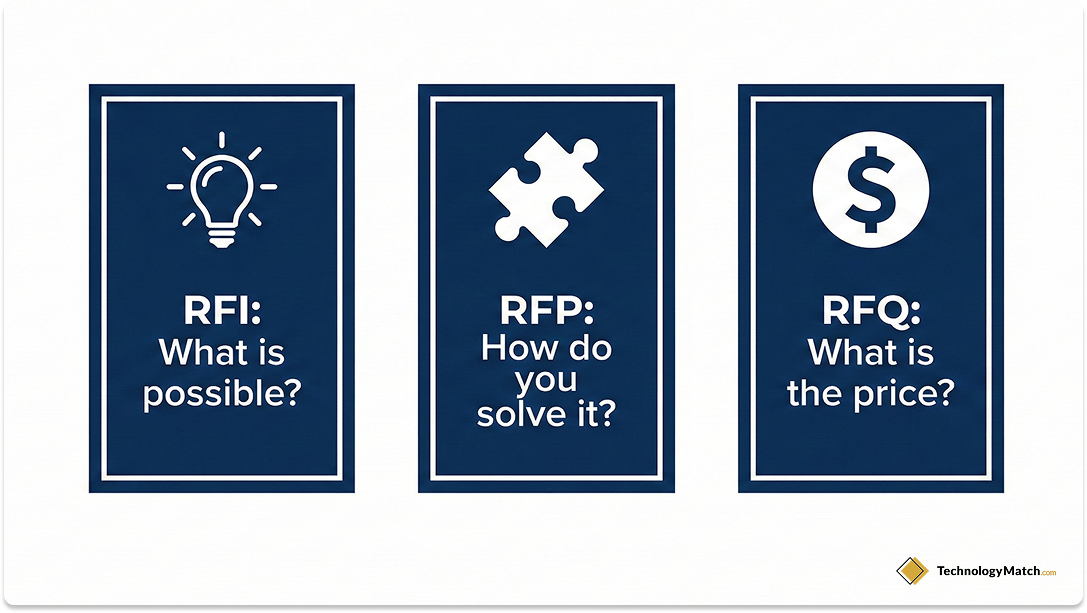
The Request for Information focuses on broad market education. You ask vendors what is possible. The Request for Proposal focuses on comparative solutions. You ask vendors how they solve your specific problem. The Request for Quote focuses purely on financials. You ask vendors for their final price.
Lean teams cannot afford a three-phase procurement cycle. You must collapse education, comparison, and pricing into a single motion. You achieve this by dictating the terms upfront rather than asking vendors for their creative interpretations.
The Hidden Costs of the Traditional Process
The primary flaw of the standard procurement cycle for small teams is the shadow workload. The time commitment is never just about writing the initial RFP document. Hidden operational costs drain your most expensive engineering talent.
The Sourcing Black Hole
Identifying potential vendors requires navigating a maze of marketing jargon. Standard advice dictates downloading industry reports and vendor whitepapers to build a shortlist. Doing this guarantees that you will trigger a relentless automated sales cadence.
B2B software companies use advanced intent data and lead scoring. Submitting your corporate email for a single whitepaper alerts their sales development team that you are an active buyer. This results in dozens of unsolicited phone calls and LinkedIn messages. Your phone will automatically mark new callers as spam because your number is circulating on vendor lead lists. You lose control of your own communication channels.
Integration Ambiguity and Technical Debt
A vendor might look flawless on paper during the initial evaluation. Discovering that their backup solution supports Google environments perfectly while struggling with your legacy Microsoft architecture often happens too late in the cycle.
Standard RFPs ask broad questions about integration. Vendors respond with broad, legally approved assurances. Uncovering exact technical friction points requires deep architectural discussions. Your lean team does not have time to conduct these deep-dive technical reviews with ten different suppliers.
The Time-to-Hire Trap
Teams cannot wait two months to hire a procurement analyst just to evaluate new infrastructure software. The average time to hire for a specialized technical position now exceeds 44 days according to SHRM.
A standard RFP forces your existing engineers to become part-time procurement specialists. This pulls them away from securing your network, patching vulnerabilities, and maintaining uptime. The opportunity cost of having a Senior DevOps Engineer reading a vendor Service Level Agreement is astronomical.
The Minimum Viable Procurement (MVP) Framework
Understaffed teams need a framework to evaluate technologies safely without stopping their daily operations. Minimum Viable Procurement replaces exhaustive documentation with strict, binary filtering.
Instead of creating a massive document outlining every possible feature, the MVP approach focuses strictly on the 80/20 rule. You dictate your absolute limitations and force the market to meet you there.
Traditional RFP vs. MVP Procurement Lifecycle
The 5-Day Reverse RFP Playbook
If corporate policy dictates that you must run the process internally, you have to run it with ruthless efficiency. This is the exact operational playbook to use when your IT department is severely understaffed.

Day 1: The Dealbreaker Brief
Do not ask for 100 features. Define your absolute dealbreakers. Create a strict one-page brief divided into three non-negotiable categories.
Business Dealbreakers: Outline your budget ceiling and required contract terms. State clearly that the solution must offer consumption-based pricing and a 30-day exit clause without penalty.
Technical Dealbreakers: Define your exact architectural constraints. State that the solution must be hardware-agnostic and integrate natively with your custom legacy CRM via open APIs. Do not accept the phrase compatible with. Demand native integration.
Security Dealbreakers: Define your compliance baseline. State that the vendor must provide a financially backed 99.99% uptime SLA and possess a current SOC 2 Type II certification.
By defining only the dealbreakers, you immediately filter out 90% of the market. You do not waste time reading proposals from vendors who cannot meet your core requirements.
Day 2: Incognito Sourcing
You must protect your contact information to maintain your operational focus. Rather than submitting your email to ten different vendor websites, you must research invisibly.
Incognito discovery means using third-party aggregator data, community forums, or specialized matchmaking platforms to research vendors. I highly recommend using dedicated burner aliases for any forced email captures. You evaluate the pre-vetted shortlist in total anonymity. The vendors only learn your identity when you explicitly decide to take a meeting.
Day 3: The Single Pane Matrix
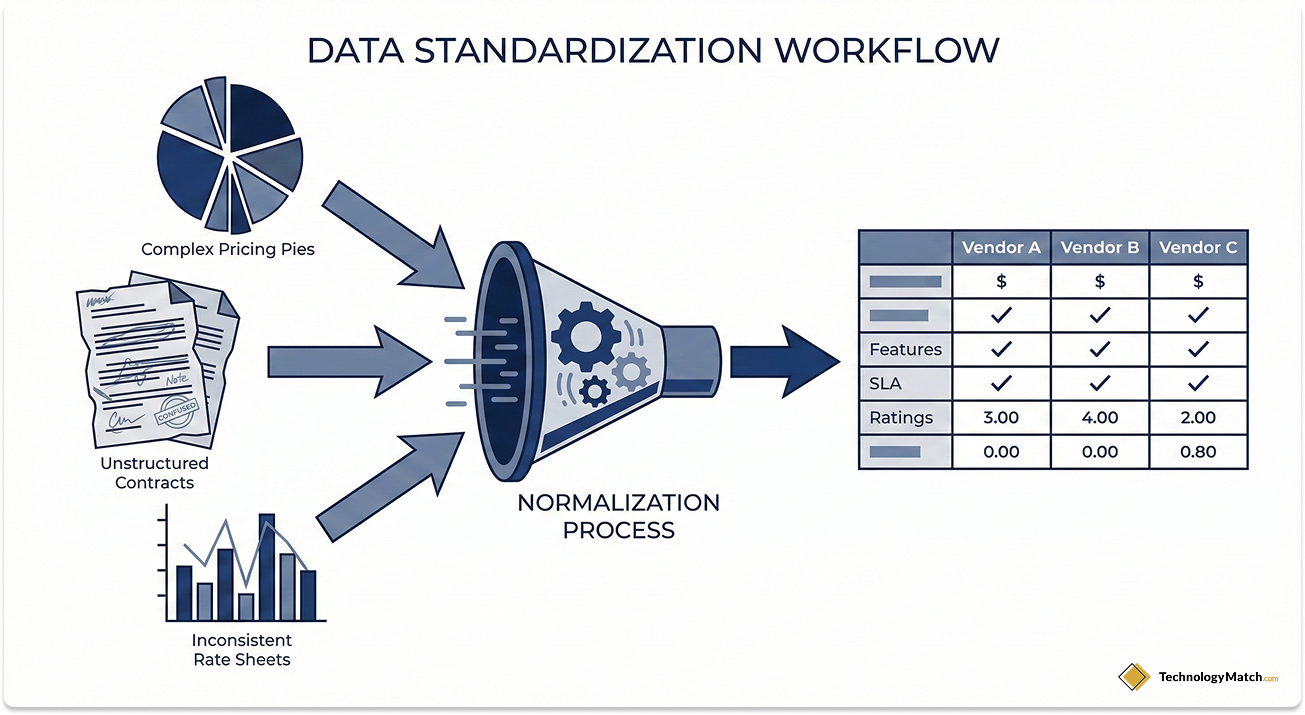
Force a standardized comparison on your terms. Instead of parsing through wildly different vendor proposal formats, you need a single spreadsheet. How to compare vendor proposals effectively is ultimately about stripping away the marketing language.
You must demand that vendors distill their critical SLAs, pricing models, and integration capabilities into your unified matrix. Force the vendor to calculate the exact Total Cost of Ownership based on your specific historical usage metrics. Give them your active user count, your monthly data volume, and your projected 24-month growth rate. If a vendor refuses to provide a clear, binding cost calculation based on your parameters, disqualify them immediately.
Day 4: Pre-Recorded Technical Validation
Do not schedule live introductory demonstrations. Live demos take an hour, require scheduling across multiple calendars, and are bloated with corporate history presentations.
Require vendors to send a pre-recorded, 15-minute technical demonstration. Give them a strict script. Tell them to focus exclusively on your defined dealbreakers. You and your engineers can watch these recordings at 1.5x speed on your own time. This tactic alone saves weeks of calendar gridlock.
Day 5: The Curated Introduction
You only schedule a live meeting with the two vendors who provided the clearest pre-recorded technical proof and agreed to your TCO calculations. You skip the tedious discovery calls and move straight to the technical validation phase. This is how to choose the right vendor when you have zero free time.
Governance and Compliance: Getting MVP Past Legal
The biggest objection to skipping the traditional RFP comes from internal compliance teams. Enterprise readers constantly ask how to execute an agile procurement process without violating corporate policy. You can run an MVP process legally and safely by understanding what your compliance officers actually need.
Legal and procurement departments require an audit trail. They need proof that you evaluated multiple options, mitigated operational risk, and secured competitive pricing. They do not care if that takes ten weeks or ten days.
Replacing the 100-Page Questionnaire
Handling Vendor Risk Assessments without a dedicated compliance officer is a nightmare. Lean teams get bogged down reading massive security questionnaires.
Push the burden of proof back onto the vendor. Stop sending custom security spreadsheets. Demand a Standardized Information Gathering questionnaire or a current SOC 2 Type II report. You can instruct your internal compliance team that any vendor failing to provide a recognized, third-party audited security certificate is automatically disqualified. This satisfies the risk mitigation requirement instantly.
Building the Audit Trail
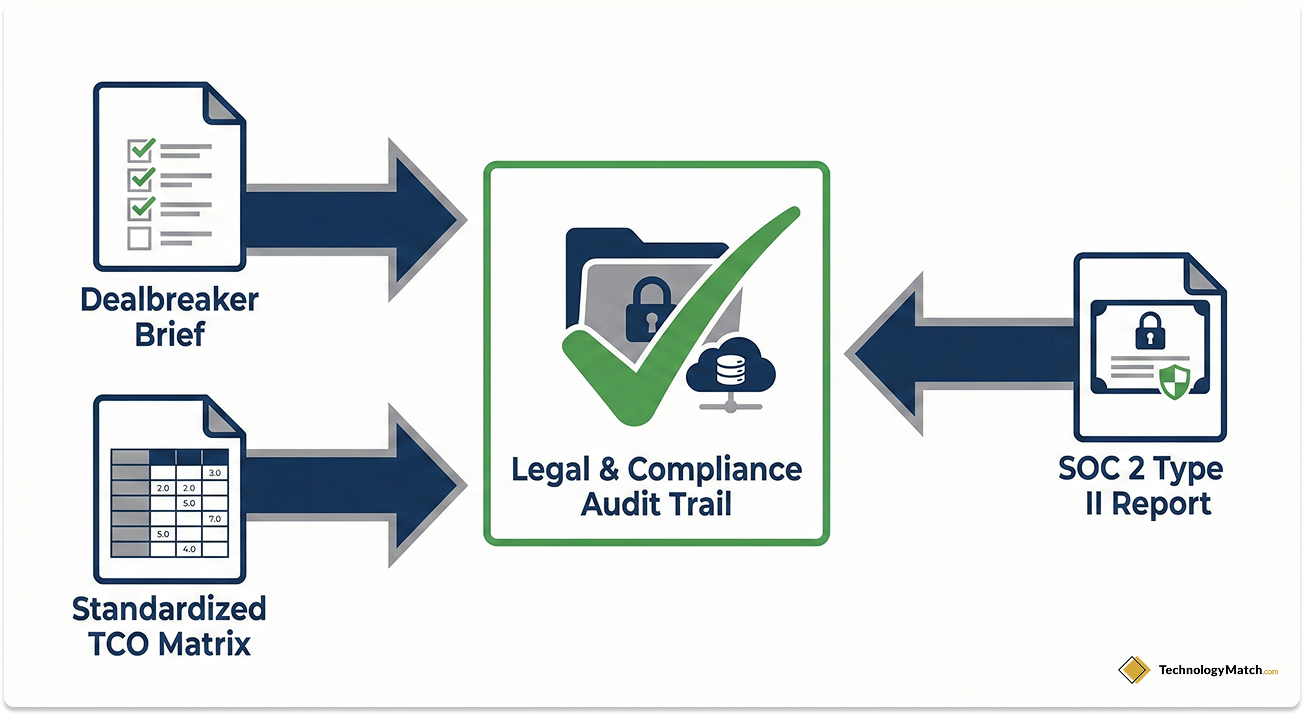
Your one-page Dealbreaker Brief and your Single Pane Matrix serve as your official audit trail. When procurement asks for evidence of competitive bidding, you present the completed matrix.
The matrix proves that you evaluated three distinct vendors against the exact same technical and financial criteria. It provides a mathematically sound justification for your final choice. This approach aligns perfectly with standard vendor selection best practices while stripping away the narrative bloat.
Real-World Application: Replacing a SIEM in 12 Days
Let us look at a practical application of this framework. A company recently needed to replace their legacy Security Information and Event Management system. Their internal IT team consisted of one Director and two Security Engineers.
Their old SIEM was generating too much noise and failing to integrate with their newly adopted cloud infrastructure. The traditional RFP timeline projected a three-month evaluation period. The IT Director knew this would paralyze their daily security operations.
They adopted the MVP framework.
Day 1: They built a Dealbreaker Brief requiring native AWS integration, a specific log ingestion pricing model, and an analyst-to-asset ratio guarantee.
Day 2: They used an anonymous proxy to map the market, filtering a list of 42 potential SIEM vendors down to exactly four that met the strict criteria.
Day 5: They received four completed TCO matrices and four pre-recorded technical demos. They disqualified two vendors based on pricing ambiguity.
Day 8: They held two highly focused, 45-minute technical deep dives with the finalists.
Day 12: They signed the final contract.
The Quantified Outcome: They reduced their vendor shortlist from 42 to 4 in under a week. They saved an estimated 120 hours of engineering time that would have been spent on discovery calls and live demos. They satisfied their internal legal team by presenting the standardized TCO matrix as their competitive audit trail.
The Employee No. 0 Strategy
To execute an MVP effectively, resource-constrained leaders are increasingly turning to IT matchmaking. Think of this approach like hiring a high-end travel agent for a complex international expedition.
You know exactly what destination you need to reach. You might need a successful ERP migration, an automated document parsing system, or a transition from aging tape-based archives to the cloud. You do not have the time to hack through the jungle of vendor options, negotiate the logistics, or manage the sales reps.
A concierge matchmaking service acts as Employee No. 0. This is a highly specialized team member who is not on your payroll but handles your back-end procurement logistics.
Phase 1: The Blind Architecture Review
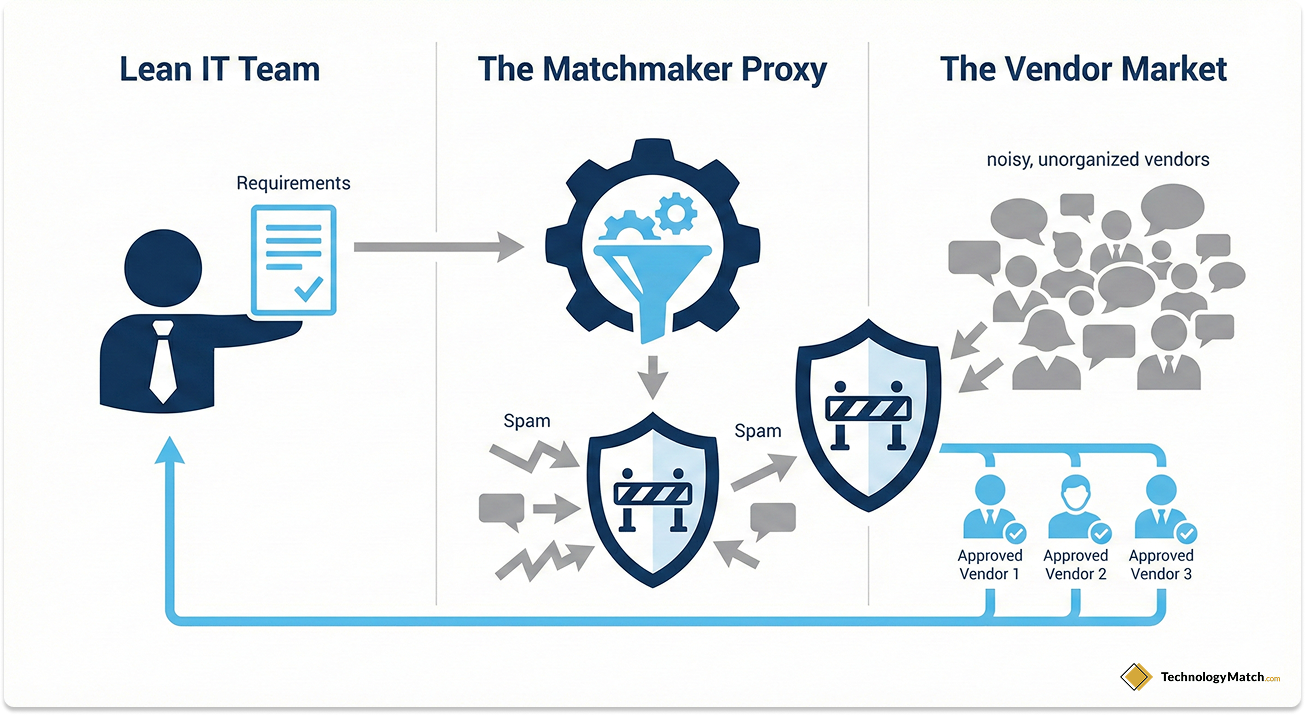
When you utilize a matchmaker, you dictate your environment limitations upfront. You provide them with your one-page dealbreaker brief. The matchmaker takes your specific architecture requirements to the market anonymously.
They perform the heavy lifting of identifying which vendors actually play nice with your specific tech stack. They have the hard conversations about API rate limits on your behalf. You remain entirely shielded from vendor outreach.
Phase 2: Pre-Negotiated Leverage
A massive benefit of the concierge model is leverage. Matchmakers understand the baseline pricing and standard SLAs for the industry. They force the vendor to agree to your baseline requirements before an introduction is ever made.
By the time you speak to a vendor, the matchmaking service has already ensured their pricing model aligns with your constraints. They guarantee that the vendor has completed the required compliance documentation.
Protecting Your Engineers' Time
The ultimate goal of Procurement as a Service and the MVP framework is protecting your technical team. Every hour a senior engineer spends reading a poorly formatted vendor proposal is an hour they are not optimizing your cloud architecture.
When organizations lack the human bandwidth to drive complex projects, staff become bogged down by high-volume manual tasks. Failed internal initiatives often drive leaders to seek pre-vetted external expertise. By adopting an incognito, matchmaking-led approach, IT leaders maintain control over their schedules.
You guard your inbox. You keep your engineers focused on critical infrastructure. You secure the exact technology you need without the ten-week waiting period. The traditional RFP was built for a different era of IT staffing. Survival requires operational agility. Stop playing the procurement game by the old rules and start protecting your team's bandwidth.
Looking for IT partners?
Find your next IT partner on a curated marketplace of vetted vendors and save weeks of research. Your info stays anonymous until you choose to talk to them so you can avoid cold outreach. Always free to you.
FAQ
What is the fastest alternative to an IT vendor RFP?
The fastest alternative is Minimum Viable Procurement. Lean teams use a one-page technical constraint brief, define strict dealbreakers, and rely on third-party matchmakers to filter out unqualified vendors quickly without draining internal engineering time.
How do I bypass a 100-page vendor security questionnaire?
You bypass lengthy questionnaires by adopting industry-standard compliance reports. Require vendors to submit a current SOC 2 Type II report or a Standardized Information Gathering questionnaire, automatically disqualifying those who cannot provide third-party validated security posture.
What is an IT procurement concierge service?
An IT procurement concierge service acts as an outsourced research partner. They take your specific technical constraints, perform blind architecture reviews, and use their market knowledge to bring you a pre-vetted shortlist of vendors.
How do I legally justify skipping the traditional RFP process?
You justify an agile procurement process by building a clear audit trail. Use a standardized Total Cost of Ownership matrix to evaluate a pre-vetted shortlist of vendors against identical criteria, satisfying internal requirements for competitive bidding and risk mitigation.
How do I avoid vendor cold calls during software research?
You avoid cold calls by conducting incognito discovery. Do not fill out lead forms on vendor websites. Use aggregator platforms, community forums, or an anonymous matchmaking service to gather technical data without revealing your corporate identity to sales teams.